
Why Insurance for Factory Operations Is Your First Line of Defense
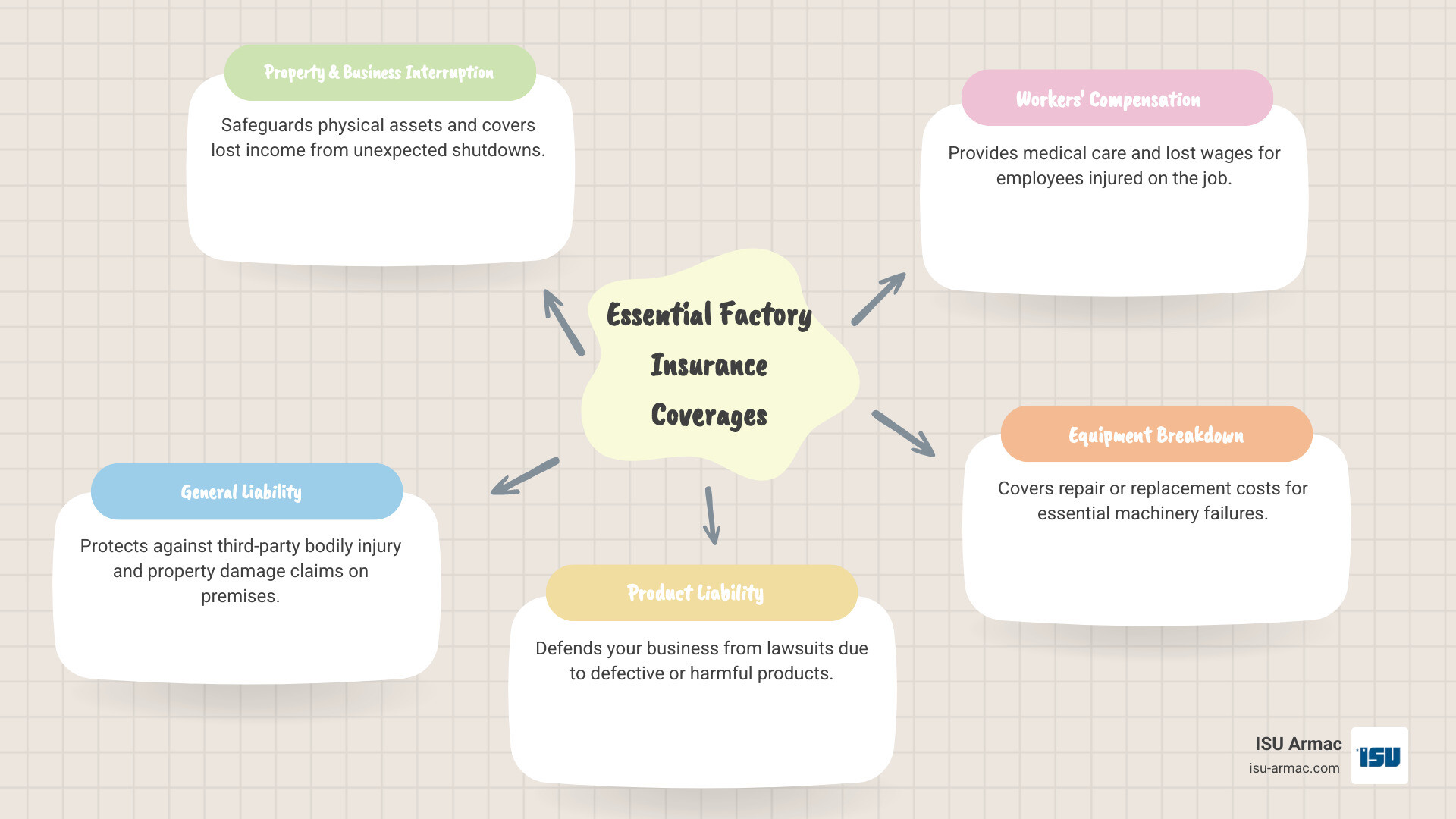
Insurance for factory operations protects your business from the unique risks of manufacturing—from damaged equipment and injured workers to product liability lawsuits and natural disasters. Here’s what factory insurance typically covers:
- Property Insurance – Protects buildings, machinery, inventory, and raw materials
- General Liability – Covers third-party injury and property damage claims
- Product Liability – Defends against claims from defective products
- Workers’ Compensation – Required coverage for employee injuries
- Business Interruption – Replaces lost income during shutdowns
- Equipment Breakdown – Covers repair or replacement of critical machinery
- Cyber Liability – Protects against data breaches and digital threats
The manufacturing sector drives our economy, but it’s an environment filled with significant risks. Your factory represents a major investment—expensive machinery, valuable inventory, complex supply chains, and a dedicated workforce. A single unexpected event can shut down production and threaten everything you’ve built.
Whether it’s a critical equipment failure that halts your production line, a product defect that leads to a costly lawsuit, or a natural disaster that damages your facility, the financial impact can be devastating. The average Business Owner’s Policy for manufacturers costs just $126 per month, but the protection it provides is worth exponentially more when disaster strikes.
Many factory owners in Victorville and throughout Southern California face a common challenge: finding comprehensive coverage that protects against all their risks without breaking the budget. You need insurance that fits your specific manufacturing operations—whether you’re in food processing, metalworking, plastics production, or any other specialty.
I’m Ryan McEachron, CEO of ISU Armac in Victorville, and I’ve spent decades helping local business owners secure the right insurance for factory operations across our region. Through my work with the Victorville Chamber of Commerce and Planning Commission, I’ve seen how proper coverage protects manufacturers and keeps our local economy strong.
This guide breaks down everything you need to know about factory insurance—from understanding your core risks to choosing the right coverage limits, managing costs, and working with specialized providers who understand manufacturing. By the end, you’ll know exactly how to build a comprehensive insurance program that shields your factory from financial catastrophe.
Similar topics to insurance for factory:
Understanding Key Risks and the Role of Manufacturing Insurance

Manufacturing insurance isn’t just one policy; it’s a carefully crafted portfolio of coverages designed to shield your business from the unique and often complex risks it faces. It’s the financial backbone that allows you to recover from property damage, defend against costly liability claims, and maintain crucial business continuity. Without this comprehensive protection, a factory in Victorville, Hesperia, or anywhere in Southern California is exposed to potentially catastrophic financial losses that could force its doors shut permanently.
Why is Insurance Crucial for Your Factory?
Every manufacturing operation, from precision metalworking in Apple Valley to food processing plants in Oak Hills, is a “well-oiled machine” that relies on critical equipment and seamless processes. Yet, even the most meticulous operations face constant threats. Unexpected events like a devastating power surge, a catastrophic storm, or even a simple human error can bring production to a grinding halt.
Here’s why robust insurance for factory operations isn’t just an expense, but an essential investment:
- Financial Safety Net: It provides the funds needed to repair or replace damaged property, cover legal defense costs, and compensate for lost income after a covered event. This prevents a single incident from derailing your entire financial stability.
- Operational Resilience: With the right coverage, you can quickly get back to business as usual after a disruption. This minimizes downtime, preserves customer relationships, and protects your market share.
- Legal and Contractual Requirements: Many types of insurance for factory are legally mandated (like workers’ compensation) or required by contracts with suppliers, clients, or lenders. Without them, you could face hefty fines or lose crucial business opportunities.
- Employee Protection: Ensuring your workforce is protected in case of injury or illness shows you care, boosting morale and fulfilling your legal obligations.
- Key Risks Covered: Your policy can cover a wide spectrum of potential exposures, including:
- Property damage: Protecting your physical assets from fire, theft, vandalism, and natural disasters.
- Bodily injury claims: Covering legal fees and settlements if a third party is injured on your premises.
- Product defects: Defending against lawsuits if a product you manufacture causes harm.
- Business interruption: Replacing lost income and covering ongoing expenses during a temporary shutdown.
For a deeper dive into how different commercial insurance services can benefit your manufacturing business, explore our More info about commercial insurance services.
Common Liabilities and Exposures in Manufacturing
While the products manufactured in Southern California vary greatly, the underlying risks often differ more in degree than in kind. Manufacturers face a wide spectrum of potential exposures, including:
- Slips and falls on premises: Visitors, clients, or delivery personnel can suffer injuries on your property, leading to liability claims.
- Employee injuries from machinery: Factory environments, by nature, involve heavy machinery and repetitive tasks, increasing the risk of workplace accidents.
- Damage from defective products: A faulty component or design flaw in your product can lead to injuries or property damage for consumers, triggering expensive product liability lawsuits.
- Environmental contamination: Manufacturing processes can sometimes involve hazardous materials, leading to potential pollution or environmental damage claims, which are often excluded from standard policies but can be covered via endorsements.
- Data breaches: As factories become more digitized, cyber threats like ransomware can cripple operations, compromise sensitive data, and lead to significant financial losses.
- Vehicle accidents: If your business uses vehicles for transport, deliveries, or sales, accidents can lead to property damage, bodily injury claims, and legal costs.
- Supply chain failures: Disruptions in the supply chain, whether due to a natural disaster affecting a supplier or geopolitical events, can halt your production and impact your bottom line.
Core Coverages for Comprehensive Factory Protection
This section breaks down the essential policies that form the foundation of a robust manufacturer insurance program. Each coverage addresses a specific category of risk, working together to create a comprehensive safety net for your operations.
Commercial Property & Business Interruption Insurance

Your factory building, its contents, and the materials within are the heart of your operation. Commercial Property Insurance protects these vital physical assets, including:
- The factory building itself, whether you own or lease it. If you rent, it covers your tenants’ improvements and betterments.
- Machinery, equipment, and tools.
- Raw materials, goods in production, and finished inventory. Insurers often require periodic reporting of inventory values to ensure accurate claims settlement after a loss.
- Electronic data, which can include protection against computer viruses and harmful code, as well as the cost to restore lost data.
This coverage shields your business from common perils like fire, theft, vandalism, and natural disasters. However, direct damage isn’t the only concern. What happens if a fire forces your factory to close for months? That’s where Business interruption coverage (also known as Business Income and Extra Expense Insurance) becomes absolutely critical. It replaces lost income and covers ongoing operating expenses—like payroll, rent, and utilities—if a covered event forces a temporary shutdown. This ensures you can rebuild and recover without facing financial ruin, turning “business at risk” back into “business as usual.” We help manufacturers throughout Southern California ensure they have adequate coverage for property damage and business interruption, protecting their vital assets and revenue streams.
General Liability & Product Liability Insurance
General liability insurance is a foundational policy for any business, covering third-party claims of bodily injury or property damage occurring on your premises or as a result of your operations. For example, if a client slips and falls in your Hesperia factory, or if a delivery driver accidentally damages a wall while backing up, general liability helps cover medical expenses, repair costs, and legal fees.
However, for manufacturers, product liability insurance is absolutely essential and often the most critical component of their coverage. This insurance protects your business against claims that a product you manufactured, distributed, or sold caused bodily injury or property damage to a third party. Consider a scenario where a faulty part in a machine you produced leads to an injury on a customer’s factory floor. Product liability coverage provides for legal defense and payment of damages if a lawsuit charges that your product caused harm. Without it, a single defective product could lead to devastating financial consequences for your Southern California factory.
The distinction between general liability and product liability is important: general liability covers incidents related to your premises or general operations, while product liability specifically addresses claims arising from your manufactured goods after they’ve left your control.
Workers’ Compensation Insurance
A legal requirement in almost every state, including California, workers compensation insurance is paramount for factories. It provides crucial benefits to employees who suffer work-related injuries or illnesses. This coverage typically includes:
- Medical expenses for treatment, rehabilitation, and medication.
- Lost wages if an employee is unable to work due to the injury.
- Disability benefits for long-term or permanent impairments.
- Death benefits for dependents in tragic cases.
Beyond providing for your employees, workers’ compensation also protects your business. In exchange for these benefits, employees typically cannot sue their employer for work-related injuries, shielding your factory from potentially ruinous lawsuits. For businesses in Victorville, Apple Valley, or Oak Hills with three or more employees, check with the California Department of Workers’ Compensation to ensure full compliance.
Equipment Breakdown & Cyber Liability Insurance
Modern factories in Southern California are highly reliant on sophisticated, often custom-built, machinery and interconnected digital systems. This reliance introduces specific risks that traditional property insurance might not fully cover.
Equipment Breakdown Coverage is designed for the scenario where your critical machinery suddenly malfunctions. Unlike standard property insurance that covers damage from external perils (like fire), equipment breakdown insurance pays for the repair or replacement of essential equipment after an internal mechanical or electrical failure, boiler explosion, or even operator error. This could be anything from a crucial CNC machine in a metalworking plant to a refrigeration unit in a food processing facility. Given the long lead times and high costs associated with specialized factory equipment, this coverage is indispensable.
In today’s digital landscape, Cyber Liability Insurance is no longer a luxury but a necessity. Factories are increasingly vulnerable to cyber threats, including data breaches, ransomware attacks, and disruptions to operational technology (OT) systems. A cyberattack can cripple production, expose sensitive company data, and lead to significant financial losses from downtime, data recovery costs, and regulatory fines. Cyber liability insurance helps cover these costs, including forensic investigation, legal defense, notification expenses, and even business interruption due to a cyber event. For example, if a ransomware attack locks down your production line, this insurance can help cover the lost income.
Customizing Your Insurance for Factory Operations
No two factories are the same, and your insurance for factory operations shouldn’t be either. Choosing the right policy involves a detailed assessment of your specific operations, unique risks, tolerance for risk, and budget. This ensures you aren’t overpaying for coverage you don’t need or, worse, leaving critical gaps in your protection.
Factors That Influence the Cost of Your insurance for factory
The cost of your insurance for factory is influenced by a variety of factors, reflecting the unique risk profile of your business. Understanding these can help you manage your premiums effectively:
- Industry Type: Different manufacturing sectors carry different inherent risks. For instance, a food processing plant might have higher product recall and spoilage risks, while a metalworking facility faces greater machinery breakdown and fire hazards.
- Annual Revenue: Generally, higher revenue indicates a larger operation with more assets and potential liabilities, which can lead to higher premiums.
- Number of Employees: More employees mean a higher potential for workers’ compensation claims and general liability exposures.
- Claims History: A history of frequent or large claims will likely result in higher premiums, as it signals a higher risk to insurers.
- Safety Protocols: Factories with robust safety programs, regular employee training, and a strong safety culture often qualify for lower rates.
- Coverage Limits and Deductibles: Choosing higher liability limits provides more protection but increases premiums. Opting for a higher deductible (the amount you pay out-of-pocket before insurance kicks in) can lower your premium.
- Location: Geographic location plays a role, with areas prone to natural disasters (like wildfires or earthquakes in Southern California) potentially facing higher property insurance costs.
While the average cost of a Business Owner’s Policy (BOP) for manufacturers is around $126 per month, or $1,517 per year, this is just an average. Your specific premium will be custom to your factory’s unique characteristics. To get a clearer picture of potential costs and to understand how different factors impact your premiums, you can Learn more about business insurance cost.
The Role of Risk Management in Your insurance for factory
Insurance for factory operations is a safety net, but proactive risk management is your first line of defense. It’s a powerful partnership between your business and your insurer, aimed at preventing incidents before they occur. Implementing robust safety programs, conducting regular employee training, and carefully maintaining equipment not only prevents accidents but can also significantly lower your insurance premiums.
For example, a factory that invests in comprehensive safety training, performs regular hazard assessments, and has a strong safety committee demonstrates a commitment to preventing losses. Insurers recognize these efforts, often rewarding them with more favorable rates. This is especially true for workers’ compensation, where a strong safety record directly translates to fewer claims and lower premiums. A strong safety culture isn’t just good for business; it’s good for your bottom line. We work closely with our Southern California clients to help them identify potential risks and implement effective mitigation strategies, creating a safer environment and potentially reducing insurance costs.
Is a Business Owner’s Policy (BOP) Right for Your Factory?
A business owners policy (BOP) is a convenient and often cost-effective package that bundles general liability and commercial property insurance into a single policy. For many small to medium-sized manufacturers in Southern California, a BOP can be an excellent starting point, providing essential coverage at a reduced rate compared to purchasing policies separately.
A BOP typically protects against customer injuries and property damage, along with damage to your facility and inventory. It often includes basic electronic data coverage and business income/extra expense insurance. For example, the average policy limits for a manufacturer’s BOP are $1 million per occurrence and $2 million aggregate, with an average deductible of $500.
However, while a BOP is a great starting point for smaller, lower-risk manufacturers, many factories—especially those with complex operations, specialized machinery, or significant product liability exposure—require more specialized coverage and higher limits than a standard BOP can provide. Endorsements like equipment breakdown coverage or product recall insurance might be necessary additions. It’s crucial to evaluate if a BOP meets all your needs or if a more customized package is appropriate. A guide for small manufacturers can provide valuable insights on this topic, such as the one found here: A guide for small manufacturers.
Advanced Coverages and Specialized Solutions
Beyond the core policies, several specialized coverages can address the nuanced risks inherent in the manufacturing industry. Working with an experienced insurance provider, like us at ISU Armac, helps identify which of these are necessary for your specific operation in Victorville, Hesperia, or throughout Southern California.
Managing Supply Chain and Operational Risks
In today’s interconnected global economy, a factory’s operations can be significantly impacted by events far beyond its premises. Supply chain disruptions can cripple production even without direct damage to your facility. Imagine a key supplier overseas being hit by a natural disaster, or a critical component being delayed indefinitely. This is where specialized insurance for factory coverages step in:
- Contingent Business Interruption (CBI) Insurance: This coverage can be a lifesaver. It covers your lost income and ongoing expenses if a key supplier, customer, or even a crucial utility provider suffers a covered loss that impacts your ability to produce. It helps manufacturers manage supply chain disruptions and other operational risks by providing financial relief when external events directly affect their bottom line.
- Commercial Auto Insurance: If your factory owns or leases vehicles for transporting raw materials, delivering finished products, or for sales personnel, a robust commercial auto insurance policy is absolutely vital. Personal auto policies typically won’t cover vehicles used primarily for business or owned by the business. This policy protects against property damage, bodily injury, and legal costs stemming from accidents involving your company vehicles.
General Liability vs. Professional Liability (E&O)
While we’ve already discussed general liability, it’s important to clarify its distinction from professional liability, also known as Errors and Omissions (E&O) insurance, especially for manufacturers who may offer design or consulting services.
- General Liability Insurance: As established, this policy covers claims of bodily injury or property damage to third parties that occur on your premises or due to your general operations. It’s about physical harm or damage.
- Professional Liability (E&O) Insurance: This coverage is different. It doesn’t cover physical injury or property damage. Instead, it protects your business against claims of financial loss due to a professional error, omission, or negligence in the services you provide. If your factory offers design, engineering, or consulting services as part of its manufacturing process (e.g., designing a custom machine for a client, or providing expert advice), errors and omissions insurance is critical. For example, if a design flaw in a custom product you engineered causes a client significant financial loss, E&O would help cover your legal defense and potential damages.
Here’s a quick comparison:
| Coverage Type | What it Covers |
|---|---|
| General Liability | Bodily Injury to third parties, Property Damage to third parties, Personal & Advertising Injury (e.g., libel) |
| Professional Liability | Financial Loss due to professional negligence, Errors in Service, Omissions in advice or design |
Frequently Asked Questions about Factory Insurance
We often hear similar questions from our manufacturing clients in Southern California. Here are some of the most common ones we address:
How much insurance coverage does a factory need?
The “right” amount of insurance for factory operations isn’t a one-size-fits-all answer. It depends heavily on several factors unique to your business: the size of your factory, the total value of your property and equipment, your annual revenue, the number of employees, and the specific risks inherent to your industry. A thorough risk assessment conducted by an experienced insurance professional is the best way to determine adequate limits that truly protect your investment without overspending. We’re here to help you steer this process.
Are there specific insurance requirements for food processing factories?
Yes, absolutely. Food processing plants, whether in Hesperia or elsewhere, face unique risks that necessitate specialized coverage. Beyond standard policies, these businesses often require:
- Product Recall Coverage: Essential for covering the significant costs associated with recalling contaminated or mislabeled food products.
- Spoilage Coverage: Important for protecting perishable goods in case of refrigeration failure or power outages.
- Higher Liability Limits: Due to the severe health risks associated with foodborne illnesses, food processors often need higher general and product liability limits.
- Contamination Coverage: Protection against accidental or malicious contamination of food products.
These specific requirements ensure that food processing facilities are adequately protected against the unique challenges of their industry.
How can I lower my factory’s insurance premiums?
There are several effective strategies to potentially lower your insurance for factory premiums while maintaining robust protection:
- Implement a Formal Safety Program: A well-documented and actively enforced safety program, including regular employee training and hazard assessments, demonstrates a commitment to risk reduction and can lead to lower workers’ compensation and general liability premiums.
- Maintain a Clean Claims History: Fewer claims directly translate to lower premiums over time. This reinforces the importance of risk management.
- Install Fire and Security Systems: Advanced fire suppression systems, sprinkler systems, and comprehensive security measures (alarms, surveillance) can significantly reduce property damage risks and thus property insurance costs.
- Choose Higher Deductibles: By agreeing to pay a larger amount out-of-pocket before your insurance kicks in, you can often reduce your annual premium. This strategy requires careful consideration of your financial capacity to absorb potential losses.
- Bundle Policies: Combining multiple policies, such as general liability and commercial property into a Business Owner’s Policy (BOP), can often result in discounts.
- Work with an Independent Agent: We, as independent agents at ISU Armac, can shop multiple carriers to find the best rates and coverage options custom to your specific needs, ensuring you get competitive pricing.
Secure Your Factory’s Future Today
Protecting your factory with the right insurance for factory operations is one of the most important business decisions you will make. It’s not merely an expense; it’s a strategic investment that ensures your ability to withstand unexpected challenges, recover from devastating events, and continue operating for years to come. In the dynamic manufacturing landscape of Southern California, having comprehensive coverage means peace of mind and financial security.
Navigating the complexities of commercial insurance can be daunting, but you don’t have to do it alone. The experts at ISU Armac specialize in creating customized insurance solutions for manufacturers. We understand the unique risks faced by factories in Victorville, Hesperia, Apple Valley, and Oak Hills, and we pride ourselves on shopping multiple carriers to find the perfect blend of coverage and value for your unique needs. Our goal is to ensure your factory is shielded from every angle, allowing you to focus on what you do best: manufacturing.
Ready to build a comprehensive shield for your business? Contact us today to discuss your manufacturer insurance needs and get a personalized quote. Let us help you secure your factory’s future.