
Why Second Home Insurance Requires a Different Approach
Second home insurance protects properties that aren’t your primary residence, such as vacation homes, rental properties, or weekend retreats. It differs significantly from your primary policy. Here’s what you need to know:
- Separate policy required: Your primary homeowners insurance won’t cover a second home due to different risk factors.
- Higher premiums: Second homes typically cost more to insure because of increased vacancy, location risks (beaches, mountains), and delayed damage detection.
- Specialized coverage: Policies often use Dwelling Fire forms (DP-1, DP-2, DP-3) with more limited liability and personal property coverage.
- Additional considerations: You may need extra coverage for rentals, flood zones, or extended vacancy periods (usually over 30 days).
- Lender requirements: If financed, your mortgage company will require adequate buildings coverage.
Second homes face unique vulnerabilities, from burst pipes going unnoticed to higher theft risk. Standard homeowners policies don’t account for these increased risks. This guide will walk you through policy types, coverage details, and cost-saving strategies to protect your investment.
I’m Ryan McEachron, Chief Executive Officer of ISU Insurance Services ARMAC Agency in Victorville. I’ve helped countless property owners secure the right second home insurance that balances protection with affordability. Let’s break down what you need to know.
What is Second Home Insurance and Why Is It Different?
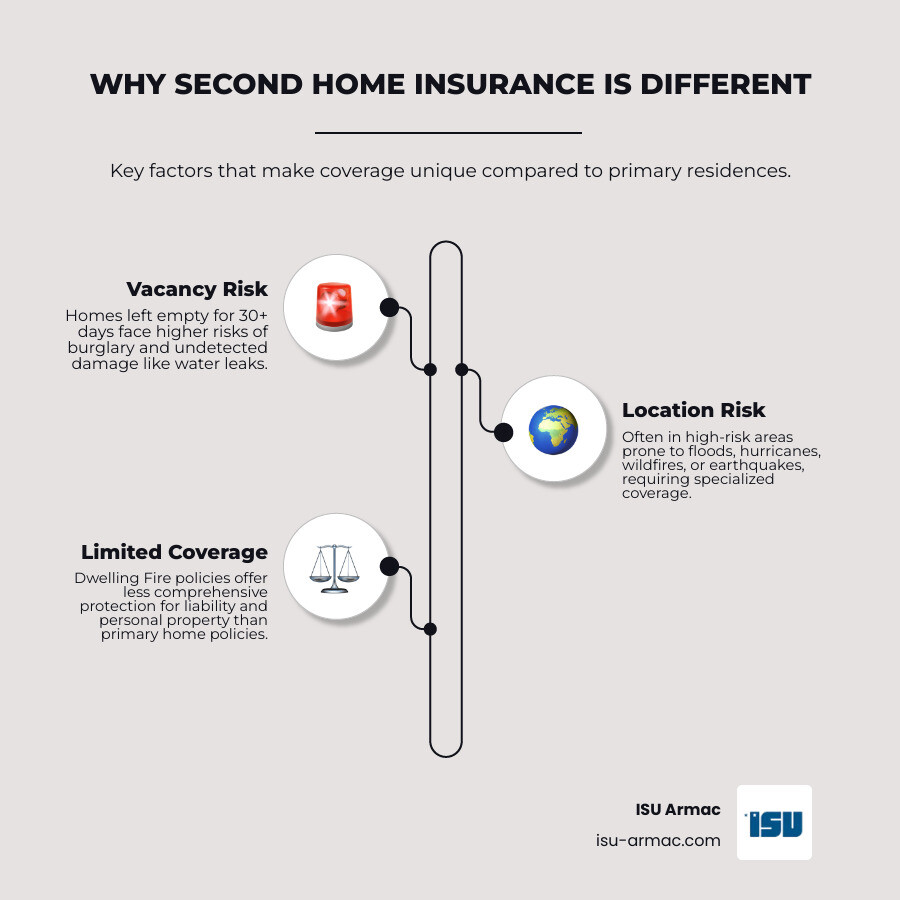
Second home insurance is a specialized policy for residences you don’t live in full-time, like a vacation home or rental property. It’s necessary because these properties have a different risk profile than your primary home.
The main difference is occupancy. A primary residence is consistently occupied, meaning problems are spotted quickly. Second homes often sit empty for weeks or months, increasing the risk of undetected damage, like a slow water leak or a broken window. Insurance companies refer to this as a “higher risk profile.”
Location also plays a major role. Many second homes are in areas prone to natural disasters like hurricanes, wildfires, or earthquakes, which standard policies may not cover adequately. Due to these factors, second home insurance typically costs more and may offer more limited coverage than a primary policy, but it’s custom to the property’s actual risks. For more on standard coverage, visit our Home Insurance page.
Why your primary policy isn’t enough
Your primary homeowners policy is designed for one specific address and assumes regular occupancy. Attempting to extend it to a second home is problematic for several reasons:
- Policy Limitations: Most policies explicitly state that coverage applies only to your primary dwelling. A claim on a second property would likely be denied.
- Unique Risks: Vacation homes and rental properties have different liability exposures and tenant-related risks that standard policies exclude.
- Lender Requirements: If you have a mortgage on your second home, the lender will mandate a separate, adequate insurance policy to protect their collateral.
- Tax Implications: The IRS treats second homes differently, and insurance policies are structured to reflect these distinctions.
The increased risks of a second property

The risks associated with a second property are significantly higher due to its intermittent use.
- Vacancy Risk: An unoccupied home is vulnerable. A burst pipe that would be a minor issue if caught immediately can cause tens of thousands in damage if it leaks for days. It’s important to understand the difference between unoccupancy (temporary absence) and vacancy (empty with no intent of immediate return). Most policies restrict coverage if a home is vacant for more than 30-60 days.
- Burglary and Vandalism: Empty homes are prime targets for criminals. Accumulated mail and a lack of activity signal that no one is around.
- Weather Damage: A small roof leak from a storm can lead to major structural damage, ruined furniture, and mold growth if left unattended.
- Delayed Findy: Minor issues like a slow leak, an electrical problem, or a pest infestation can become catastrophic because they aren’t finded early.
These heightened risks are why second home insurance is a distinct product with pricing and coverage that reflects the reality of part-time occupancy.
Understanding Your Coverage: Policy Types and Common Exclusions
Understanding what your second home insurance covers—and what it excludes—is critical. While it shares basic elements with a primary policy, the details differ significantly.
- Dwelling Coverage: Protects the physical structure of your home, from the foundation to the roof.
- Other Structures Coverage: Covers detached buildings like a garage or shed.
- Personal Property Coverage: Protects your belongings inside the home. This coverage is often more limited than in a primary policy, so pay close attention if you have high-value items.
- Loss of Use Coverage: Also known as Fair Rental Value, this reimburses you for lost rental income if a covered event makes your property uninhabitable.
- Personal Liability Coverage: Protects you financially if someone is injured on your property and you are held responsible. Some policies offer this only as an add-on.
Dwelling Fire Policies: DP-1, DP-2, and DP-3
Unlike primary homes, which typically use an HO-3 policy, second homes are usually insured with dwelling fire policies designed for non-owner-occupied properties.
- DP-1 (Basic Form): This is a “named perils” policy, offering the most limited coverage. It only protects against specific perils listed in the policy, such as fire and lightning. It’s affordable but provides minimal protection.
- DP-2 (Broad Form): Also a “named perils” policy, but it covers more risks than the DP-1, including freezing pipes and falling objects.
- DP-3 (Special Form): This is the best option and the one we most often recommend. It provides “open perils” coverage for the dwelling, meaning it covers all causes of loss unless they are specifically excluded. This offers far more comprehensive protection for the structure itself. Personal property is typically covered on a named perils basis, similar to a DP-2.
Common exclusions in a second home insurance policy
Even the best policy has exclusions. You will likely need separate coverage for these common risks:
- Flood Damage: Standard policies do not cover flooding. You’ll need a separate policy through the National Flood Insurance Program (NFIP) or a private insurer, especially for coastal or riverside properties.
- Earthquake Damage: Damage from earthquakes, landslides, and other earth movements requires a separate policy or endorsement. Learn more about how natural disasters affect coverage in this article about Damage due to a natural disaster.
- Neglect and Poor Maintenance: Insurers won’t cover damage resulting from a lack of upkeep. Regular property checks are essential to maintain coverage.
- Wear and Tear: Insurance covers sudden and accidental losses, not the gradual deterioration of your property over time.
- Pest Infestations: Damage from termites, rodents, or other pests is not covered.
At ISU Armac, we help you identify these potential gaps and find the right additional coverage to protect your investment.
Key Factors That Influence Your Second Home Insurance Premium
Several key factors determine your second home insurance premium, which is often higher than for a primary residence due to increased risk.

- Location: This is often the biggest driver. A home in a coastal flood zone, a wildfire-prone forest, or an area with severe weather will cost more to insure.
- Age and Construction: Older homes with outdated wiring or plumbing pose higher risks. The construction materials also matter; a wood-frame home is riskier in a fire zone than a masonry one.
- Rebuild Cost: This is the cost to rebuild your home from scratch, not its market value. Higher rebuild costs lead to higher premiums.
- Claims History: A history of claims on the property (even from a previous owner) or by you personally can increase your rates.
- Credit Score: In many states, insurers use an insurance score derived from your credit history to predict claim likelihood. A higher score can lead to lower premiums.
How occupancy impacts your rates
How you use your second home directly affects your premium. A property used seasonally and left vacant for long periods is more vulnerable to undetected damage, break-ins, and other issues, leading to higher rates. A home with year-round access that is visited frequently is considered less risky.
Be aware of vacancy clauses in your policy, which can limit or void coverage if the home is empty for more than 30 to 60 days. If you anticipate longer vacancies, you may need a specialized endorsement or policy. Our Vacant Home Insurance Coverage Guide provides more detail on this topic.
The role of amenities and attractive nuisances
Features that make your second home enjoyable can also increase your insurance costs by adding risk. These are sometimes called “attractive nuisances.”
- Pools and Hot Tubs: These significantly increase liability risk. Insurers will require safety measures like fencing and self-latching gates, and your premium will likely be higher.
- Trampolines: Due to a high risk of injury, some insurers won’t cover properties with trampolines, while others charge a higher premium and require safety nets.
- Other Features: Private docks, outdoor kitchens, large decks, and even fireplaces can increase property and liability risks, impacting your rate.
It’s crucial to inform your agent about these amenities to ensure you have proper coverage.
Tailoring Your Policy for Rentals and Special Risks
Renting out your second home is a great way to generate income, but it requires specialized insurance. A standard second home insurance policy does not cover rental activities.
When you rent your property, you’re operating a business with unique liability and property risks. You need coverage that protects your investment and your rental income.
- Landlord Insurance: This is for properties rented to long-term tenants. It covers the dwelling, your liability, and loss of rental income if the home becomes uninhabitable due to a covered event. It does not cover the tenant’s belongings.
- Short-Term Rental Coverage: For properties listed on platforms like Airbnb or VRBO, you need coverage designed for high turnover and unique guest-related risks. Platform-provided insurance is limited and should not be your only protection. Depending on your rental frequency, you may need a home-sharing endorsement, a specialized short-term rental policy, or a commercial policy.
Insuring a short-term vs. long-term rental
The right insurance depends on the length of the rental agreement.
- Long-Term Rentals (6+ months): A dedicated landlord insurance policy is best. It protects you as the property owner and covers the structure, liability, and loss of rent. We recommend requiring tenants to have their own renters insurance.
- Short-Term Rentals: These present higher risks due to frequent guest turnover.
- For occasional renting, a home-sharing endorsement on your second home insurance may be sufficient.
- For frequent renting, you’ll likely need a specialized short-term rental policy that covers guest-caused damage, liability, and lost income.
- If the property is a full-time vacation rental business, a commercial property policy might be necessary for the most robust coverage.
For more guidance, read our article: What type of insurance do I need if I rent out my second home?.
Navigating deductibles for your second home insurance
A deductible is the amount you pay out-of-pocket before your insurance coverage begins. For second home insurance, deductibles can be more complex.
- Standard Deductible: A flat dollar amount (e.g., $1,000 or $2,500). A higher deductible lowers your premium.
- Percentage Deductibles: Common for high-risk locations, these are calculated as a percentage (e.g., 1-5%) of your dwelling coverage limit. This can result in a much higher out-of-pocket cost.
- Hurricane/Wind Deductibles: In coastal or storm-prone areas, a 2% deductible on a $400,000 home would mean you pay the first $8,000.
- Earthquake Deductibles: In earthquake zones, these can be very high (10-25% of dwelling coverage), meaning a significant out-of-pocket expense.
It’s vital to review all deductibles in your policy to understand your financial responsibility in a disaster. We can help you understand these details clearly.
Actionable Strategies to Lower Your Premium
While second home insurance can be more expensive, you can take proactive steps to lower your premium without sacrificing coverage. Insurers reward homeowners who reduce risk.
- Bundle Your Policies: Combining your second home, primary home, and auto insurance with one carrier can lead to significant discounts, often 10-25%.
- Install Security and Smart Home Devices: A centrally monitored alarm system can earn discounts of 5-20%. Smart devices like water leak detectors and smart thermostats also qualify for savings by preventing common, costly claims.
- Increase Your Deductible: Agreeing to a higher out-of-pocket cost in the event of a claim (e.g., moving from a $1,000 to a $2,500 deductible) will lower your annual premium.
- Perform Regular Home Maintenance: A well-maintained home is less likely to have claims. Keeping the roof, plumbing, and electrical systems in good shape can prevent major issues and may even qualify you for discounts.
- Shop Around for Quotes: Rates for second home coverage vary widely between carriers. Working with an independent agency like ISU Armac allows you to compare multiple quotes to find the best value.
Proactive safety and security measures
Implementing safety features demonstrates to insurers that you are a responsible homeowner, which can lead to lower premiums.
- Alarm Systems: A centrally monitored system that alerts authorities to break-ins, fire, or carbon monoxide is a powerful tool for protection and savings.
- Water-Leak Sensors: These inexpensive devices can prevent catastrophic water damage—one of the most common claims for vacant homes.
- Storm Shutters and Fire-Resistant Materials: In high-risk areas, storm shutters can prevent wind damage, while fire-resistant roofing can lower premiums in wildfire zones. These upgrades protect your property and reduce your insurance costs.
The importance of shopping your policy
Never assume your current insurer offers the best rate. The second home insurance market is specialized, and each company prices risk differently. One carrier might offer great rates for mountain cabins, while another specializes in coastal properties.
This is where an independent agency like ISU Armac provides immense value. We are not tied to one company; we work for you. We shop the market, comparing quotes and coverage from multiple carriers to find the policy that best fits your needs and budget.
We also recommend annual policy reviews. As your needs change and the market shifts, we can ensure you continue to have the best coverage at the most competitive price, potentially uncovering hundreds in savings.
Conclusion
Your second home is a significant investment and a source of enjoyment. Protecting it with the right second home insurance is essential.
As we’ve covered, a standard homeowners policy is insufficient for a second property due to the unique risks of vacancy, location, and rental use. Understanding policy types like the DP-3, being aware of common exclusions, and knowing what factors drive your premium are key to making informed decisions. You can actively lower your costs by bundling policies, installing safety devices, and choosing the right deductible.
The most important takeaway is that second home insurance is not one-size-fits-all. Your property’s specific use and location demand customized coverage.
At ISU Armac, serving Victorville and communities throughout Southern California like Apple Valley, Hesperia, and Oak Hills, we specialize in navigating these complexities. We work for you, not an insurance company, shopping multiple carriers to find the best protection at the most competitive rate. We provide clear, straightforward advice to ensure your investment is secure.
Don’t leave your second home vulnerable. If you have a property that will be empty for an extended period, review our complete guide to vacant home insurance.
Ready to get started? Contact ISU Armac today for a personalized quote. Let’s protect what you’ve worked so hard to build.