
Why Retirees Need More Than Original Medicare
The best supplemental health insurance for retirees typically includes Medicare Supplement (Medigap) Plan G, Plan F (if eligible before 2020), or Plan N, which help cover out-of-pocket costs Original Medicare doesn’t pay:
| Plan Type | Best For | Average Monthly Premium | Key Coverage |
|---|---|---|---|
| Plan G | Most new retirees | $180/month | Covers all gaps except Part B deductible ($257 in 2025) |
| Plan F | Those eligible before 2020 | $227/month | First-dollar coverage, including Part B deductible |
| Plan N | Budget-conscious retirees | $137/month | Similar to Plan G but with small copays ($20 office, $50 ER) |
| High-Deductible Plan G | Healthy retirees | $52/month | Same as Plan G after meeting $2,870 deductible |
Medicare Part A and Part B cover about 80% of your healthcare costs. The remaining 20% can add up fast, especially if you face hospitalization, chronic illness, or frequent doctor visits. That’s the gap that leaves many retirees vulnerable to unexpected medical bills.
Supplemental health insurance for retirees—specifically Medicare Supplement (Medigap) plans—exists to fill those gaps. These standardized policies work alongside Original Medicare to cover copayments, coinsurance, and deductibles. They offer financial predictability, which is crucial when living on a fixed retirement income.
Unlike Medicare Advantage plans, Medigap policies don’t restrict you to provider networks. You can see any doctor who accepts Medicare, anywhere in the country. There are no referrals required. You simply show your Medicare card and your Medigap card, and your out-of-pocket costs are dramatically reduced or eliminated.
The challenge? Choosing the right plan from the ten standardized options (Plans A, B, C, D, F, G, K, L, M, and N) and finding a reputable insurance carrier at the best price. Premiums for the same plan letter can vary significantly between companies, and enrollment timing matters—a lot.
I’m Ryan McEachron, Chief Executive Officer of ISU Insurance Services ARMAC Agency in Victorville, and I’ve helped countless local retirees steer the complexities of finding the best supplemental health insurance for retirees to protect their health and savings. In this guide, I’ll walk you through everything you need to know to make an informed decision.
Basic best supplemental health insurance for retirees glossary:
Understanding Supplemental Health Insurance: Medicare Supplement (Medigap) Essentials

When we talk about the best supplemental health insurance for retirees, we’re primarily referring to Medicare Supplement Insurance, also known as Medigap. This isn’t just another layer of insurance; it’s a strategic financial tool designed to shield you from the unpredictable costs that Original Medicare (Parts A and B) doesn’t cover.
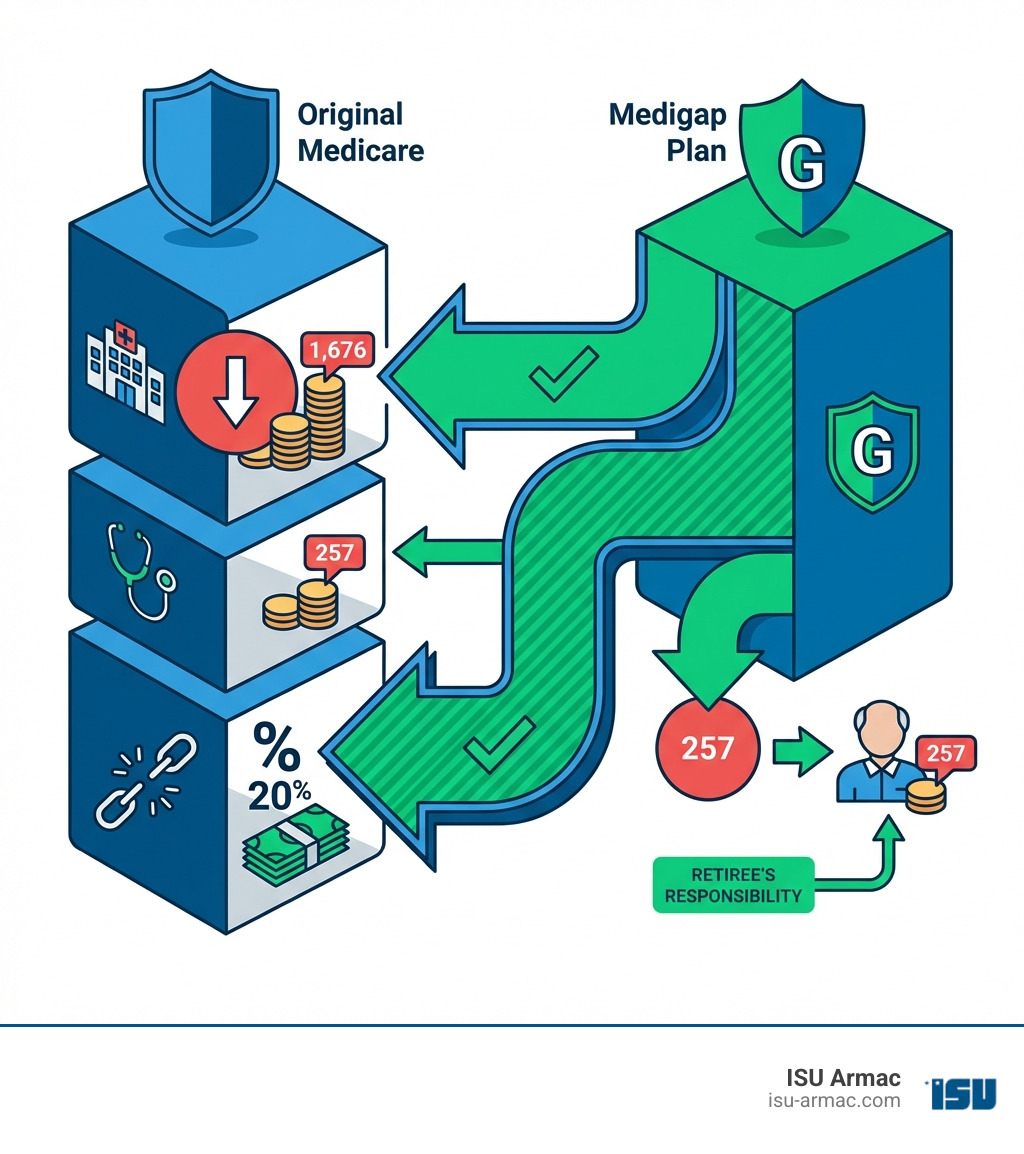
So, what exactly is Medigap insurance? It’s extra insurance you can buy from a private company that helps pay your share of costs for approved services under Original Medicare. Think of it this way: Original Medicare covers a significant portion of your healthcare expenses, typically around 80% for many services after you meet your deductibles. But what about the remaining 20%? That’s where Medigap steps in.
How does it work with Original Medicare? It’s fairly straightforward. First, Original Medicare pays its share for your healthcare costs. Then, your Medigap policy pays its share. This means less out-of-pocket spending for you. This seamless coordination is a major reason why many retirees choose Medigap. You’ll continue to use your Original Medicare card at any doctor or hospital nationwide that accepts Medicare, and your Medigap policy works in the background to pick up the remaining eligible costs.
Medigap plans are sold by private insurance companies, but they are regulated by federal and state laws. This ensures a level of standardization that makes comparing plans simpler than you might imagine. While these private companies offer the plans, Medicare itself remains your primary payer.
The out-of-pocket costs that Medigap plans help cover can be substantial. These often include the Medicare Part A deductible for hospital stays, the Medicare Part B coinsurance (that 20% we mentioned), and other deductibles and copayments. Some plans even cover emergency medical care when you travel outside the United States, which is a huge bonus for our adventurous retirees in Southern California who love to explore! You can learn more about what Medigap plans cover here.
However, it’s crucial to understand Medigap’s limitations. While incredibly helpful, Medigap plans do not cover everything. Specifically, they do not cover long-term care, vision or dental care, hearing aids, glasses, private-duty nursing, or prescription medication costs. For prescription drugs, you’ll need to enroll in a separate Medicare Part D plan. Many retirees also choose to combine their Medigap plan with a standalone dental or vision plan to ensure comprehensive coverage.
It’s also important to distinguish Medigap from other types of coverage, most notably Medicare Advantage (Part C) plans. You cannot have both a Medicare Advantage plan and a Medigap plan. Medicare Advantage plans are an alternative way to receive your Medicare benefits, often bundling Part A, Part B, and sometimes Part D, along with extra benefits like dental or vision. However, they often come with network restrictions and referrals. Medigap, on the other hand, works with Original Medicare, allowing you the freedom to choose any doctor or hospital that accepts Medicare. For many retirees in Apple Valley, Victorville, Hesperia, and Oak Hills, this flexibility is invaluable.
A Deep Dive into Medicare Supplement Plans: From A to N
Understanding the alphabet soup of Medicare Supplement plans might seem daunting at first glance, but we’re here to simplify it for you. There are ten standardized Medigap plans, identified by letters A through N. What’s truly remarkable about these plans is their standardization: a Plan G from one insurance company offers the exact same basic benefits as a Plan G from any other insurance company. This means you don’t have to worry about comparing different benefit packages when looking at the same lettered plan. The only distinction will be the cost, and that not all plans are available in every state.
While the core benefits are identical, the premiums, customer service, and added perks can vary significantly between insurance providers. This standardization is a huge advantage for you, as it allows us to focus on finding the most competitive rates and best service in Southern California for the specific plan that meets your needs.
It’s worth noting that while plans are standardized across most of the U.S., Massachusetts, Minnesota, and Wisconsin have different standardization rules. However, for our clients in Southern California, the A-N standardization applies, making your comparison process more straightforward.
Comparing the Most Popular Medicare Supplement Plans
When it comes to the best supplemental health insurance for retirees, certain Medigap plans consistently rise to the top in popularity due to their comprehensive coverage. Let’s explore the plans that most retirees consider:
Plan G: Near-total Coverage
Plan G has become the go-to choice for many new Medicare beneficiaries. It covers nearly all out-of-pocket costs that Original Medicare leaves behind, except for the Medicare Part B deductible. In 2025, the Part B deductible is $257. Once you’ve paid this small annual deductible, Plan G covers 100% of the remaining approved costs, including Part A coinsurance and hospital costs (up to an additional 365 days after Medicare benefits are exhausted), Part B coinsurance, blood (first 3 pints), Part A hospice care coinsurance or copayment, skilled nursing facility care coinsurance, and Part B excess charges. This near-total coverage makes Plan G ideal for enrollees seeking minimal out-of-pocket expenses and maximum peace of mind.Plan F: First-Dollar Coverage (for those eligible)
Medigap Plan F offers the most comprehensive coverage of any Medigap plan, covering all out-of-pocket costs, including the Medicare Part B deductible. This “first-dollar coverage” means you pay virtually nothing for Medicare-approved services after your monthly premium. However, there’s a significant catch: Plan F is no longer available to individuals who became eligible for Medicare on or after January 1, 2020. If you were eligible for Medicare prior to this date, you can still enroll in or keep Plan F. For those who qualify, Plan F is best for retirees who want zero out-of-pocket expenses and are willing to pay a higher premium for that level of predictability. You can verify your eligibility and when to buy a policy here.Plan N: Lower Premiums, Manageable Copays
For cost-conscious retirees who still desire robust coverage, Plan N is an excellent option. It offers lower premiums than Plan G or Plan F, but requires small copayments for certain services. Specifically, you might pay up to $20 for some office visits and up to $50 for emergency room visits that don’t result in an inpatient admission. Another key difference is that Plan N does not cover Medicare Part B excess charges (the difference between what a doctor charges and the Medicare-approved amount, which can happen if your doctor does not accept Medicare assignment). However, in California, doctors are generally not allowed to charge excess charges, making Plan N even more attractive for our local retirees. Plan N pays 100% of the Part B coinsurance, except for these specific copayments. It’s a good choice for those who want a balance between comprehensive coverage and lower monthly premiums and are comfortable with occasional small copays.
Understanding High-Deductible and Cost-Sharing Plans
Beyond the most popular options, other Medigap plans cater to different budget and risk tolerance levels.
High-Deductible Plan G: The Budget-Friendly Big Saver
If you’re a healthy retiree looking for the lowest possible monthly premium, High-Deductible Plan G might be your perfect match. This plan offers the same comprehensive benefits as a standard Plan G, but with a crucial difference: you must pay a significant annual deductible out of pocket before the plan begins to cover any costs. In 2025, this deductible is $2,870. Once you meet this deductible, the plan covers 100% of Medicare-approved costs for the rest of the year. This option is suitable for healthy beneficiaries who don’t anticipate frequent medical care and prefer to save on monthly premiums, accepting the higher initial out-of-pocket risk.Plan K and Plan L: The Cost-Sharing Approach
Plans K and L operate on a cost-sharing model, meaning they cover a percentage of your out-of-pocket costs until you reach an annual limit. For Plan K, it covers 50% of most costs, while Plan L covers 75%. These plans have annual out-of-pocket limits; for 2025, Plan K has a limit of $7,220, and Plan L has a limit of $3,610. Once you meet both your Part B deductible and the plan’s annual out-of-pocket limit, the plan pays 100% of covered services for the remainder of the year. These plans are less common but can be suitable for retirees who want a lower premium than Plan G or F, are comfortable with sharing initial costs, and appreciate the protection of an out-of-pocket maximum.
Here’s a simplified comparison of these key plans:
| Feature | Plan F (if eligible) | Plan G | Plan N | High-Deductible Plan G |
|---|---|---|---|---|
| Part A Deductible | Yes | Yes | Yes | Yes (after deductible) |
| Part B Deductible | Yes | No | No | No (after deductible) |
| Part B Coinsurance | Yes | Yes | Yes (with copays) | Yes (after deductible) |
| Part B Excess Charges | Yes | Yes | No | Yes (after deductible) |
| Skilled Nursing Coinsurance | Yes | Yes | Yes | Yes (after deductible) |
| Foreign Travel Emergency | 80% | 80% | 80% | 80% (after deductible) |
| Copays/Coinsurance | None | None | Up to $20 office, $50 ER | None (after deductible) |
| Out-of-Pocket Limit | None | None | None | $2,870 (2025) |
Navigating Enrollment: When and How to Sign Up for the Best Supplemental Health Insurance for Retirees
Choosing the best supplemental health insurance for retirees isn’t just about picking the right plan; it’s also about timing. Understanding when and how to enroll is critical to securing the best coverage at the most favorable rates.

First and foremost, to be eligible for a Medigap plan, you must be enrolled in both Medicare Part A (Hospital Insurance) and Part B (Medical Insurance). This is your foundational step.
The most crucial period for enrolling in Medigap is your Medicare Supplement Open Enrollment Period. This is a one-time, six-month window that begins the month you turn 65 or older AND are enrolled in Medicare Part B. During this special period, insurance companies cannot use medical underwriting to deny you a policy or charge you more due to any existing health problems. This is your guaranteed issue right, ensuring that you can buy any Medigap policy sold in your state, including right here in Apple Valley, Victorville, Hesperia, and Oak Hills, regardless of your health status. This is the absolute best time to buy a policy, as it locks in your coverage without health questions. You can find more information on when to buy a policy here.
What happens if you miss this window? Outside of your Medigap Open Enrollment Period, insurance companies can use medical underwriting. This means they can ask you health questions, review your medical history, and potentially deny you coverage or charge you higher premiums based on your health status. This is why we strongly emphasize enrolling during your initial six-month period.
However, there are Special Enrollment Periods and rules that can provide guaranteed issue rights outside of this initial window. For instance, if you lose other health coverage (like employer-sponsored insurance) or if your Medicare Advantage plan leaves your service area, you may qualify for a Special Enrollment Period that allows you to purchase a Medigap policy without medical underwriting. Additionally, some states have specific rules. California, for example, has a “Birthday Rule” which allows you to switch to another Medigap plan of equal or lesser benefits within 30-60 days of your birthday each year without medical underwriting. This is a valuable protection for our California retirees, offering flexibility to shop for better rates on your existing plan.
Understanding these enrollment periods and rights is key to avoiding potential roadblocks and ensuring you get the comprehensive supplemental coverage you need for your golden years.
How to Choose the Perfect Plan for Your Needs
Choosing the best supplemental health insurance for retirees is a deeply personal decision, much like picking the perfect retirement community or deciding where to enjoy your golden years in Southern California. There’s no one-size-fits-all answer, but by considering a few key factors, we can help you find a plan that fits like a glove.
One of the significant advantages of Medigap plans, as we discussed, is the freedom to choose your doctors and specialists. Unlike many Medicare Advantage plans, Medigap policies generally do not restrict you to specific provider networks, and you won’t need referrals to see specialists. If your doctor accepts Medicare, your Medigap plan will work. This flexibility is a huge benefit for many retirees who value continuity of care with their trusted physicians.
When considering a plan, we guide our clients to think about three core factors: your budget, your current and anticipated health needs, and any travel plans you might have. Your budget dictates how much you’re comfortable paying in monthly premiums. Your health needs will determine how much coverage you truly need to minimize out-of-pocket costs. And if you’re planning to explore the world, foreign travel emergency coverage might be a non-negotiable for you.
It’s also helpful to understand how premiums are set. Insurance companies use different premium pricing models:
- Community-rated (or “no-age-rated”): Everyone pays the same premium, regardless of age. Premiums may increase due to inflation or other factors, but not because you get older.
- Issue-age-rated (or “entry-age-rated”): Your premium is based on your age when you first buy the policy. It won’t increase just because you get older, but it may rise due to inflation or other factors.
- Attained-age-rated: Your premium is based on your current age, meaning it will increase as you get older. These policies often start with lower premiums but can become more expensive over time.
In Southern California, you might encounter any of these models, so understanding them helps predict your long-term costs.
Finding the Best Supplemental Health Insurance for Retirees Based on Health Needs
Your health is your wealth, especially in retirement. That’s why assessing your medical usage is paramount when selecting the best supplemental health insurance for retirees.
- Chronic Conditions and Anticipated Surgeries: If you have chronic health conditions or anticipate needing surgeries, a comprehensive plan like Plan G or Plan F (if eligible) will likely offer the most financial protection. These plans minimize your out-of-pocket expenses, providing predictability during times of high medical need.
- Healthy and Active Lifestyle: If you consider yourself healthy and active, rarely visiting the doctor, a plan with lower premiums might be more appealing. High-Deductible Plan G, for instance, could be a smart choice, allowing you to save on monthly costs while still providing excellent coverage once the deductible is met. Plan N is another great option for healthy individuals who are comfortable with small copays for office visits.
- Risk Tolerance: How comfortable are you with unexpected medical bills? If you prefer maximum predictability and minimal out-of-pocket surprises, comprehensive plans are ideal. If you’re willing to take on a bit more risk for lower monthly premiums, a high-deductible plan or Plan N could be a good fit.
We can help you compare plan benefits to match your lifestyle and health outlook.
Comparing Costs to Find the Best Supplemental Health Insurance for Retirees
Finding the best supplemental health insurance for retirees often comes down to balancing robust coverage with an affordable price tag. Since Medigap plans with the same letter offer identical benefits, the premium is often the deciding factor.
Premium variations are significant and can depend on several factors:
- Location: Rates can vary by state, and sometimes even by ZIP code within California.
- Company: Each insurance company sets its own premiums for the standardized plans. For example, in Southern California, you might find different premiums for Plan G from UnitedHealthcare/AARP versus Mutual of Omaha.
- Plan Type: As we’ve seen, Plan F generally costs more than Plan G, and Plan N is typically more affordable than both. High-Deductible Plan G will have the lowest premiums.
In 2025, the Medicare Part B deductible is $257. This is a key figure to consider, especially when comparing Plan G (which doesn’t cover it) with Plan F (which does). You can keep an eye on current Medicare costs for the latest figures.
When evaluating companies, look beyond just the initial premium. Consider their long-term rate stability. Some companies have a history of more predictable rate increases than others. Also, inquire about household discounts or multi-policy discounts, which can save you 5–10% if you and your spouse (or another adult you live with) both enroll with the same company. Companies like Mutual of Omaha are known for offering sizable premium discounts.
Top providers of Medigap plans, many of which are available nationwide and right here in Southern California, include:
- UnitedHealthcare / AARP: Offers nationwide reach, broad provider acceptance, AARP discounts, and a strong history of rate stability. They are noted for having few customer complaints.
- Cigna Healthcare: Known for highly rated customer service and a strong financial position.
- Humana: Provides easy online enrollment and support, with nationwide accessibility.
- Aetna (CVS Health): Offers a simple digital enrollment process and household/multi-policy discounts.
- Blue Cross Blue Shield (State Plans): A trusted name in each state (including California), with broad Medicare provider acceptance and dependable claims support.
- Mutual of Omaha: Offers competitive premiums, steady rates, and an excellent customer service reputation.
- State Farm: Has complaint rates nearly 50% below the market average and competitive prices.
- Physicians Mutual: Noted for steady premiums and a simple enrollment process.
The best way to find the right value for your budget and health needs is to get quotes from several different companies for the specific plan you’re considering. This allows for a true apples-to-apples comparison.
Frequently Asked Questions about Retiree Health Insurance
Can I be denied Medicare Supplement coverage?
During your six-month Medicare Supplement Open Enrollment Period, private insurance companies cannot use medical underwriting to deny you a policy or charge you more due to health problems. Outside of this window or a special enrollment period, you may be subject to underwriting and could be denied for a policy or charged more based on your health history.
Do Medicare Supplement plans cover prescription drugs?
No, Medicare Supplement plans sold today do not include prescription drug coverage. You will need to enroll in a separate Medicare Part D plan for your medications.
Can I switch my Medicare Supplement plan?
Yes, you can apply to switch your Medicare Supplement plan at any time. However, unless you have a guaranteed issue right or live in a state with special rules like the “Birthday Rule” in California, you will likely have to pass medical underwriting to be approved for a new policy.
Conclusion: Take the Next Step Towards a Secure Retirement
Navigating supplemental health insurance for retirees can feel like a complex journey, but with the right information, it becomes a path to greater security and peace of mind. We’ve explored what Medigap is, how it works with Original Medicare, the nuances of plans from A to N, and the critical importance of timing your enrollment.
The key takeaways are clear:
- Original Medicare leaves significant gaps, making supplemental coverage essential for financial predictability.
- Medigap plans are standardized, meaning the benefits for a Plan G are the same regardless of the insurer; only the price and customer service vary.
- Plan G is often the best supplemental health insurance for retirees new to Medicare, offering comprehensive coverage at a reasonable premium.
- Your six-month Medigap Open Enrollment Period is your golden ticket to guaranteed coverage without medical underwriting. Don’t miss it!
- Comparing premiums and considering long-term rate stability, household discounts, and customer service are crucial steps in finding the best value.
Balancing cost and coverage for your unique health needs and budget is what we do best. Empowering your choice means having all the facts and personalized guidance. As an independent insurance agency based right here in Victorville, serving Apple Valley, Hesperia, Oak Hills, and throughout Southern California, ISU Armac shops multiple carriers to find you the best coverage at the lowest rates. We understand the local landscape and are committed to helping you make informed decisions that protect your health and your retirement savings.
For personalized guidance and to compare plans from multiple carriers, explore our Medicare Supplement resources. Let us help you retire right, with confidence and comprehensive healthcare coverage.