
Why Retail Business Insurance is Your First Line of Defense
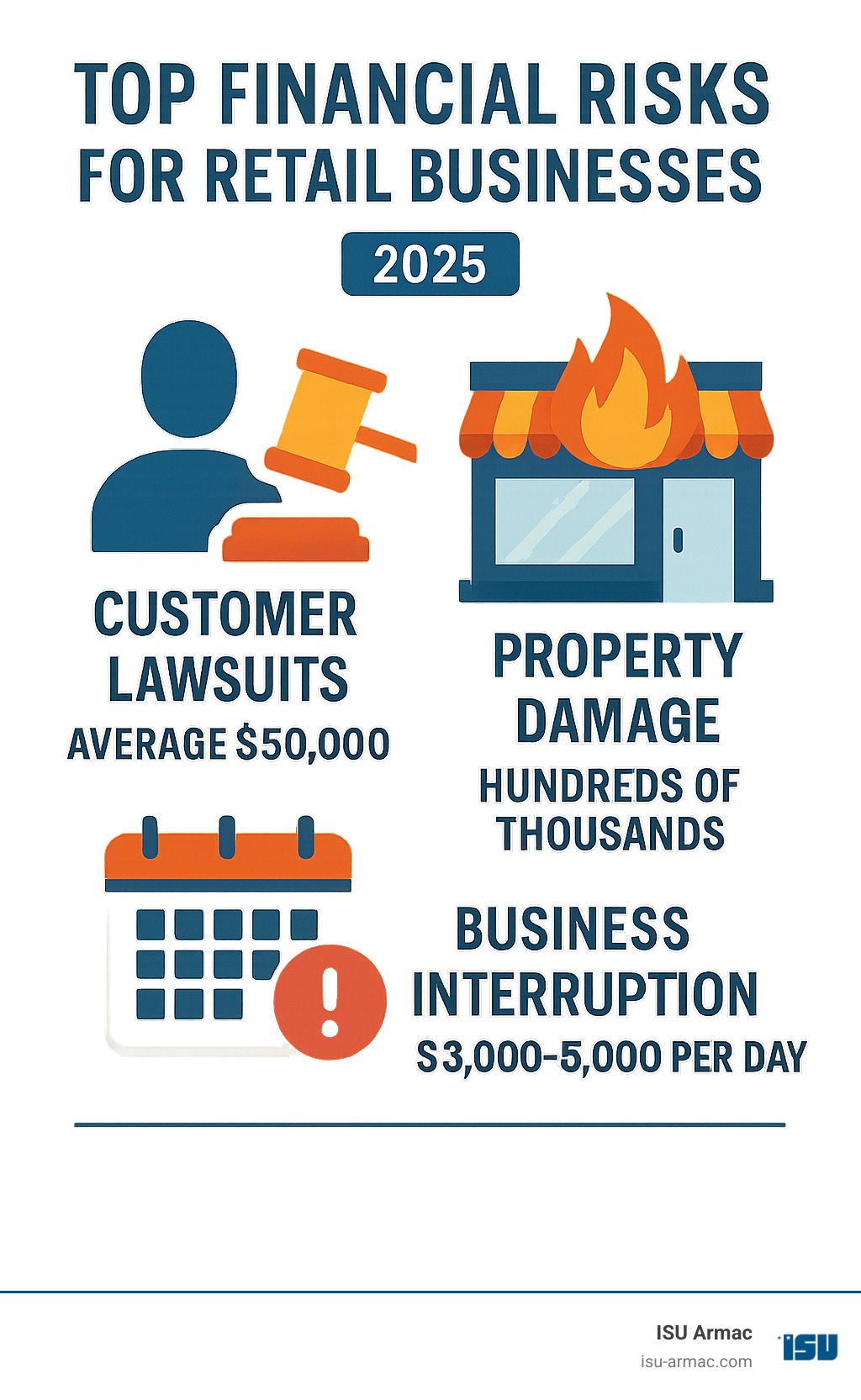
Insurance for retail businesses is essential protection against the unique risks of serving customers, managing inventory, and operating in public spaces. Your business faces potential losses from customer injuries, property damage, theft, and product liability claims that could lead to costly lawsuits or temporary closure.
Essential retail insurance coverage includes:
- General Liability Insurance – Protects against customer slip-and-fall accidents and property damage claims.
- Commercial Property Insurance – Covers building damage and inventory loss from fire, theft, or natural disasters.
- Product Liability Insurance – Shields against claims if products cause customer injury or property damage.
- Workers’ Compensation – Required in most states, it covers employee injuries on the job.
- Business Interruption Insurance – Replaces lost income during temporary closures after covered events.
The average retail business pays around $42 per month for general liability coverage and $95 per month for a comprehensive Business Owner’s Policy (BOP) that bundles multiple protections. Without proper coverage, a single incident like a customer injury or fire could threaten your business’s survival.
From physical storefronts dealing with premises liability to e-commerce operations facing cyber threats, every retail business requires a custom insurance solution. The key is understanding your specific risks and choosing coverage that protects your assets, employees, and customers.
I’m Ryan McEachron, Chief Executive Officer of ISU Insurance Services ARMAC Agency. I’ve spent decades helping Victorville area businesses secure comprehensive insurance for retail businesses that fits their needs and budgets. My experience on the Victorville City Council and Chamber of Commerce has given me a deep understanding of the challenges local retailers face and how proper insurance supports business continuity.
Find more about insurance for retail businesses:
Core Coverage: Essential Insurance for Retail Businesses
Running a retail business means navigating a dynamic environment filled with daily hazards. From the moment a customer enters your property to the point of sale, your business is exposed to risk. That’s why a robust insurance for retail businesses portfolio is a necessity. We help clients in Apple Valley, Hesperia, and throughout Southern California mitigate these risks effectively.
Here are the essential types of coverage every retail business should consider:
Business Owner’s Policy (BOP): A BOP is a cost-effective starting point for small to medium-sized retailers. It bundles Commercial General Liability and Commercial Property Insurance, often at a lower price than separate policies. A BOP protects against common risks like customer injuries and property damage while also safeguarding your equipment and inventory. A basic BOP averages around $95 per month.
Commercial General Liability (CGL): Often called “slip-and-fall” insurance, CGL is essential for any business interacting with the public. It covers financial losses from third-party claims of bodily injury, property damage, or advertising injury caused by your operations or products. For example, it would cover legal fees and medical costs if a customer slips in your store. The average cost for a retail business is $42 per month. You can find More info about General Liability Insurance for Small Business on our website.
Commercial Property Insurance: This coverage is vital for protecting your physical assets like your building, inventory, and equipment from events like fire, theft, or vandalism. If a pipe bursts and damages your stock, commercial property insurance helps you recover.
Workers’ Compensation Insurance: If you have employees, workers’ compensation is almost always required by state law. It covers medical costs and lost wages for employees who suffer work-related injuries or illnesses. The average cost for a retail business is $86 per month.
Business Interruption Insurance: This coverage can be a lifesaver. If your business must close temporarily due to a covered event like a fire, it helps replace lost income and covers ongoing expenses like rent and payroll, keeping you financially afloat during repairs.
Physical Stores vs. E-commerce: Tailoring Your Coverage

The world of retail has expanded beyond brick-and-mortar, and with this evolution come distinct insurance needs. Whether you sell from a physical location, online, or both, your risks differ.
Brick-and-mortar risks: Physical stores face premises-related liabilities, such as a customer slipping on a wet floor. They are also vulnerable to property damage from fire, theft, or vandalism.
E-commerce risks: Online businesses face a unique set of digital vulnerabilities.
- Cyber Liability Insurance: This is paramount for online retailers who handle sensitive customer data. It helps cover costs associated with a data breach, such as customer notification, fraud monitoring, and legal fees.
- Product Liability Insurance: This is critical for e-commerce, as customers cannot physically inspect products before buying. It protects you if a product you sell causes injury or property damage due to a defect. Product-related injuries are extremely expensive, costing an estimated $12 billion annually.
Understanding these distinctions allows us to tailor your insurance for retail businesses to your operational model. For more insights, explore More info on what insurance is needed for a small business.
Specialized Insurance for Retail Businesses
Some retail businesses require additional, specialized policies.
- Liquor Liability: Crucial if you sell alcohol, protecting against damages caused by intoxicated patrons.
- Spoilage Coverage: Essential for businesses with perishable goods like florists or grocers, covering losses from power or equipment failure.
- High-Value Inventory: Retailers like jewelers or art galleries may need higher limits to protect against theft.
- Commercial Auto: A must if your business uses vehicles for deliveries or other errands. Hired and Non-Owned Auto (HNOA) coverage is also important if employees use their personal cars for work.
Retail sectors that often need these coverages include restaurants, jewelry stores, florists, grocery stores, electronics stores, and liquor stores.
Understanding the Cost of Your Retail Insurance Policy
One of the most common questions we hear from business owners in Victorville is, “How much will insurance for retail businesses cost?” The answer isn’t a flat rate, as several factors influence your premiums.
Factors influencing premiums:
- Business Location: Premiums can be higher in areas with more crime or natural disaster risk.
- Type of Retail Business: A liquor store has higher inherent risks and costs than a candle shop.
- Business Size and Revenue: Larger operations with more inventory and sales have greater exposure and higher costs.
- Number of Employees: More employees increase payroll, which raises workers’ compensation premiums.
- Claims History: A history of frequent claims will likely increase your premiums.
- Coverage Limits and Deductibles: Higher coverage limits increase premiums, while higher deductibles can lower them.
- Security Measures: Alarms and cameras can demonstrate risk reduction and may lower your costs.
Average cost statistics: While costs vary, we can provide a general idea. The average cost for a general liability policy is $42 per month. A Business Owner’s Policy (BOP) for a retail business typically averages $95 per month. Workers’ compensation insurance averages $86 per month. These are averages; your specific quote will be customized for your business.
Bundling policies: One of the best ways to manage insurance costs is by bundling policies. A Business Owner’s Policy (BOP) combines general liability and commercial property insurance, often at a lower cost than purchasing them separately. We can help you explore other bundling opportunities to achieve potential discounts.
How to Get an Affordable Quote for Insurance for Retail Businesses
Getting the right coverage at a competitive price is simple with the right partner.
Comparing quotes: We work with multiple top-rated carriers, allowing us to shop around on your behalf to find the best coverage at the lowest rates.
Working with an agent: An experienced agent at ISU Armac acts as your advocate. We take the time to understand your retail operation, identify specific risks, and recommend custom solutions.
Choosing appropriate deductibles: We’ll guide you in selecting deductibles that balance your premium costs with your comfort level for out-of-pocket expenses.
Implementing safety measures: Proactive risk management can directly impact your premiums. Implementing security measures and employee training can lead to more favorable rates.
For a deeper dive into how costs are calculated, visit our page on More info about Commercial Insurance Cost.
Proactive Protection: Managing and Reducing Business Risks
The smartest insurance for retail businesses strategy combines solid coverage with smart risk management. While insurance is your safety net, prevention is your first line of defense. Taking proactive steps can lower your premiums and protect your business from costly incidents.
Key risk management practices include:
- Employee Training: Train staff on safety procedures, like proper lifting and spill cleanup, to prevent common injuries.
- Security Systems: Surveillance cameras and alarms deter theft and vandalism, which can demonstrate risk reduction to insurers.
- Regular Maintenance: Keep your building and equipment in good repair to prevent accidents, fires, and breakdowns.
- Clear Safety Protocols: Use “wet floor” signs, keep aisles clear, and ensure emergency exits are accessible to prevent customer injuries.
Preventing common claims requires understanding what typically goes wrong. Customer slip-and-fall accidents top the list of retail insurance claims. Keep floors clean and dry, and maintain good lighting. Property damage from plumbing or electrical issues can be prevented with regular inspections.
Product liability deserves special attention, as any business that sells products can be held responsible for defects. Product-related injuries cost an estimated $12 billion annually. Ensure all products are properly labeled with necessary warnings and that they meet safety standards. The Product Liability Debate explores the complex issues surrounding this topic.
Shoplifting prevention strategies protect your bottom line. While commercial property insurance typically covers external theft, prevention is always better. Visible security cameras, attentive staff, and anti-theft tagging systems all help discourage shoplifting.
By actively managing these risks, you create a safer environment and can potentially reduce your insurance costs. To understand the consequences of being underinsured, read More info about the 9 Big Risks of Going Without Commercial Liability Insurance. The combination of comprehensive insurance for retail businesses and proactive risk management offers the best protection.
Frequently Asked Questions about Insurance for Retail Businesses
We’ve helped countless business owners in Victorville, Apple Valley, and throughout Southern California steer their insurance options. Here are the questions that come up most often.
Is my business legally required to have insurance?
Yes, in many cases. Most states legally require Workers’ Compensation if you have employees. If your business uses vehicles, Commercial Auto Insurance is mandatory. Additionally, commercial landlords typically require tenants to carry General Liability and Property Insurance as part of the lease agreement. Some businesses, like those selling alcohol, need specific coverage like Liquor Liability to get licensed. Failing to carry required coverage can lead to fines and other penalties. For more details, check our guide on mandatory Commercial Liability Insurance.
Does commercial property insurance cover shoplifting and employee theft?
This is a key distinction. Commercial Property Insurance typically covers theft by external parties, such as shoplifting or burglary. However, it excludes theft by your own employees. To protect against internal theft, embezzlement, or fraud, you need a separate Commercial Crime Insurance policy or a fidelity bond. Given that employee theft costs retailers billions annually, this is an important coverage gap to address.
What is a Business Owner’s Policy (BOP) and is it right for my store?
A Business Owner’s Policy (BOP) is a package policy designed for small to medium-sized businesses that combines Commercial General Liability and Commercial Property Insurance. It’s often more affordable than buying these coverages separately. If you have a physical location, own inventory or equipment, and have a relatively low-risk operation, a BOP is likely an excellent and cost-effective choice for your core coverage. It simplifies your insurance while covering the most common retail risks. A BOP doesn’t cover everything, so you’ll still need separate policies for workers’ comp or commercial auto. For more insights, visit our page on Business Insurance for Small Businesses.
Finding the Right Partner for Your Retail Insurance Needs
Choosing the right insurance for retail businesses is complex, but finding the right partner makes it simple. An independent agent offers a significant advantage over a captive agent who only represents one company.
As independent agents with deep roots in Southern California, ISU Armac acts as your advocate. We serve businesses in Victorville, Apple Valley, Hesperia, and Oak Hills, providing local knowledge you can trust. We shop multiple top-rated carriers to find you the best combination of coverage and price, ensuring your policy is customized to your unique needs.
Your business is always evolving, and your insurance should too. We build long-term relationships to ensure your coverage adapts as you grow. Don’t leave your business vulnerable when professional help is just a phone call away. We’re here to make the complex world of insurance for retail businesses simple, so you can focus on what you do best—running your business.
Ready to get started? Get a Commercial Insurance Quote today and find out how the right insurance partner can make all the difference.