
Why Understanding Personal Insurance for Business Matters
Personal insurance for business is often misunderstood by entrepreneurs, sole proprietors, and small business owners in Southern California and beyond. Many assume their personal auto policy will cover them when they drive to meet a client, deliver goods, or run business errands. Unfortunately, that assumption can lead to denied claims, out-of-pocket expenses, and serious financial exposure when an accident occurs during business activities.
Key Differences at a Glance:
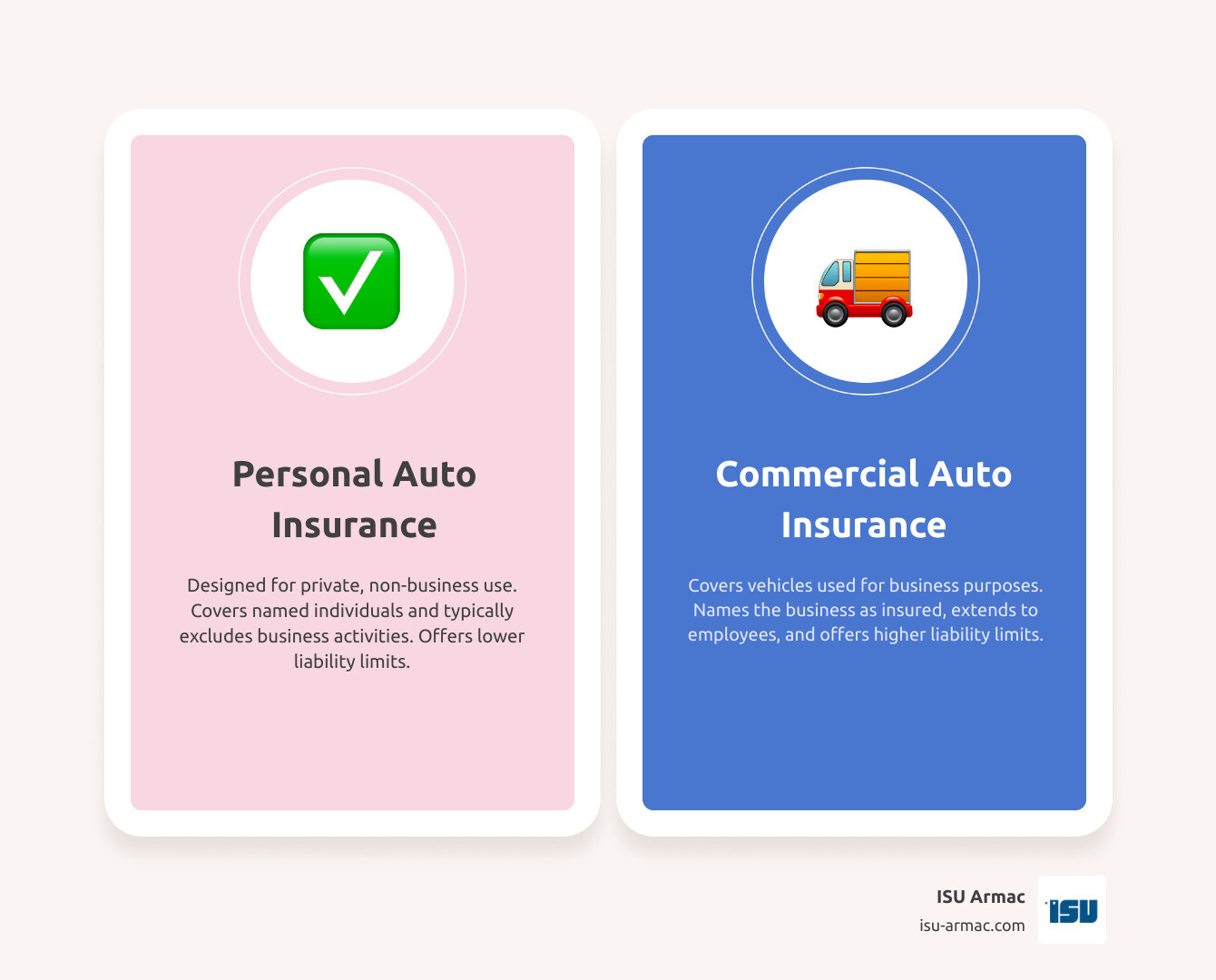
| Personal Auto Insurance | Business/Commercial Auto Insurance |
|---|---|
| Covers private, non-business use | Covers vehicles used for business purposes |
| Named individuals as insured | Names the business as insured |
| Excludes business activities | Includes employees, deliveries, client visits |
| Lower liability limits | Higher liability limits available |
| Typically cheaper | Higher premiums, but comprehensive protection |
The bottom line: If you use your vehicle for business—whether transporting equipment, visiting job sites, or carrying passengers for a fee—you likely need commercial auto insurance, not just personal coverage.
Beyond auto insurance, many business owners also need to consider how other personal insurance policies—like life insurance, disability insurance, and umbrella liability—can protect both their personal assets and their business interests. For example, key person life insurance can fund a buy-sell agreement, while disability insurance can cover business overhead expenses if you’re unable to work.
I’m Ryan McEachron, CEO of ISU Insurance Services ARMAC Agency in Victorville, and I’ve spent over two decades helping High Desert business owners steer the complexities of personal insurance for business needs, ensuring they have the right coverage to protect both their livelihoods and their personal assets. Whether you’re a contractor, consultant, or entrepreneur, understanding these distinctions is the first step toward comprehensive protection.
What’s next? In the following sections, we’ll break down exactly when your personal auto policy falls short, explore the types of personal insurance that double as business tools, and show you how to secure the right protection without overpaying.
Personal insurance for business word roundup:
The Core Distinction: Personal Auto vs. Commercial Auto Insurance
The fundamental difference between personal and commercial auto insurance is the vehicle’s intended use. A personal policy covers private, non-business activities like commuting or family trips. It’s structured for everyday personal risks and almost always excludes business activities, leaving you dangerously exposed if an accident happens on the clock.
Conversely, a commercial auto policy is designed for business use. It names the business as the insured, covers employees driving for work, and addresses specific commercial risks. These policies offer higher liability limits, which are essential for protecting a business from major claims. Understanding this is critical for business owners in Apple Valley, Victorville, Hesperia, or Oak Hills. For more details, see our guides on Personal Vehicle Business Use and Auto Insurance for Commercial Vehicles.
When Does Your Car Need Business Insurance?
The line between personal and business use of a vehicle can be thin, and crossing it without the right coverage can have severe repercussions. Here are key scenarios where your personal car likely needs business insurance:
- Transporting goods or people for a fee: If you use your vehicle for deliveries, courier services, or ridesharing, your personal policy will almost certainly not cover you. This is a common pitfall for entrepreneurs in the gig economy. Our Uber Commercial Auto Insurance Guide 2025 offers specific insights for rideshare drivers.
- Hauling equipment: Contractors and landscapers in Southern California often transport tools in their personal trucks or vans. If these items are integral to your business, a commercial policy is essential.
- Frequent client travel: While an occasional trip to a client might be overlooked, consistent travel for business meetings or sales calls usually necessitates commercial coverage.
- Employee driving: If employees use their personal vehicles or company-owned vehicles for business tasks, commercial auto insurance is a must to protect your business from liability.
- Rideshare or delivery services: These are unequivocally business activities, and many personal auto policies explicitly exclude coverage for accidents that occur while performing them.
The California Department of Insurance emphasizes that commercial insurance protects against common business losses, including vehicle-related risks. Don’t let your business in Victorville or Hesperia be caught off guard.
The Financial Risks of Using the Wrong Policy
Relying on a personal auto policy for business use is a major gamble, as the financial consequences of an accident can be catastrophic:
- Claim denial: This is the most immediate risk. If your insurer finds you were using your vehicle for business during an accident, they will likely deny your claim, leaving you responsible for all costs.
- Out-of-pocket costs: Without coverage, you’ll have to pay for all vehicle repairs, property damage, and medical expenses for anyone injured.
- Personal lawsuits: Injured parties can sue you directly, putting your personal assets—your home, savings, and investments—at risk. As the SBA notes, business insurance protects you from events that could bankrupt your company.
- Personal asset exposure: Even with an LLC, operating without proper insurance can be seen as negligence, potentially “piercing the corporate veil” and exposing your personal wealth to lawsuits. Our guide on Commercial Vehicle Private Use Complete Guide clarifies these boundaries.
For business owners in Apple Valley and Oak Hills, understanding these risks is not just about compliance, but about safeguarding your entire financial future.
Beyond the Vehicle: Key Types of Personal Insurance for Business
While commercial auto insurance addresses vehicle-specific risks, the concept of personal insurance for business extends much further. Many personal insurance products become powerful tools for business continuity, asset protection, and succession planning. It’s about creating a safety net that protects both your personal life and professional endeavors. Our article on The ABCs of Personal Lines Insurance Protecting Your Assets provides a good foundation for this.
Life Insurance as a Business Tool
Life insurance isn’t just for family protection; it has crucial applications for business owners:
- Key Person Insurance: This is a life insurance policy taken out by a business on a critical employee or owner. The business is the beneficiary, receiving a payout to cover lost revenue, recruit a replacement, or pay off debts. This coverage helps your business recover from the loss of someone invaluable. Our Key Man Insurance Complete Guide provides an in-depth look.
- Buy-Sell Agreements: For businesses with multiple owners in Victorville, a buy-sell agreement funded by life insurance ensures a smooth transition if an owner dies. The payout provides surviving owners with funds to purchase the deceased owner’s share from their heirs, maintaining business control and protecting the financial interests of each owner’s family.
- Collateral for business loans: Life insurance policies with cash value can sometimes be used as collateral for business loans, helping you secure financing for your Apple Valley business.
These applications show how life insurance becomes a strategic asset for business resilience.
Disability and Overhead Expense Insurance
An owner’s ability to work is often their most valuable asset. Disability insurance addresses what happens if you’re unable to perform your duties due to illness or injury.
- Personal income protection for owners: Individual disability insurance replaces a portion of your income if you become disabled and cannot work, ensuring your personal finances remain stable.
- Business overhead expense coverage: This specialized policy pays for fixed operating expenses (rent, utilities, salaries) if you, as the owner, become disabled. It is vital for service-based businesses in Hesperia and Oak Hills and ensures your business can pay its bills if you cannot work.
- Ensuring business continuity during illness or injury: Both types of disability insurance are critical for business continuity. They provide the financial bridge for your business to survive your absence. For broader protection, consider our insights on Business Interruption Coverage.
Extending Your Liability Shield with a Personal Umbrella Policy
A personal umbrella policy is a powerful, often-overlooked tool for entrepreneurs in Southern California.
- Excess liability coverage: An umbrella policy provides an additional layer of liability coverage above the limits of your underlying personal policies, like home and auto. If a major lawsuit exhausts your primary policy limits, the umbrella policy kicks in.
- Filling gaps in underlying policies: Umbrella policies can offer broader coverage than standard policies, sometimes extending to claims like libel, slander, or false arrest.
- Protecting personal assets from business-related lawsuits: While a personal product, an umbrella policy can indirectly protect you from business lawsuits. If a suit targets you personally and your assets are at risk, a robust personal umbrella policy acts as a crucial final defense. Our guide on Personal Umbrella Liability Insurance explains its extensive benefits.
Navigating Your Coverage: How to Secure the Right Protection
Securing the right personal insurance for business is a strategic decision. It involves understanding your unique risks to find custom solutions that provide robust protection without overpaying. As the SBA emphasizes, making smart insurance choices is key to protecting your business from catastrophic events.
- Assessing your needs: Evaluate how your personal and business activities intersect. Consider your assets at risk, services provided, employees, and contractual obligations.
- Understanding your industry’s risk profile: A contractor in Victorville has different risks than a consultant in Apple Valley. The California Department of Insurance offers Commercial Insurance Information Guides to help you understand industry risks.
- Considering your business structure (LLC, Sole Proprietor, etc.): Your business entity impacts your personal liability. An LLC offers protection, but doesn’t eliminate all personal exposure.
- Bundling policies for savings: Combining policies like commercial auto and general liability can be a smart way to save money, as bundling often leads to discounts.
Align your insurance strategy with your business stage. For guidance, refer to the SBA’s guide on how to Get business insurance.
Factors That Influence Your Insurance Costs
The cost of commercial policies is not one-size-fits-all. Several factors contribute to your premium:
- Coverage limits: Higher liability limits mean higher premiums but provide greater protection.
- Deductible amounts: Choosing a higher deductible (the amount you pay out-of-pocket) can lower your premium.
- Claims history: A history of frequent or large claims will likely increase your premiums.
- Industry type: Riskier industries, like construction in Hesperia, typically pay more for insurance than a graphic design firm in Oak Hills.
- Number of employees: More employees generally mean increased risk exposure.
- Vehicle types: The type, age, and value of business vehicles all play a role in commercial auto insurance costs.
Understanding these variables can help you make informed decisions. For a deeper understanding, our Commercial Insurance Cost guide offers valuable insights.
Determining the Right Amount of Personal Insurance for Business Coverage
Deciding on the right amount of coverage is a critical step that balances protection with affordability. The goal is the most appropriate policy, not necessarily the cheapest.
- Asset valuation: Assess the value of your business assets, including property, equipment, and inventory, to determine adequate coverage.
- Liability risk assessment: Consider worst-case scenarios, like a major lawsuit from a client injury in Victorville. The California Department of Insurance advises understanding your policy’s exclusions and limitations.
- Contractual requirements from clients: Many clients require you to carry specific types and amounts of insurance. Ensure your policies meet these minimums.
- Planning for future growth: Periodically review your coverage to ensure it keeps pace with your business expansion.
As the SBA suggests, the goal is to avoid being underinsured. Our Complete Business Liability Insurance Guide offers strategies for this assessment.
Key Considerations When Choosing a Personal Insurance for Business Provider
Choosing an insurance provider is as important as choosing the right policy. You need a reliable partner who understands the Southern California business landscape.
- Financial stability ratings: Check an insurer’s financial strength ratings from agencies like A.M. Best or Moody’s to confirm their ability to pay claims.
- Claims service reputation: A policy is only as good as the claims service behind it. Look for providers with a strong reputation for efficient and fair claims handling.
- Specialization in your industry: Some insurers specialize in certain industries, offering custom policies that better address your specific risks.
- Licensed advisors: Work with licensed insurance advisors who can provide expert guidance and advocate on your behalf. The California Department of Insurance stresses the importance of verifying an agent’s license.
At ISU Armac, we are licensed advisors who understand the unique needs of businesses in Victorville, Apple Valley, Hesperia, and Oak Hills. We shop multiple carriers to find the best coverage at the lowest rates, ensuring you get the right protection for your personal insurance for business needs. For more details, refer to the Commercial Insurance Information Guides from the California Department of Insurance.
Frequently Asked Questions about Business Insurance
Can I use my personal car insurance for my LLC?
An LLC (Limited Liability Company) protects your personal assets from business liabilities, but it doesn’t mean your personal auto insurance covers your vehicle for business use. The answer is almost always no. Here’s why:
- LLC asset protection: An LLC shields your personal assets from business debts, but if you cause an accident while driving for your business with only personal insurance, the claim can be denied. This leaves your LLC’s assets exposed. While an LLC protects your personal assets, your business’s assets are still at risk, necessitating business liability insurance.
- Business vehicle registration: If your vehicle is registered under your LLC’s name or is primarily used for business, insurers will require a commercial policy.
- Policy exclusions: Personal auto policies have “business use” exclusions. Driving to a client meeting, making deliveries, or transporting equipment are all considered business use.
- Risk of claim denial: If an accident occurs during business use, your personal insurer can deny the claim, leaving you personally responsible for all damages and injuries.
Therefore, even with an LLC, you need commercial auto insurance if your vehicle is used for business purposes.
What is a Business Owner’s Policy (BOP) and how does it relate?
A Business Owner’s Policy (BOP) is a cost-effective package for small to medium-sized businesses, combining several essential policies into one.
- BOP definition: A BOP typically includes:
- Commercial General Liability (CGL): Covers claims of bodily injury or property damage to third parties.
- Commercial Property Insurance: Protects your business’s physical assets, like your building, equipment, and inventory.
- Business Interruption Insurance: Covers lost income and ongoing expenses if your business must close temporarily due to a covered loss.
- Bundled coverages: By bundling these coverages, a BOP often offers savings compared to purchasing each policy separately. Our Small Business Insurance Packages can provide more context on these bundled options.
- Not a substitute for other policies: A BOP is not a substitute for specialized policies like commercial auto insurance or professional liability (E&O). If you use a vehicle for business, you’ll still need a separate commercial auto policy.
Does my homeowner’s insurance cover my home-based business?
This is a common question for home-based entrepreneurs in Apple Valley, Victorville, Hesperia, and Oak Hills. The answer is that your homeowner’s policy offers very little, if any, coverage for your business, making it a significant risk to rely on.
- Limited coverage for business property: Standard homeowner’s policies typically provide minimal coverage (often $2,500 or less) for business equipment. This will likely fall far short of replacement costs for stolen or damaged items.
- Liability exclusions: Homeowner’s insurance is for personal, not business, liability. If a client is injured at your home office, your policy will almost certainly exclude coverage. While home insurance may cover certain business activities, coverage limits are generally low.
- Need for a separate business policy or endorsement: To adequately protect your home-based business, you’ll need either a home-based business endorsement on your homeowner’s policy or a separate Business Owner’s Policy (BOP).
It’s vital to recognize that your homeowner’s insurance is not a business bodyguard. For more information, check out our guide on Insurance Needed for Small Business.
Conclusion
We’ve covered the critical distinctions between personal and commercial auto insurance and explored how policies for life, disability, and umbrella liability are indispensable tools for business continuity. These policies are not luxuries but strategic necessities for any entrepreneur in Southern California, protecting both personal assets and business interests.
The value of comprehensive, custom protection is clear, and securing the right policies can lead to significant financial benefits and peace of mind. Industry insights show that flexible business insurance can offer substantial savings, making it a wise investment.
At ISU Armac, we understand that navigating these complexities can be daunting. As an independent agency serving the High Desert communities of Apple Valley, Victorville, Hesperia, and Oak Hills, we shop multiple carriers on your behalf. This allows us to find the best coverage at the most competitive rates, ensuring your unique personal insurance for business needs are met. Don’t leave your personal and business future to chance.

Secure the right protection for your business vehicle today.