
Why Every California Homeowner Needs to Know About Earthquake Insurance
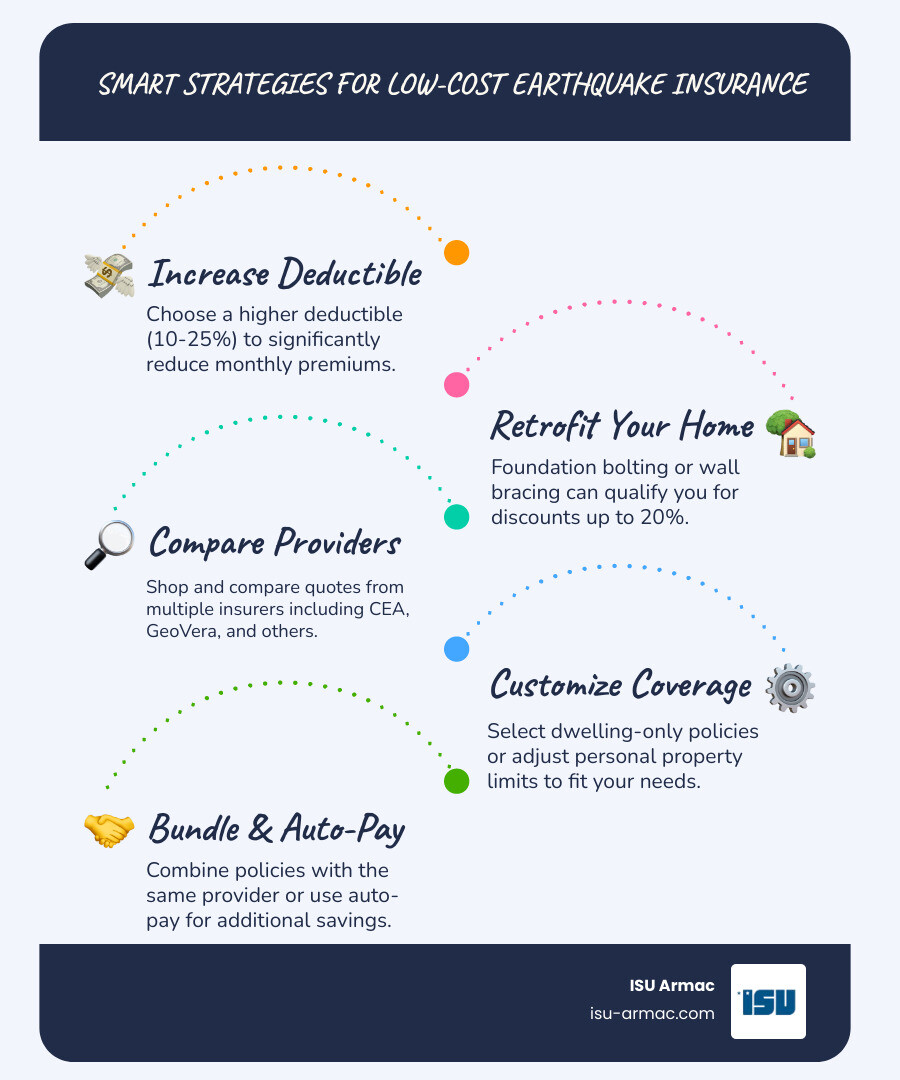
Low cost earthquake insurance is available to California homeowners. Strategic choices like higher deductibles, retrofitting discounts, and custom coverage can make protection affordable. Here’s how:
Quick Ways to Lower Your Earthquake Insurance Costs:
- Choose a higher deductible (10-25% vs. 5%) to reduce monthly premiums
- Retrofit your home with foundation bolting or wall bracing for discounts up to 20%
- Compare multiple providers including the CEA and private insurers
- Customize coverage by selecting dwelling-only policies or lower personal property limits
- Bundle policies or use auto-pay for additional savings
California sits on some of the world’s most active fault lines. Over 70% of the population lives within 30 miles of a fault capable of damaging ground shaking. Yet standard homeowners insurance doesn’t cover earthquake damage—not a cracked foundation, collapsed chimney, or your broken belongings.
The financial risk is real. While national averages are around $800/year, premiums in high-risk California areas can reach $2,000-$5,000. Without coverage, you face six-figure repair bills while still owing your mortgage, even on a destroyed home.
Affordable earthquake insurance exists if you shop smart. The key is understanding what drives your premium and making informed choices.
I’m Ryan McEachron, CEO of ISU Insurance Services ARMAC Agency in Victorville. I’ve helped countless California families find low cost earthquake insurance. This guide shares strategies to protect your home equity and financial future.
Why Standard Home Insurance Isn’t Enough in California
Many California homeowners are surprised to learn their standard policy doesn’t cover earthquake damage. This gap leaves you responsible for catastrophic repair costs, from a cracked foundation to a collapsed chimney.

After a major quake, you’re on the hook for all rebuilding and replacement costs, which can easily hit six figures. Worse, you’ll still owe your mortgage even if your home is uninhabitable. For most of us, our home is our largest financial investment. Losing that equity without protection would be devastating, which is why finding low cost earthquake insurance is so important.
The Stark Reality: Cost of Damage vs. Cost of a Policy
Let’s talk numbers. The national average for earthquake coverage is about $800 annually. In high-risk California areas like San Francisco, premiums range from $2,000 to $5,000.
While a significant expense, it pales in comparison to potential six-figure repair bills. Without coverage, you pay for all repairs, personal property replacement, and temporary housing out-of-pocket. The peace of mind from dedicated earthquake protection is invaluable when you consider these numbers.
Don’t count on FEMA to rebuild your home. While FEMA provides critical disaster aid, FEMA assistance may not cover all expenses. By law, they cannot duplicate insurance benefits. Their help is for immediate needs like food and shelter, not for rebuilding your home or replacing belongings. Rebuilding your home is your responsibility.
Understanding this makes it clear why affordable earthquake coverage is essential financial protection. With the right strategies, you can find coverage that protects your home equity. To learn more, check out our guide: More info about if earthquake insurance is worth it.
Decoding the Price Tag: What Factors Influence Your Premium?
Ever wonder why your neighbor’s earthquake insurance is cheaper? It’s not a magic discount. Low cost earthquake insurance comes from understanding how insurers calculate your home’s specific risk. Insurers bet on your home’s resilience—the more resilient it is, the less you pay. Key factors include:
- Location: This is the biggest factor. Proximity to active fault lines like the San Andreas directly increases your premium.
- Home Age and Construction: Homes built before 1979, when building codes were updated, are more vulnerable. Wood-frame homes often get lower premiums because they flex, while unreinforced brick can crumble.
- Foundation Type: This is critical. Homes with unbraced “cripple walls” are vulnerable, but retrofitting them can lower your premium.
- Other Factors: The number of stories and your home’s rebuild value also play a direct role in the cost. Finally, your deductible choice is a powerful tool for controlling your premium.
High-Risk vs. Low-Risk: A Cost Comparison
National averages of $800/year are misleading. Your actual cost is highly specific. In high-risk San Francisco, premiums are $2,000 to $5,000 annually, reflecting the high probability of a damaging quake. In lower-risk parts of California, costs are much less. The statewide average of $850 is skewed by high-cost areas; your premium depends on your specific home and location.
Understanding your personal risk level is crucial. We recommend taking a few minutes to assess your personal risk at FEMA.gov, which provides detailed seismic hazard information for your address.
In Southern California, costs vary dramatically by neighborhood. For a detailed breakdown in this region, see our guide: More info about Southern California earthquake insurance costs.
Your premium is as unique as your home. Once you understand what drives these costs, you can take control and find affordable coverage.
Your Blueprint for Low-Cost Earthquake Insurance
Protecting your home without breaking the bank is possible. Finding low cost earthquake insurance is about making smart, strategic choices, not cutting corners. Every decision, from your deductible to home improvements, shapes your premium. The good news is you have significant control over these costs.

Master the Deductible to Lower Your Premium
Your deductible is the most powerful tool for lowering your premium. Unlike a flat dollar amount, earthquake deductibles are percentage-based (5% to 25% of your home’s insured value). For a $500,000 home, a 10% deductible means you cover the first $50,000 of damage.
The trade-off is simple: a higher deductible means a lower premium. Before choosing the highest deductible, be honest about what you could afford to pay out-of-pocket after a disaster. The right choice balances premium savings with your financial reality.
Smart Strategies for Finding Low-Cost Earthquake Insurance
Beyond the deductible, other strategies can secure affordable coverage:
- Home Retrofitting: This is one of the smartest investments. Strengthening your home with foundation bolting or bracing cripple walls can earn you discounts of 20% or more. Over time, the savings can pay for the retrofit, all while making your home safer.
- Available Discounts: Look for savings by bundling policies, using auto-pay, or for having a newer home built to modern seismic codes.
- Shop with an Independent Agent: An independent agent is invaluable. At ISU Armac, we shop multiple carriers to find the best value, as pricing can vary significantly. For a step-by-step guide, see how to buy earthquake insurance.
Choosing Budget-Friendly Coverage
Finally, customize your coverage to save money. You may not need maximum limits in every category.
- Dwelling-Only Policy: This focuses on your home’s structure. Lowering limits for personal property or additional living expenses can reduce your premium.
- Customize Limits: Insure your personal property for its actual value based on a home inventory. For loss-of-use coverage, select lower limits if you have other options like staying with family.
- Parametric Insurance: This option pays a fixed amount immediately after a qualifying earthquake, regardless of actual damage. While not a replacement for full coverage, it provides quick cash for immediate needs and is often very affordable.
By thoughtfully adjusting these components, you can build a policy that protects what matters most without overpaying. To learn more, read our guide on what earthquake insurance covers.
Choosing Your Policy: Standalone, Endorsements, and Provider Vetting
After exploring cost-saving strategies, it’s time to choose a policy and provider. This decision isn’t just about the lowest price; it’s about ensuring your low cost earthquake insurance has solid financial backing and reliable claims service.
Standalone Policy vs. Endorsement: What’s the Difference?
There are two main paths for earthquake coverage:
- A standalone policy offers more flexibility to customize deductibles and coverage limits. These are offered by specialized insurers but mean a separate policy from your homeowners insurance.
- An endorsement adds earthquake coverage to your existing homeowners policy. Its main appeal is simplicity, but it may be less flexible and still has its own separate, percentage-based deductible.
In California, the California Earthquake Authority (CEA) is a key player. CEA policies are sold through participating insurers and are an essential option to consider. Learn more here: More info about who writes earthquake insurance in California?
What to Know About Low-Cost Earthquake Insurance Providers
The cheapest premium isn’t always the best deal. When evaluating providers, look beyond price to what happens after a disaster.
- Financial Stability: This is crucial. Look for insurers with high ratings from A.M. Best (an “A” or better), which indicates they can pay claims after a major event. At ISU Armac, we prioritize financially sound carriers.
- Claims Handling: Research a provider’s reputation for claims service. A smooth process is essential during the stressful aftermath of an earthquake.
- The CEA: The California Earthquake Authority (CEA) is a publicly managed, not-for-profit organization created to make earthquake insurance more available and affordable. It’s a cornerstone option for California residents.
An independent agent like ISU Armac can shop both CEA policies and private insurers to find the best value for you. Our goal is to balance affordable pricing with reliable coverage from a financially stable company.
Frequently Asked Questions about Affordable Earthquake Insurance
Let’s tackle some common questions to empower your search for low cost earthquake insurance.
Is earthquake insurance required in California?
No, earthquake insurance is not legally required in California. However, your mortgage lender might require it, especially in a high-risk zone, so always check your agreement. While legally optional, we consider it essential financial protection. The seismic risk is significant, and standard policies don’t cover quake damage. It’s not a matter of if a major quake will happen, but when.
Can I get a discount on my policy?
Yes! Discounts are a great way to lower your premium. The biggest savings come from strengthening your home.
- Seismic Retrofitting: Insurers reward you for making your home more earthquake-resistant through foundation bolting and bracing cripple walls. These improvements can lead to premium reductions of 20% or more.
- Other Discounts: Look for multi-policy discounts for bundling with home or auto insurance. You may also get savings for using auto-pay or for having a newer home built to modern seismic codes.
As your agent, we make it our job to uncover every possible saving for you.
How do I determine the right amount of coverage?
Balancing protection with affordability is key. Here’s how to determine the right amount:
- Dwelling Limit: Start with the cost to rebuild your home. We recommend matching your homeowners policy’s dwelling limit and perhaps even increasing it, as post-quake reconstruction costs can surge.
- Home Equity: Protect your largest investment. Adequate coverage prevents you from losing years of hard-earned value.
- Personal Belongings: Inventory your belongings to estimate their replacement cost. You can adjust this coverage limit to fit your needs and budget.
- Loss-of-Use: This covers temporary housing. Choose a limit that reflects realistic post-quake living expenses.
Finding the right balance is a conversation. We’re here to walk you through these considerations to find a solution that fits your unique situation.
Secure Your Financial Future Today
We’ve covered how to find affordable protection, from mastering deductibles to leveraging retrofitting discounts. The bottom line: Low cost earthquake insurance is achievable with smart choices. The most important step is to act now. Waiting until after a quake is too late. The peace of mind from knowing your financial future is protected is invaluable.
To recap: a higher deductible lowers your premium, retrofitting earns discounts, customizing coverage saves money, and an independent agent provides access to the best options.
That’s where ISU Armac comes in. As an independent agency with deep roots in Southern California—serving Apple Valley, Victorville, Hesperia, Oak Hills, and beyond—we’re not tied to a single insurance company. We compare policies from multiple carriers to find you the best coverage at a competitive price. We do the heavy lifting for you.
Think of us as your advocate. We explain your options in plain English and help you make confident decisions. Whether you need basic or comprehensive coverage, we’ll tailor a solution to your budget and needs.
California’s seismic reality isn’t going away, but your financial vulnerability can be managed. Don’t wait to get the protection your home deserves. Get your personalized earthquake insurance quote today! and let’s build a more secure future together.