
Why Independent Contractor Liability Insurance is Critical for Your Business
Independent contractor liability insurance protects self-employed professionals from costly lawsuits when accidents or mistakes happen on the job. As the number of contractors grows across North America, having your own insurance is critical to stay protected and win contracts.
Quick Answer: What Independent Contractors Need to Know
- General Liability Insurance: Covers bodily injury, property damage, and advertising injury claims
- Professional Liability (E&O): Protects against errors, omissions, and negligence claims
- Cost: Basic policies start around $450-$550 annually for $2M coverage
- Requirements: Many clients require proof of insurance before hiring contractors
- Consequences: Without coverage, you pay legal fees ($150-$500/hour) and damages out of pocket
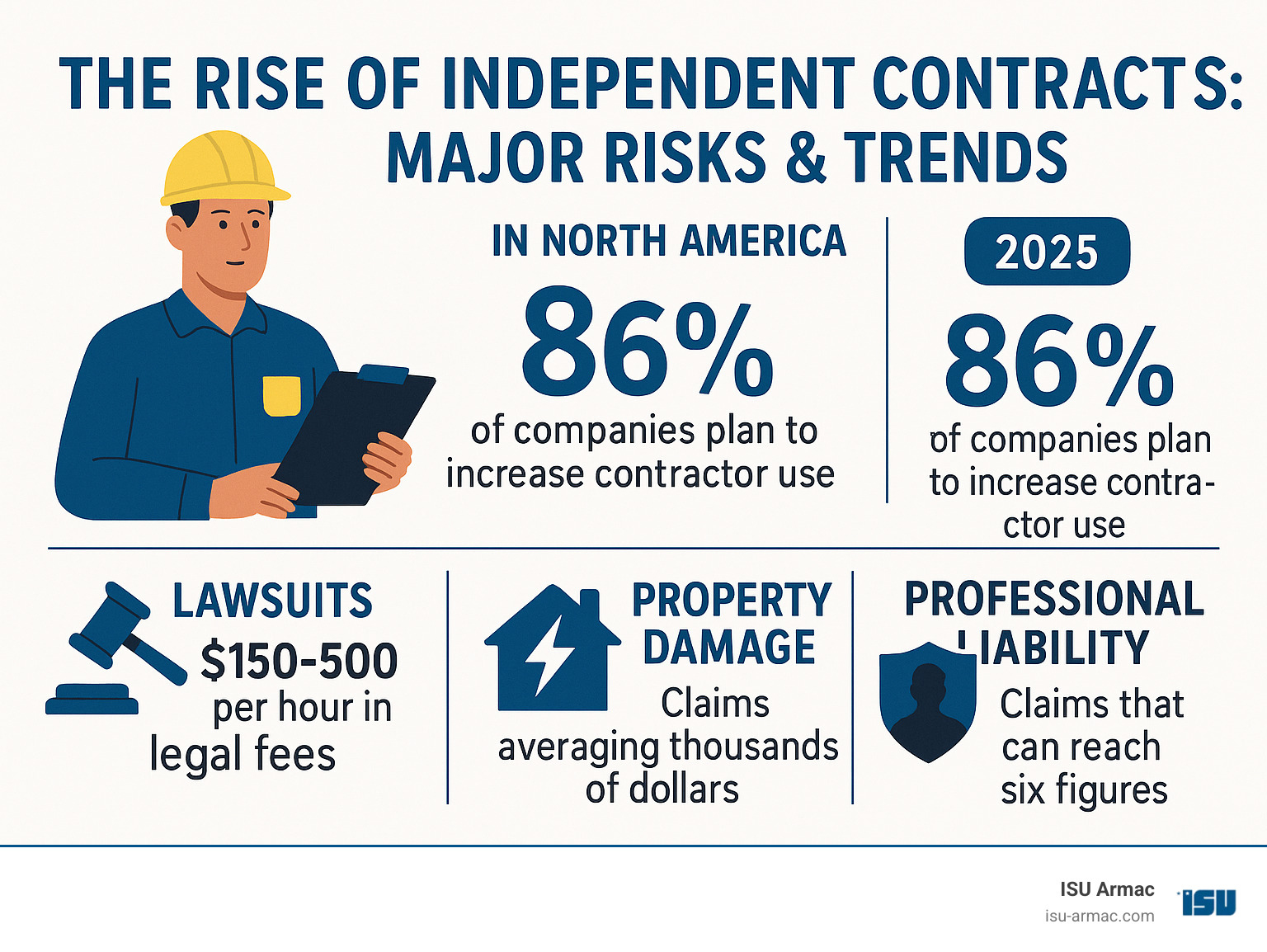
The stakes are high. Legal fees average $150-$500 per hour, and lawsuits can drag on for years. A single claim can force an uninsured contractor out of business permanently.
Most contractors mistakenly believe their clients’ insurance will cover them. This rarely happens. Client policies typically exclude independent contractors, leaving you exposed to personal financial liability for accidents, property damage, or professional mistakes.
I’m Ryan McEachron, CEO of ISU Insurance Services ARMAC Agency. With over two decades of experience in California’s High Desert region, I’ve seen how the right independent contractor liability insurance transforms vulnerable contractors into confident business owners who can focus on growth, not financial catastrophe.
Basic independent contractor liability insurance vocab:
- what does general liability insurance cover for a contractor
- do contractors need insurance
- health insurance for independent contractors
What is Independent Contractor Liability Insurance and Why is it Essential?
When we talk about independent contractor liability insurance, we’re primarily referring to Commercial General Liability (CGL) coverage. Think of it as a financial shield for your business, protecting you from the everyday risks that can lead to costly lawsuits.

This insurance is crucial because as an independent contractor, you are your own business. You’re personally responsible for any damages or injuries your work causes to a third party. Unlike an employee, you are not covered under a client’s business insurance. A CGL policy is designed to protect your assets and give you peace of mind, so an accident won’t lead to financial ruin.
The consequences of being uninsured are severe. If you’re a carpenter and a client trips over your tools, or a painter who spills paint on an expensive rug, you’re personally responsible for the fallout. Without independent contractor liability insurance, you’d have to pay for medical bills, property repairs, and massive legal fees out of pocket.
Core Risks Covered by Your Policy
Your independent contractor liability insurance policy, specifically the General Liability portion, covers a range of common risks:
- Bodily Injury: Covers medical expenses, legal fees, and settlements if a third party is injured because of your business operations. For example, a delivery person slips on a wet floor at a client’s office.
- Third-Party Property Damage: If your work damages someone else’s property, this pays for repairs or replacement. Think of a plumber whose work leads to water damage or a landscaper who damages a neighbor’s fence.
- Advertising Injury: This vital coverage protects you against claims of libel, slander, or copyright infringement in your advertising.
- Reputational Harm: Covers legal costs if you’re sued for slander or libel related to your business operations.
- Legal Defense Costs: Even if a claim is baseless, defending yourself in court is expensive. Your liability policy covers these legal fees, which can range from $150-$500 per hour or more in the U.S.
The High Cost of Going Uninsured
Operating without independent contractor liability insurance is a profound risk. A single accident could cost you everything:
- Personal Asset Seizure: Without business insurance, your personal assets (savings, home, car) could be on the line to cover legal judgments or settlements.
- Business Bankruptcy: A single large lawsuit could easily exceed your personal financial capacity, forcing your business into bankruptcy.
- Damaged Professional Reputation: News of a lawsuit, especially one where you’re found liable, can severely damage your reputation, making it difficult to secure future contracts.
- Inability to Secure Contracts: Many clients, especially larger businesses, require proof of insurance before hiring you. No insurance, no work.
Here are some common scenarios where an uninsured contractor faces immense financial and professional consequences:
- A freelance photographer’s camera bag falls, damaging a client’s expensive antique vase.
- An IT consultant accidentally deletes crucial data from a client’s server due to a mistake in their work.
- A house cleaner uses the wrong chemical, causing discoloration on a client’s wooden floor.
- A personal trainer’s client injures themselves during a session and claims negligence.
- A graphic designer uses copyrighted images without permission, leading to a lawsuit for infringement.
- An independent electrician’s faulty wiring causes a small fire, damaging a portion of a client’s property.
These are not far-fetched scenarios; they happen every day. Having the right independent contractor liability insurance means you can focus on your craft, knowing you’re protected.
Key Coverages: General Liability vs. Professional Liability
When discussing independent contractor liability insurance, it’s important to know there isn’t just one type of coverage. The two most critical policies are General Liability and Professional Liability (also known as Errors & Omissions), which protect against different risks.

Think of General Liability as covering physical harm or damage, while Professional Liability covers financial harm from your professional services or advice. Depending on your profession, you might need one or both for comprehensive protection.
Understanding Your General Liability Insurance
General Liability (CGL) is the foundation of independent contractor liability insurance. It covers claims of:
- Bodily Injury: Someone getting hurt on your property or because of your work.
- Property Damage: Damage to someone else’s property caused by your business operations.
- Advertising Injury: Claims arising from your advertising, such as libel, slander, or copyright infringement.
What it covers: If a client’s child trips over your ladder and breaks an arm, CGL steps in. If you scratch a client’s floor, CGL covers the repair. It also includes “completed operations coverage,” protecting you from claims arising from your completed work, like a faulty installation causing damage months later.
What it excludes: CGL generally does not cover:
- Professional Mistakes or Errors: Financial loss due to your professional advice or a mistake in your service falls under Professional Liability.
- Work-Related Injuries to You or Your Employees: These are covered by personal health insurance or Workers’ Compensation.
- Vehicle Damage: Business vehicle accidents are covered by Commercial Auto Insurance.
- Intentional Acts: Damage or injury caused intentionally is not covered.
- Employee Accusations: Claims like discrimination or harassment are usually excluded.
When to Add Professional Liability (Errors & Omissions)
While General Liability covers tangible harm, Professional Liability, or Errors & Omissions (E&O) insurance, covers risks from your professional services. An E&O policy is for businesses that provide advice, consulting, or design.
You should strongly consider E&O if your work involves:
- Advice-Based Professions: Offering expert advice as a consultant or financial advisor.
- Design Flaws: For architects or designers whose work could cause a client’s financial loss.
- Financial Loss Claims: If a client could claim your negligence, error, or omission caused them financial harm, like a software bug causing lost revenue.
For consultants, designers, and other service-based contractors in Southern California, this independent contractor liability insurance is a must. It protects you from claims of negligence, errors, or incorrect advice that cause a client financial harm. A single claim could jeopardize your career.
Navigating Client Contracts and Subcontractors
As an independent contractor, your success depends on building trust and demonstrating professionalism. Your independent contractor liability insurance is a powerful tool that opens doors, wins contracts, and protects your relationships with clients and subcontractors.

From your client’s perspective, they’re trusting you with their property. They don’t want to be financially responsible if something goes wrong. Your insurance gives them peace of mind and shows you’re a serious professional who plans ahead.
Clients rarely extend their insurance to cover contractors. As your own business entity, you’re responsible for your own protection. Proper coverage isn’t just smart—stay competitive.
The Role of a Certificate of Insurance (COI)
A Certificate of Insurance is your golden ticket for winning contracts. This simple document proves you have active coverage and can be the deciding factor between you and an uninsured competitor.
Winning bids is easier when you can provide proof of insurance. Many clients won’t consider contractors without a current COI, and I’ve seen contractors lose projects for lacking this basic document.
Demonstrating professionalism happens the moment you hand over your certificate. It signals that you understand business risks and take responsibility seriously, showing clients you’re organized and prepared.
Meeting contract requirements is often non-negotiable. Large companies and government entities typically require specific insurance minimums. Your COI shows you meet their standards.
Instant proof of coverage is easy with modern insurers. Most offer online portals where you can download your COI immediately when clients need it.
Understanding ‘Additional Insured’ Status
Clients may ask to be added to your policy as an additional insured. It’s important to understand what this means for your coverage.
When a client is an additional insured on your independent contractor liability insurance policy, they gain protection under your coverage for claims related to your work. If an incident involves you both, your policy may defend them too.
Client requests for this status are common on larger projects, giving them direct access to your policy’s benefits.
Policy endorsements are required to add an additional insured. This isn’t automatic and may involve an additional fee from your insurer.
Premium impact varies. Some policies include this at no extra cost, while others charge a fee. Understand these costs upfront to factor them into your pricing.
Does My Independent Contractor Liability Insurance Cover Subcontractors?
Many contractors are surprised to learn their independent contractor liability insurance typically doesn’t cover subcontractors. This crucial gap can create significant liability if not addressed.
Subcontractor liability remains with the subcontractor. As independent businesses, they need their own insurance. If an uninsured sub causes damage, you could be held responsible.
Hiring insured subs should be standard practice. Require them to carry liability insurance with limits that match or exceed your own. This is essential protection for your company.
Risk transfer occurs when subs carry proper insurance and name you as an additional insured on their policies. Their insurance becomes the primary coverage for incidents they cause.
Verifying coverage means getting a current Certificate of Insurance from every subcontractor before they start work. Keep these on file to prove you’ve done your due diligence.
Managing subcontractor insurance is as important as carrying your own. It’s another way that proper independent contractor liability insurance knowledge protects your business.
How to Get the Right Insurance for Your Business
Finding the right independent contractor liability insurance for your business might seem overwhelming at first, but it’s actually more straightforward than you’d think. The key is understanding what drives your costs and knowing where to turn for expert guidance.

Think of shopping for insurance like buying a car. You wouldn’t walk onto a lot and pick the first vehicle you see, right? The same principle applies here. Your premium isn’t pulled out of thin air – it’s carefully calculated based on your specific situation and risk factors.
Factors That Influence Your Insurance Cost
Your independent contractor liability insurance premium is like a recipe – different ingredients combine to create your final cost. Understanding these ingredients helps you make smarter decisions about your coverage.
Type of work plays the biggest role in determining your rates. A freelance graphic designer working from their home office faces very different risks than a roofer working three stories up. Insurance companies know this, so they price accordingly. High-risk trades like demolition, electrical work, or tree removal typically see higher premiums than desk-based professions like consulting or bookkeeping.
Business location matters more than you might expect. Here in California’s High Desert region, including Victorville, Apple Valley, and Hesperia, we see different rate structures than contractors in other states or even other parts of California. Local legal environments, population density, and historical claim patterns all factor into your premium.
Your years of experience tell insurers a story about your risk level. A contractor with fifteen years of accident-free work under their belt typically pays less than someone just starting out. It’s not personal – it’s just that experience often translates to fewer claims.
Annual revenue gives insurers insight into the size and scope of your operation. A contractor pulling in $500,000 annually likely handles bigger, more complex projects than someone earning $50,000, which can affect risk exposure and premium calculations.
Your claims history acts like a credit score for insurance. A clean record works in your favor, while previous claims might bump up your rates. The good news? One minor claim won’t necessarily break the bank, especially if you have years of clean history.
Finally, coverage limits directly impact your premium. Choosing $2 million in liability coverage instead of $1 million will increase your cost, but it also dramatically increases your protection. Most contractors find that $2 million coverage offers excellent value – the extra premium is usually quite reasonable compared to the additional peace of mind.
Finding the Best Policy: Working with an Insurance Professional
You could spend hours clicking through online quote forms, but here’s the thing – independent contractor liability insurance has nuances that generic websites often miss. This is where working with an experienced agent makes all the difference.
At ISU Armac, we bring something unique to the table: market access. Instead of being tied to one company’s rates and options, we shop multiple carriers to find you the best deal. It’s like having a personal shopper who knows exactly where to find the best prices and coverage options for your specific trade.
Policy options can be confusing when you’re going it alone. Should you add professional liability? Do you need hired and non-owned auto coverage? What about cyber liability? We help you steer these decisions based on your actual business needs, not what some algorithm thinks you might need.
The real value comes from personalized advice custom to your situation. After two decades serving contractors in the High Desert, we’ve seen every type of claim and coverage gap you can imagine. We use that experience to make sure you get exactly the protection you need – nothing more, nothing less.
When you’re ready to get serious about protecting your business, give us a call. We’ll walk you through your options, answer all your questions, and make sure you understand exactly what you’re buying. Because the best insurance policy is one you actually understand.
Beyond Liability: A Roundup of Other Essential Contractor Policies
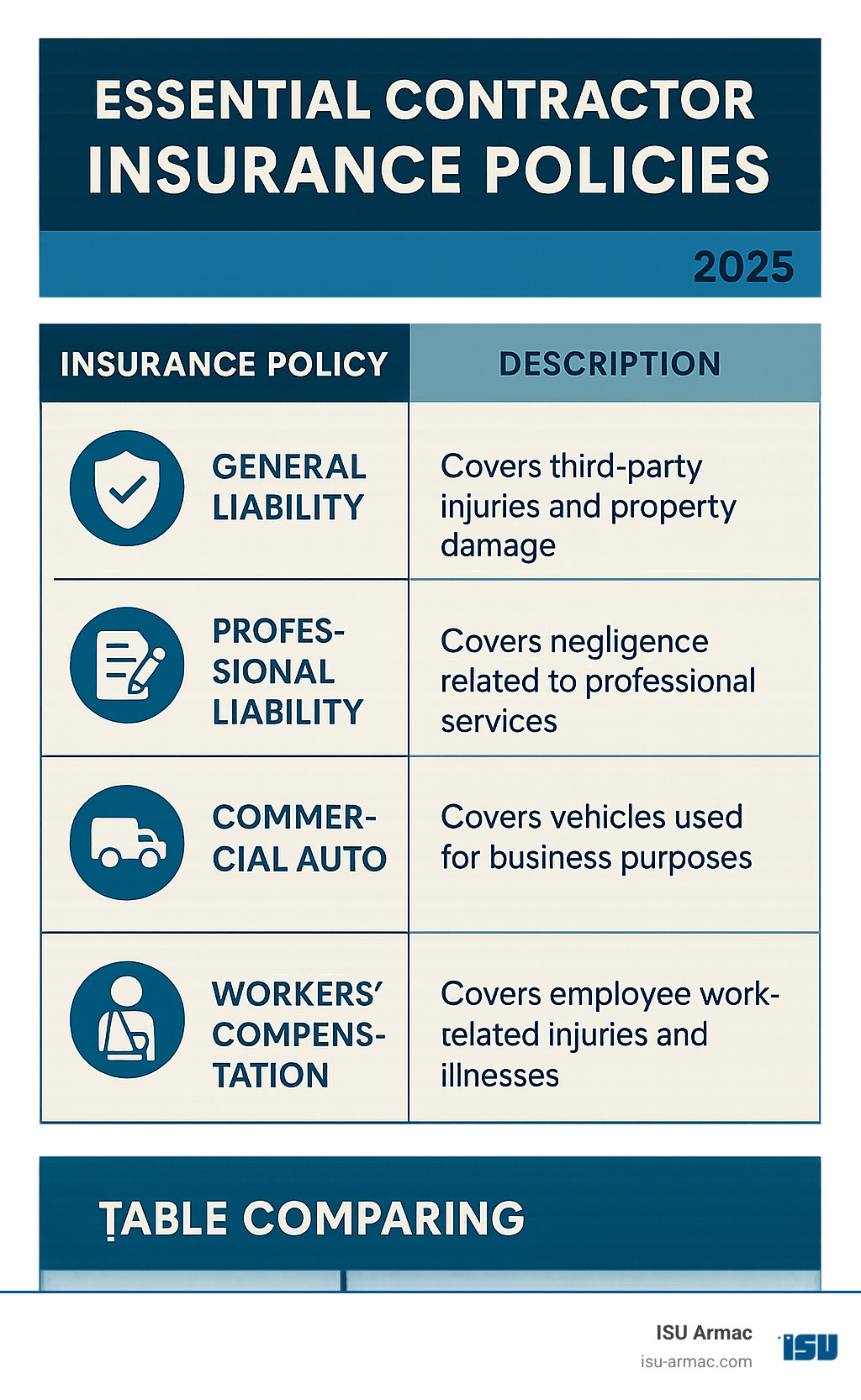
While independent contractor liability insurance (General Liability and Professional Liability) forms the bedrock of your protection, smart contractors know that true peace of mind comes from comprehensive coverage. Think of it like building a house – liability insurance is your foundation, but you need walls, a roof, and security systems to create a complete structure.
As your business grows and evolves, you’ll likely find yourself needing protection for your tools, vehicles, employees, and even your home office. Each of these areas represents a potential financial vulnerability that could sideline your business if not properly addressed.
Commercial Auto Insurance
Here’s something that catches many contractors off guard: your personal auto insurance probably won’t cover you when you’re using your vehicle for business. Whether you’re hauling equipment in your pickup truck or driving your sedan to client meetings, you need commercial auto insurance to stay protected.
The distinction matters more than you might think. If you get into an accident while heading to a job site, your personal insurer could deny the claim entirely, leaving you personally liable for damages and injuries. Commercial auto insurance fills this critical gap by covering business use of vehicles, ensuring you’re protected whether you’re transporting tools, meeting clients, or running business errands.
Don’t overlook hired and non-owned auto coverage either. This protects you when you rent vehicles for business purposes or when employees use their personal vehicles for work-related tasks. It’s one of those coverages you hope you’ll never need, but when you do, you’ll be grateful it’s there.
Tools and Equipment Insurance
For most contractors, losing your tools is like a surgeon losing their hands – it brings everything to a grinding halt. Your hammers, saws, computers, and specialized equipment represent thousands of dollars of investment that could disappear in an instant through theft or damage.
Standard business insurance often provides limited coverage for tools and equipment, especially when they’re away from your primary business location. That’s where dedicated tools and equipment insurance becomes invaluable. It protects your assets whether they’re on a job site, in your vehicle, or in transit between locations.
The industry typically distinguishes between “tools” (items valued under $1,500) and “equipment” (anything above that threshold), but good coverage protects both categories. From a stolen toolbox to a damaged laptop, this insurance ensures you can replace what you need to keep working without devastating your cash flow.
Workers’ Compensation
The day you hire your first employee marks a significant milestone in your business growth – and it also triggers new insurance requirements. Workers’ compensation isn’t just a good idea; it’s legally mandated in California and most other states as soon as you have employees on payroll.
This coverage provides a crucial safety net for employee injuries that occur on the job. It covers medical expenses and provides lost wages while your employee recovers, protecting both their financial security and your business from potentially massive liability claims. Without it, a single workplace accident could result in a lawsuit that threatens everything you’ve built.
The state requirements vary, but California’s regulations are particularly strict about compliance. Getting ahead of this requirement before you need it can save you from scrambling to secure coverage when you’re ready to expand your team.
Home-Based Business Insurance
Many independent contractors start their businesses from home, and why not? It’s cost-effective and convenient. However, your standard homeowner’s policy offers surprisingly limited coverage for business activities, leaving significant gaps in your protection.
Home-based business insurance bridges these gaps by protecting your home office and the business activities that happen there. If a client visits your home office and gets injured, or if your business equipment is damaged in a fire, standard home insurance typically won’t cover these scenarios.
The business property coverage component is particularly valuable, ensuring your computers, printers, inventory, and other business assets receive proper protection. For more comprehensive information about how home and business insurance work together, check out more info about home insurance.
At ISU Armac, we’ve helped countless contractors in the High Desert region build comprehensive insurance programs that grow with their businesses. The key is starting with solid independent contractor liability insurance and then adding layers of protection as your needs evolve. It’s much easier to add coverage as you grow than to scramble for protection after a loss occurs.
Conclusion
As we wrap up our comprehensive guide, it’s clear that independent contractor liability insurance stands as the cornerstone of your business protection strategy. Without it, you’re essentially walking a tightrope without a safety net – one slip could mean the end of everything you’ve worked to build.
The numbers tell the story. With legal fees averaging $150-$500 per hour and lawsuits potentially dragging on for years, a single claim can easily bankrupt an uninsured contractor. Meanwhile, a solid General Liability policy typically costs just $450-$550 annually – less than what many contractors spend on coffee in a year. It’s not just smart business; it’s essential business.
Your business deserves protection that matches your ambition. Whether you’re a seasoned electrician in Victorville, a growing landscaping operation in Apple Valley, or a freelance consultant working from your home office in Hesperia, the right insurance coverage transforms uncertainty into confidence. You can bid on bigger projects, work with demanding clients, and sleep soundly knowing your financial future is secure.
At ISU Armac, we’ve spent over two decades helping contractors across the High Desert steer the insurance landscape. We know that every business is unique, which is why we shop multiple carriers to find coverage that fits both your needs and your budget. No cookie-cutter solutions – just personalized service that puts your success first.
The question isn’t whether you can afford independent contractor liability insurance – it’s whether you can afford to go without it. Your reputation, your assets, and your family’s financial security all depend on making the right choice today.
Ready to protect what matters most? Find the right contractor insurance policy for your California business and take the first step toward true peace of mind. Your future self will thank you for making this smart investment in your business’s tomorrow.