
You're driving north on the 15 freeway outside Victorville when another driver cuts across two lanes. The impact is minor, but your bumper is damaged, traffic is building, and several questions arrive at once. Whose insurance pays? What happens if the other driver has no insurance? What if the damage costs more than that driver's policy limit?
Many California drivers would describe their policy as “full coverage” without knowing exactly what appears on the declarations page. The phrase sounds complete, but it doesn't identify specific limits, deductibles, exclusions, or optional protections. A policy can protect your vehicle from collision damage while leaving you without rental reimbursement, gap coverage, or enough liability protection for a serious injury claim.
The practical way to understand full coverage car insurance in California is to separate the phrase into its working parts. You need to know what the state requires, what collision cover does, how deductibles affect your risk, why prices vary, and how a local independent agency such as ISU Armac can help you compare the details instead of relying on a vague label.
Table of Contents
- A Quick Reality Check for California Drivers
- What Full Coverage Actually Means in California
- The Building Blocks of a Full Coverage Policy
- What Full Coverage Costs in California
- How to Shop, Compare, and Save
- Why a Local California Agency Makes a Difference
- Putting It All Together and Final Checklist
A Quick Reality Check for California Drivers
The driver who caused the freeway crash may be responsible for your vehicle damage, but responsibility and payment aren't always the same thing. If that driver has liability insurance, their property-damage coverage may respond, subject to the policy limit and claims investigation. If the driver has no insurance or too little coverage, your own policy may become the more practical route, depending on the protections you selected.
Your own collision coverage can generally address damage to your vehicle after an impact, even when fault is disputed or you caused the crash. You'll usually pay the selected collision deductible first, and the insurer handles covered damage beyond that amount, subject to the policy's terms. Without collision coverage, you may have to pursue the other driver directly or pay for repairs yourself.
Practical rule: “Full coverage” doesn't answer a claim question by itself. The declarations page does.
A second issue appears when the damage or injuries exceed the at-fault driver's liability limit. California's required liability limits changed on January 1, 2025, from the long-standing 15/30/5 framework to 30/60/15, meaning $30,000 for bodily injury to one person, $60,000 for bodily injury in one accident, and $15,000 for property damage, as reflected by the California Department of Insurance explanation of the updated limits. Those limits establish a legal baseline, not a promise that every loss will be fully paid.
That distinction creates the central problem. A driver may believe they bought an all-inclusive safety net, while the policy contains a specific combination of liability limits, collision deductibles, and selected endorsements. Understanding that combination turns an unsettling phrase into a set of decisions you can evaluate.
What Full Coverage Actually Means in California
You buy a policy after hearing that “full coverage” will protect you, then discover after a loss that the phrase does not identify every limit, deductible, or optional benefit. Full coverage isn't a legal policy category in California. It is a common shorthand for liability coverage plus protection for your own vehicle. The exact package varies, so treat the phrase as a starting point for questions, not as a guarantee.
California requires financial responsibility through liability protection. Since January 1, 2025, the minimum liability limits are 30/60/15: $30,000 for bodily injury to one person, $60,000 for bodily injury in one accident, and $15,000 for property damage in one accident, according to the state's insurance requirements. For a plain-language explanation of the baseline, see these California minimum car insurance requirements. State requirements also distinguish liability protection from coverage for damage to your own vehicle. Collision and other-than-collision coverage do not replace the liability layer.
Liability addresses harm you cause to other people. If you are responsible for a crash, bodily injury liability can pay covered injuries to others, while property damage liability can address damage to another vehicle or property, up to the limits you selected. Minimum liability generally does not repair your own car after a crash.
Collision supplies that vehicle-protection layer for impact-related losses, subject to your deductible. Other-than-collision coverage addresses events such as theft, fire, vandalism, windstorm, flood, or falling objects. The California Department of Insurance rate-comparison materials list these as separate physical-damage coverages, each with its own deductible.
A simple analogy makes the difference clearer. Minimum liability is like agreeing to pay for damage you cause while carrying no protection for the car you are driving. Adding collision and broader vehicle protection is like covering both sides of the arrangement: damage you cause to others and covered damage to your own vehicle.
| Coverage Type | State Minimum Liability | Full Coverage |
|---|---|---|
| Bodily injury liability | Required at 30/60 limits | Included, often with higher limits |
| Property damage liability | Required at $15,000 | Included, often with higher limits |
| Collision | Not included | Usually included |
| Other-than-collision coverage | Not included | Usually included |
| Uninsured or underinsured motorist | Separate coverage choice | May be added, not guaranteed by the phrase |
| Medical payments | Separate coverage choice | May be added, not guaranteed by the phrase |
| Rental reimbursement and roadside assistance | Not included automatically | Optional add-ons |
The table shows why the label can mislead. Full coverage doesn't automatically include everything you might need after a loss. Rental reimbursement, roadside assistance, gap coverage, uninsured or underinsured motorist protection, and medical payments are separate features or endorsements. Review each one on the declarations page before assuming it is included.
The Building Blocks of a Full Coverage Policy
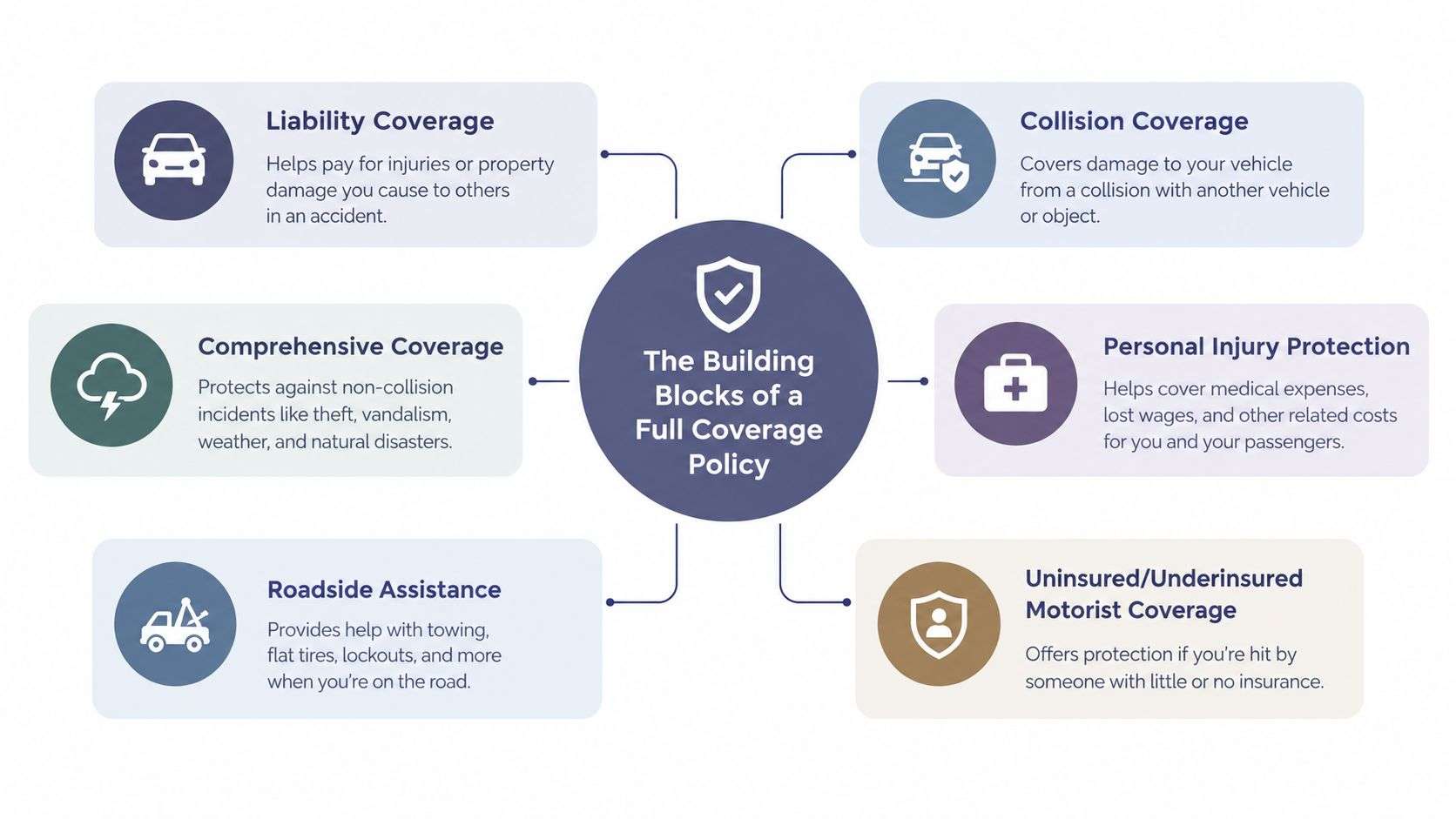
A well-designed policy is easier to understand when you view it as a collection of layers. Each layer answers a different question: Whom does it protect, what event triggers it, and what expense does it address?
Liability protects other people
Bodily injury liability applies when you're legally responsible for injuries to another person. A typical claim might involve the other driver's medical treatment after a collision you caused. The insurer investigates the accident and pays covered damages up to the bodily injury limits you selected.
Property damage liability addresses damage you cause to another vehicle, fence, building, or similar property. It doesn't repair your own vehicle. That distinction is easy to miss because both coverages may appear under the same liability heading on a declarations page.
California's required limits are a baseline, not necessarily a comfortable personal limit. A severe injury claim or a collision involving multiple vehicles can create financial exposure beyond those limits, which is why drivers often discuss higher liability limits with an agent.
Collision and comprehensive protect your vehicle
Collision coverage responds to covered impact damage. If you strike another vehicle, a stationary object, or lose control and hit a barrier, collision is the coverage that typically addresses repairs to your car after the deductible.
Full coverage responds to non-collision causes. Theft, fire, vandalism, flood, windstorm, and falling objects fall into the types of risks this coverage is designed to address. The cause of loss matters more than who was at fault. A stolen vehicle isn't a collision claim, while a car that hits a pole is generally evaluated under collision.
Protection for injuries and uninsured drivers
Uninsured and underinsured motorist coverage can help when another driver causes a crash but has no liability insurance or doesn't carry enough to address your covered injuries or damage. California drivers face a meaningful exposure from uninsured motorists, so this coverage deserves a direct conversation rather than an assumption that “full coverage” includes it.
Medical payments coverage can help with covered medical expenses for you or passengers, subject to the selected limit and policy terms. It isn't the same as liability coverage, because liability protects other people when you cause harm. It focuses on certain medical expenses for occupants of your vehicle.
Rental reimbursement and roadside assistance are conveniences, but they can become practical necessities. Rental reimbursement can help with transportation while a covered repair is underway. Roadside assistance can address services such as towing or help with a disabled vehicle. Neither should be assumed because collision and other-than-collision appear on the policy.
What Full Coverage Costs in California
A clean-record driver in Victorville may receive a very different quote from a new driver in Los Angeles, even when both ask for “full coverage.” The phrase describes a package of protections, not a standard California price. Insurers combine the driver, vehicle, location, limits, and deductible to calculate the premium.
Statewide 2026 comparisons place average full-coverage premiums roughly between $1,775 and $3,001 per year, or about $148 to $250 per month, depending on the dataset and driver profile. One comparison places liability-only coverage near $827 per year, or about $69 per month. In that dataset, the added physical-damage protection comes to roughly $948 annually. Other statewide 2026 summaries put liability-only coverage around $97 per month and full coverage around $194 per month. These figures provide context, not a promise for your household.
Why two California drivers receive different quotes
Your ZIP-level risk can affect the price through local claims patterns, traffic conditions, theft exposure, and weather-related losses. Your driving record also matters. At-fault accidents and violations can raise the cost of liability and physical-damage protection.
The vehicle changes the calculation as well. A higher-value car may cost more to repair or replace, while parts availability, safety systems, and labor requirements can affect the size of a claim. Annual mileage gives the insurer another measure of how often the vehicle is exposed to road risk.
Coverage limits and deductibles work like two sides of a budget. Higher limits transfer more potential financial responsibility to the insurer, while a higher deductible leaves you paying more before covered repairs begin. A $500 deductible usually costs more in premium but requires less at claim time than a $1,000 deductible. The lower premium only helps if you can cover the larger out-of-pocket amount after a loss.
| Driver Profile | Minimum Liability Only | Full Coverage ($500 Deductible) | Full Coverage ($1,000 Deductible) |
|---|---|---|---|
| Clean-record driver in Victorville | Quote varies by profile | Quote varies by vehicle and limits | Quote varies by vehicle and limits |
| New driver in Los Angeles | Quote varies by profile | Quote varies by vehicle and limits | Quote varies by vehicle and limits |
| Commuter in Sacramento | Quote varies by profile | Quote varies by vehicle and limits | Quote varies by vehicle and limits |
Verified data does not provide separate 2026 premiums for these three individual profiles, so precise figures would be misleading. Use the profiles as quote examples instead. Ask an agent to show the premium change between deductible choices while keeping the vehicle, limits, and other details the same.
Vehicle history may also appear in underwriting information. This guide explains how past records can support insurance savings with VIN history. The insurer's calculation is straightforward: estimate the likelihood and potential cost of a claim, then price the selected limits, vehicle protection, and deductible.
How to Shop, Compare, and Save
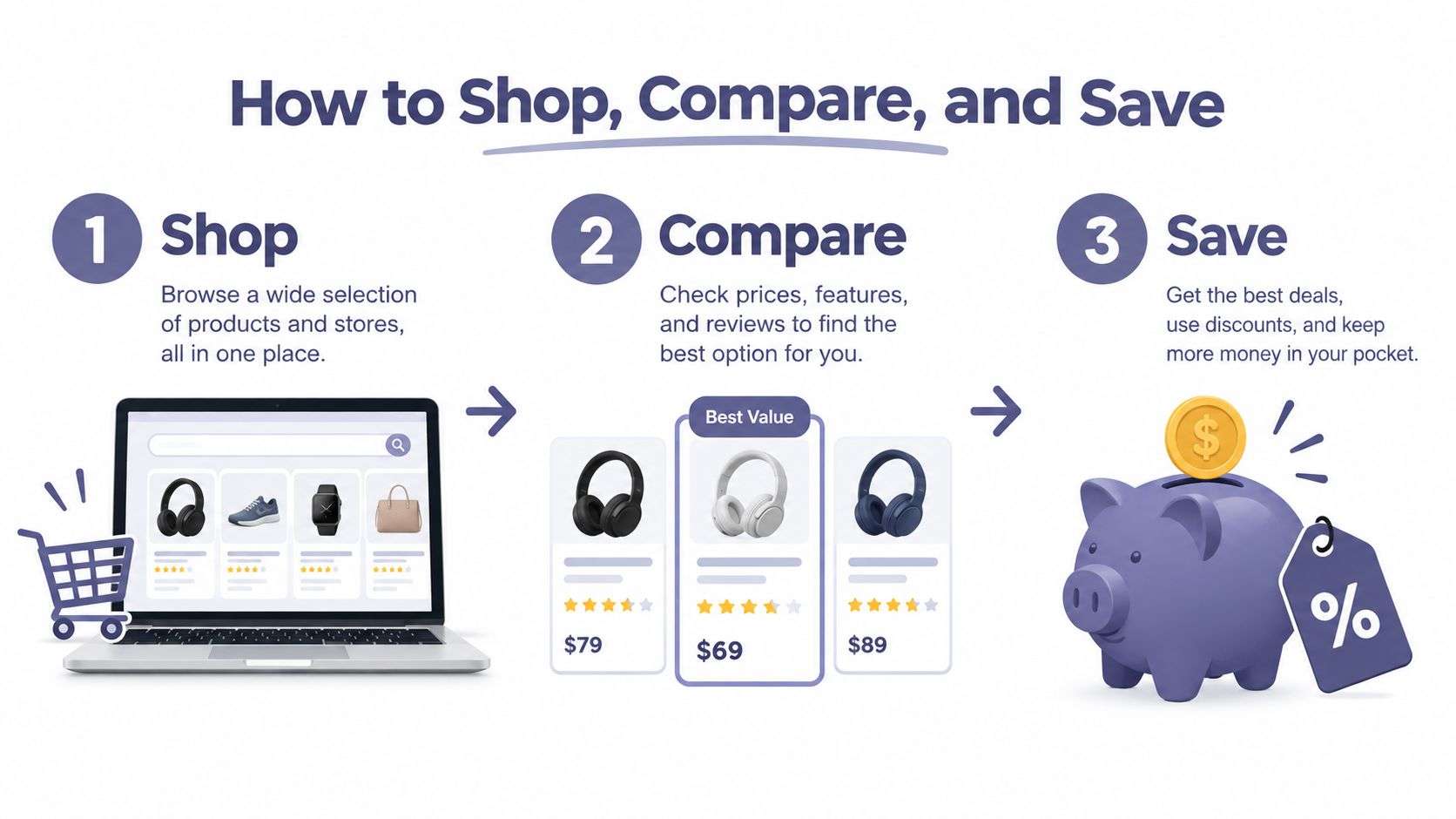
You find a tempting quote after entering only your car model and ZIP code. Later, the insurer corrects missing driver or vehicle details, and the price changes. Start with accurate information instead. Gather the vehicle identification number, current declarations page, estimated mileage, garaging address, and driver license information for every household member who may drive. A quote is useful only when its details match your real situation.
Build comparable quotes
Request quotes from multiple insurers during the same shopping period. Give each the same liability limits, uninsured motorist selections, physical-damage coverage, and deductibles. A low-limit policy beside a broader policy cannot show which insurer offers the lower price. The policies are assigning different amounts of risk to you and the insurer.
Review each quote line by line:
- Liability limits: Confirm bodily injury and property damage limits before comparing premiums.
- Uninsured motorist limits: Ask whether they match your bodily injury liability limits and how the protection applies.
- Physical-damage deductibles: Compare collision and deductibles for other physical damage separately, rather than treating them as one figure.
- Actual cash value: Understand that covered vehicle losses generally settle according to market value, not the remaining loan balance.
- Optional protections: Review rental reimbursement, roadside assistance, and gap coverage as separate choices.
State regulator comparison guidance can help clarify how limits and deductibles work together. If an agency prepares the quotes, request a written summary with each coverage line placed side by side. A guide to comparing auto insurance quotes can also help you organize the questions before requesting prices.
Choose the deductible with your budget in mind
A higher deductible may lower the premium, but it raises the amount you must pay after a covered claim. Select an amount available savings could cover without high-cost debt or postponed essential repairs. For an older vehicle, compare the yearly cost of collision and full coverage with the car's market value and the deductible due after a loss.
Ask about legitimate discounts
Discount eligibility depends on the insurer and your circumstances. Ask about multi-policy, good-driver, continuous-coverage, low-mileage, student-away-from-home, and occupational programs. Prepare documentation when requested, then check the renewal documents to confirm that an eligible discount remains in place.
Finish with a simple decision check:
- Are the limits identical across quotes?
- Can you afford each deductible after a claim?
- Are uninsured motorist and medical payments protections included, or knowingly declined?
- Would you have transportation if the car enters a covered repair?
- Does the policy meet California requirements and any lender or lease requirements?
Why a Local California Agency Makes a Difference
A local independent agency can make the policy easier to manage because the conversation doesn't end when the quote is issued. In Victorville and the surrounding High Desert, your driving pattern, household drivers, vehicle changes, and financial priorities can shift over time. A familiar adviser can help you revisit the policy instead of leaving you to interpret every renewal notice alone.
An independent agent can request options from multiple carriers without requiring you to repeat the same information to each separate sales channel. Suppose a Victorville household adds a teen driver. The agent can review how that change affects liability limits, vehicle assignments, deductibles, and available discounts, then present the differences in one conversation.
A lower premium only counts as a better option when the limits, deductibles, and exclusions still fit the driver's situation.
Local support also matters during a policy change or claim. If you purchase another vehicle, move, add a driver, or change how the car is used, the agency can help evaluate whether the policy should be rewritten or adjusted mid-term. If a claim settlement feels lower than expected, an agent can help you understand the coverage language, documentation, and next questions for the adjuster. The agent doesn't replace the claims department, but can provide context while you work through the process.
ISU Armac Insurance Services has High Desert roots and offers in-person and online quoting options. Its carrier options may include discounts for teachers, first responders, military members, and federal employees, subject to eligibility and carrier rules. The agency also handles auto insurance alongside other personal and commercial insurance needs, which can make a wider household review more practical.
For drivers who want local guidance rather than a one-time transaction, this California independent insurance agent resource explains the role an independent agency can play in comparing and maintaining coverage. The useful question isn't, “Who has the lowest monthly price?” It's, “Who will help me understand what I bought and revisit it when my circumstances change?”
Putting It All Together and Final Checklist
Full coverage is a bundle, not a single product. In practice, it usually combines California liability coverage with collision and additional protection, but the phrase doesn't automatically include every protection a driver may need.
Three misconceptions cause repeated problems:
- “Full coverage pays for everything.” It doesn't. Rental reimbursement, roadside assistance, gap coverage, uninsured motorist protection, and medical payments may require separate selections.
- “A newer vehicle needs every add-on.” A newer vehicle may make physical-damage coverage especially important, but each endorsement should still match your needs, budget, and lender requirements.
- “Minimum liability satisfies every requirement.” California minimum liability addresses the state's financial responsibility rule, while a lender or leasing company may separately require collision and other types of coverage.
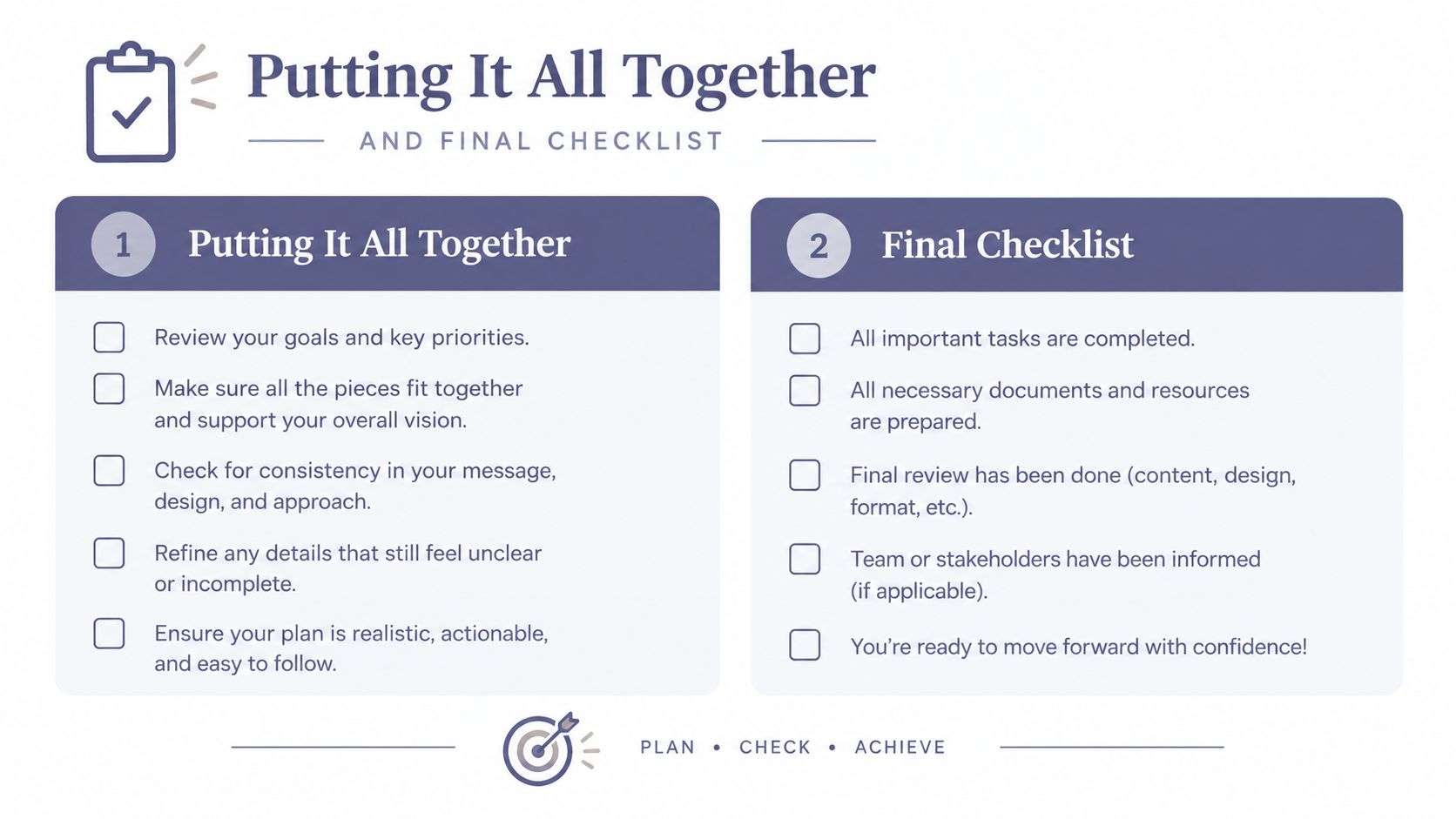
Use this checklist today:
- Pull your declarations page and identify every limit and deductible.
- Ask about liability limits of 100/300/100 or higher and compare the premium difference with the minimum option.
- Choose a deductible you can pay from savings after a covered loss.
- Request at least three competing quotes using identical limits and coverage selections.
- Review the policy annually and after changes to drivers, vehicles, residence, mileage, or financing.
A local independent agent can walk through each line item and tailor the policy to how and where you drive in California.
ISU Insurance Services offers California auto insurance guidance, comparison support, and coverage reviews for drivers who want to understand their limits, deductibles, and optional protections. Visit ISU Insurance Services to request a quote or speak with a local team serving Victorville and the High Desert.