
As an electrician, you understand that one crossed wire can have catastrophic consequences. Electrician's liability insurance serves the same critical function for your business—it is the essential protection that prevents a single on-the-job mistake from short-circuiting your entire livelihood. Consider it your business's financial shock absorber, prepared to manage the fallout from property damage or injuries caused by your work.
Without this coverage, you are one accident away from a lawsuit that could drain your financial resources and terminate your business operations permanently.
Why You Cannot Afford to Work Without It
Every job site, whether a simple residential rewire or a complex commercial build-out, is filled with potential liabilities. It is the nature of the trade. Even the most meticulous electrician can face unforeseen accidents. A tool bag left in a high-traffic hallway becomes a trip-and-fall hazard. A minor wiring error causes a power surge that destroys a client’s expensive home theater system.
When these incidents occur, financial responsibility must be assigned. If you lack the appropriate insurance, that responsibility falls directly on you.
Understanding the Real-World Financial Stakes
To be direct: in a state like California, operating without insurance is a significant gamble. Imagine you are working on a kitchen remodel and a faulty connection inside a wall sparks a fire overnight, causing hundreds of thousands of dollars in damage. The homeowner’s insurance company will pursue legal action against you to recover those costs. Without your own liability policy, you would be personally liable for repairs, legal defense, and any resulting settlement.
This is precisely what general liability insurance is designed to cover. It constitutes 38.5% of the contractor insurance market for a reason—it is the foundational policy that covers these exact scenarios. We have witnessed firsthand the consequences for contractors who forgo this coverage; you can read more about the 9 big risks of going without commercial liability insurance in our comprehensive guide.
Here is a breakdown of the most common risks you face and how the correct insurance policy provides a solution.
Core Risks Covered by Electrician's Liability Insurance
This table outlines typical "what-if" scenarios that concern every electrician and identifies the primary insurance policy designed to respond.
| Risk Scenario | Potential Consequence | Primary Insurance Solution |
|---|---|---|
| A power surge from your work damages a client's electronics. | You are liable for replacing all damaged equipment. | General Liability Insurance |
| A visitor trips over your extension cord and breaks their wrist. | You must cover their medical bills and potential lawsuit. | General Liability Insurance |
| Your advice on a new panel installation leads to a system failure. | The client sues you for the cost of rework and business interruption. | Professional Liability (E&O) |
| A fire starts due to faulty wiring you installed months ago. | You are sued for massive property damage and repair costs. | General Liability (Completed Operations) |
As illustrated, the risks are varied, but the solution is to have a comprehensive insurance plan in place before ever stepping onto a job site.
According to U.S. Small Business Administration data, uninsured electricians are 70% more likely to face business closure following a significant liability claim.
It's About More Than Just Paying for Accidents
Prudent business owners understand that insurance is not merely a defensive measure—it is a proactive strategy. It begins with a commitment to effective electrical risk management to prevent incidents, but it is supported by a policy ready for the unexpected.
This approach does more than protect your assets. It provides the peace of mind to focus on your craft. It also enhances your professional credibility, as an increasing number of homeowners and general contractors will not hire an electrician who cannot provide a certificate of insurance. It demonstrates that you are a serious professional operating a legitimate business.

Understanding the Different Types of Coverage You'll Need

Assembling the right insurance plan is analogous to packing your toolkit for a major project. You would not arrive with only a pair of wire strippers; you require different tools for different tasks. Similarly, a single insurance policy will not cover every risk you encounter on the job site.
To be truly protected, you need a combination of specific coverages. Each one functions as a different tool, designed to handle a particular type of problem. Let's examine what a robust electrician's liability insurance plan entails, starting with the one policy no contractor can afford to be without.
General Liability: The Foundation of Your Protection
If you carry only one policy, this should be it. General Liability is your first line of defense against the common accidents that can occur on any job. It activates when your work or your presence on a site leads to third-party property damage or bodily injury.
This coverage is designed to protect you from claims brought by clients, other contractors, or members of the public. It does not cover your own injuries or your own property, but it is absolutely essential for managing incidents involving others.
General Liability is your safety net when: a client trips over your tool bag and breaks an arm, or a power surge from a panel swap you are performing fries every computer in an office. It is designed to pay for their medical bills, the cost to repair or replace their damaged property, and, critically, the legal fees if you are sued.
Frankly, your business will not progress far without it. Most general contractors and commercial clients will demand proof of your general liability policy before allowing you on their property. It is the hallmark of a professional who takes responsibility seriously.
Professional Liability: Covering Your Expertise and Advice
General liability addresses physical mishaps, but what about errors in your professional judgment? That is where Professional Liability Insurance—often called Errors and Omissions (E&O)—is essential. As an electrician, you are not just pulling wire; you are also providing advice, designing systems, and making critical recommendations. If that advice proves to be flawed and costs your client money, E&O is the policy that protects you.
This coverage is not for physical accidents but for financial loss resulting from your professional service.
%20insurance%20is%20activated%3A%20design%20flaws%2C%20incorrect%20advice%2C%20and%20professional%20oversights.&keywords=professional%20liability%3BE%26O%3Belectrician%3Binsurance%3Brisk%3Bdesign%20flaw%3Bincorrect%20advice%3Boversight&creator=ISU%20Insurance%20Services©right=Copyright%202026%2C%20ISU%20Insurance%20Services.%20All%20rights%20reserved.)
Imagine one of these situations:
- A Design Flaw: You map out the electrical plan for a new restaurant, but an error in your design causes recurring outages, forcing the business to close and lose revenue.
- Incorrect Advice: A homeowner asks if their current panel can handle a new EV charger. You confirm it can, but it cannot, leading to constant breaker trips and the need for a costly, unplanned upgrade.
- An Oversight: During an inspection, you miss a non-compliant wiring issue. The new owner is later cited for a code violation and must pay for expensive repairs.
These types of professional mistakes can be financially devastating. The global market for this coverage reached USD 42,815.2 million in 2024 because the average lawsuit for a professional error can easily exceed $100,000. For electricians in California, the risk is even more pronounced, as they account for 12% of professional liability payouts.
Rounding Out Your Coverage with Essential Add-Ons
While liability policies are crucial for protection against lawsuits, they do not cover your own business assets. They will not replace a truck full of stolen copper wire, nor will they pay to repair your van after an accident. That is why you must add a few more key coverages.
Tools and Equipment Insurance
Often referred to as "Inland Marine" insurance, this policy is designed to protect the gear you rely on daily. Whether your tools are stolen from a job site, damaged in transit, or lost in a fire at your shop, this policy helps you replace them quickly so you can return to work.
Commercial Auto Liability
This is a critical coverage many electricians overlook: your personal auto policy becomes void the moment you start using your vehicle for work. If you cause an accident while driving to a job or hauling materials, your personal insurance will not cover it. Commercial Auto Liability is mandatory to cover injuries and property damage you cause, and you can add physical damage coverage for your work vehicle as well.
Bundle and Save with a Business Owner's Policy (BOP)
Managing separate policies can be cumbersome, but a more efficient method exists. A Business Owner's Policy (BOP) is a package deal designed for businesses like yours. It combines General Liability and Commercial Property insurance into a single policy, almost always at a more favorable price than purchasing them separately.
A BOP is ideal for most small and mid-sized electrical contractors, bundling the essentials into one convenient package:
- General Liability: Your core protection against third-party injury and property damage claims.
- Commercial Property: Covers the physical building you own or rent (like your office or shop) and its contents.
- Business Interruption: A vital component. If a fire or other covered disaster forces a temporary shutdown, this helps replace your lost income.
Furthermore, an experienced agent can often bundle other policies like Commercial Auto into the BOP. Insurers favor these bundles and frequently offer significant discounts—sometimes up to 20%—for consolidating your coverage. It is one of the simplest ways to achieve complete, gap-free protection without overspending.
Navigating California's Legal and Licensing Rules
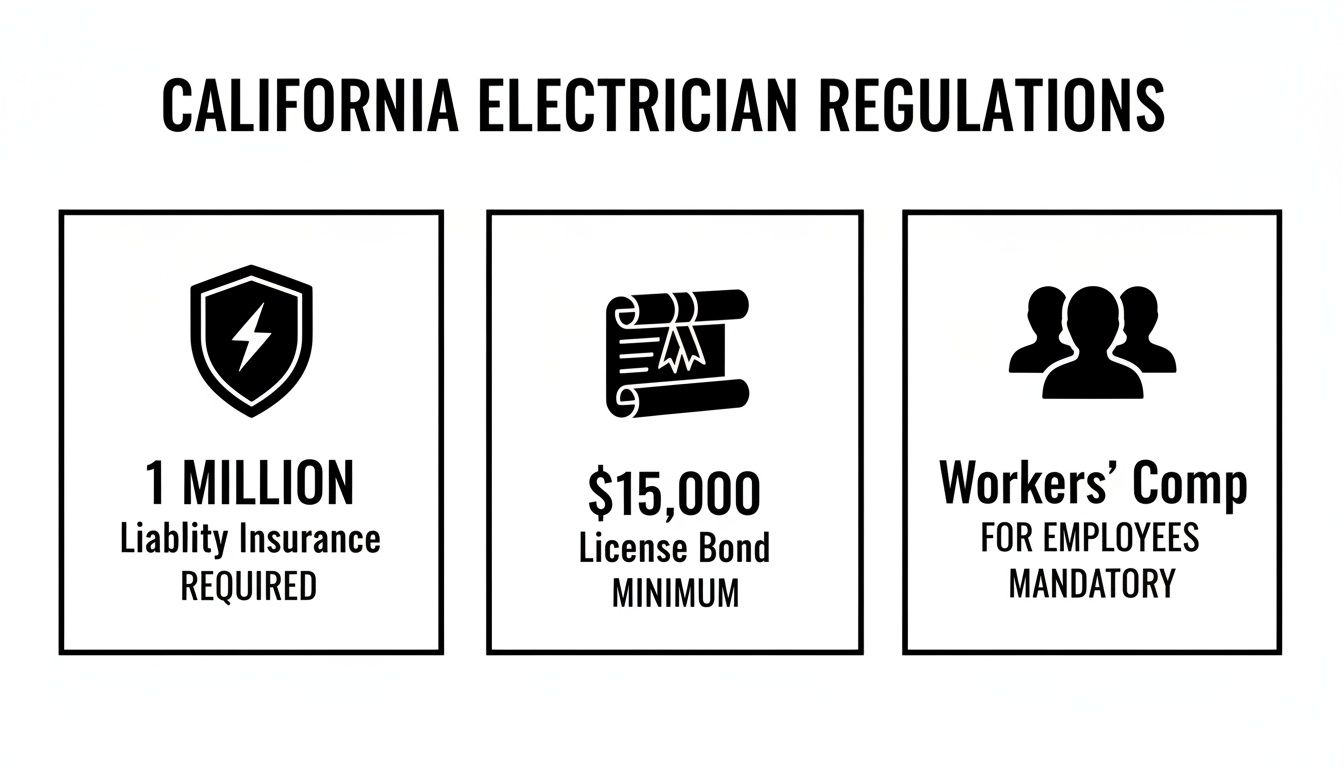
Operating as a licensed electrician in California requires more than mastering your craft. You must also navigate a strict set of state regulations, with the Contractors State License Board (CSLB) setting the standards. Failure to comply with their requirements can jeopardize your license and your entire business.
Understanding these legal obligations is the first step toward building a sustainable business. While it may seem like administrative overhead, it all comes down to a few key financial safeguards every electrical contractor must have.
The CSLB Insurance and Bond Mandates
At its core, the CSLB requires you to prove financial responsibility. You cannot simply obtain your license and begin work; you must demonstrate that you have a safety net in place for potential issues. This ensures that funds are available to cover damages or other problems.
For most electricians, this means securing two items: a license bond and general liability insurance. The license bond serves as your promise to the CSLB and your clients that you will adhere to regulations. The insurance, conversely, protects people and property from the tangible risks of your work.
The CSLB requires every licensed contractor to carry a $25,000 contractor's license bond. This is not insurance that protects you; it is a consumer protection instrument that can be used to cover project failures or legal violations on your part.
Minimum Liability Insurance Requirements
As of January 1, 2023, the CSLB mandated general liability insurance for most licensed contractors, including electricians. This change ensures that if your work causes property damage or injures someone, a policy is in place to respond.
The state has set specific minimum coverage limits based on company size:
- Sole Proprietors: You need at least $1 million per occurrence and a $1 million aggregate limit.
- Firms with 5 or Fewer Personnel: The requirement is $1 million per occurrence and a $2 million aggregate limit.
- Firms with More Than 5 Personnel: Your aggregate coverage must be $3 million or higher, based on your total team size.
Note that these are minimums. Many electricians opt for higher limits to provide greater financial protection. You can explore these statewide rules in more detail in our complete guide to California business insurance requirements.
California's Strict Workers' Compensation Laws
When it comes to workers' compensation, California's laws are notoriously strict and offer no flexibility. If you have even one employee—regardless of whether they are full-time, part-time, or temporary—you are legally required to have a workers' comp policy. Exceptions are virtually nonexistent.
Ignoring this mandate is a criminal offense, and the CSLB will enforce severe penalties, including:
- An immediate stop-work order, halting all operations.
- Heavy fines up to $10,000 for every uncovered employee.
- The possibility of jail time.
Even as a sole proprietor with no employees, you are not exempt from this process. You must still formally file a "Workers' Compensation Insurance Exemption" form with the CSLB. Adhering to these non-negotiable rules is absolutely critical for protecting your license, your team, and your business.
How Your Insurance Premiums Are Calculated
Determining your electrician's liability insurance quote can feel like tracing a wire through a crowded junction box. While the final premium might seem arbitrary, it is the result of a precise risk calculation.
Insurance carriers do not guess. They analyze your business through a specific lens, predicting the probability of a claim and its potential cost. Just as a larger, more complex job requires more time and materials, a business with greater risk will incur a higher premium. Understanding their evaluation criteria will give you a better grasp of your costs.
Key Factors That Shape Your Insurance Cost
What exactly does an underwriter review when your application is submitted? The price you pay is a direct reflection of your company's risk profile. While every detail is considered, a few key elements carry the most weight.
Here are the primary factors that drive your insurance rate:
- Type of Electrical Work: This is a major determinant. An electrician focused on low-voltage residential jobs presents a fundamentally different risk than a contractor working on high-voltage industrial systems. The more hazardous the work, the higher the premium.
- Number of Employees: It is a matter of scale—more employees mean more work completed, but it also increases the probability of a mistake or an accident. Your payroll is a primary factor for calculating both general liability and workers' compensation premiums.
- Business Location: Your operating area matters. Working in a major metropolitan area like Los Angeles, with its higher cost of living and litigious environment, will almost always result in higher rates than working in a rural part of California.
- Claims History: Your past performance is the best indicator of future risk. A business with a history of claims, particularly large or frequent ones, will be viewed as higher-risk and will pay more than a business with a clean record.
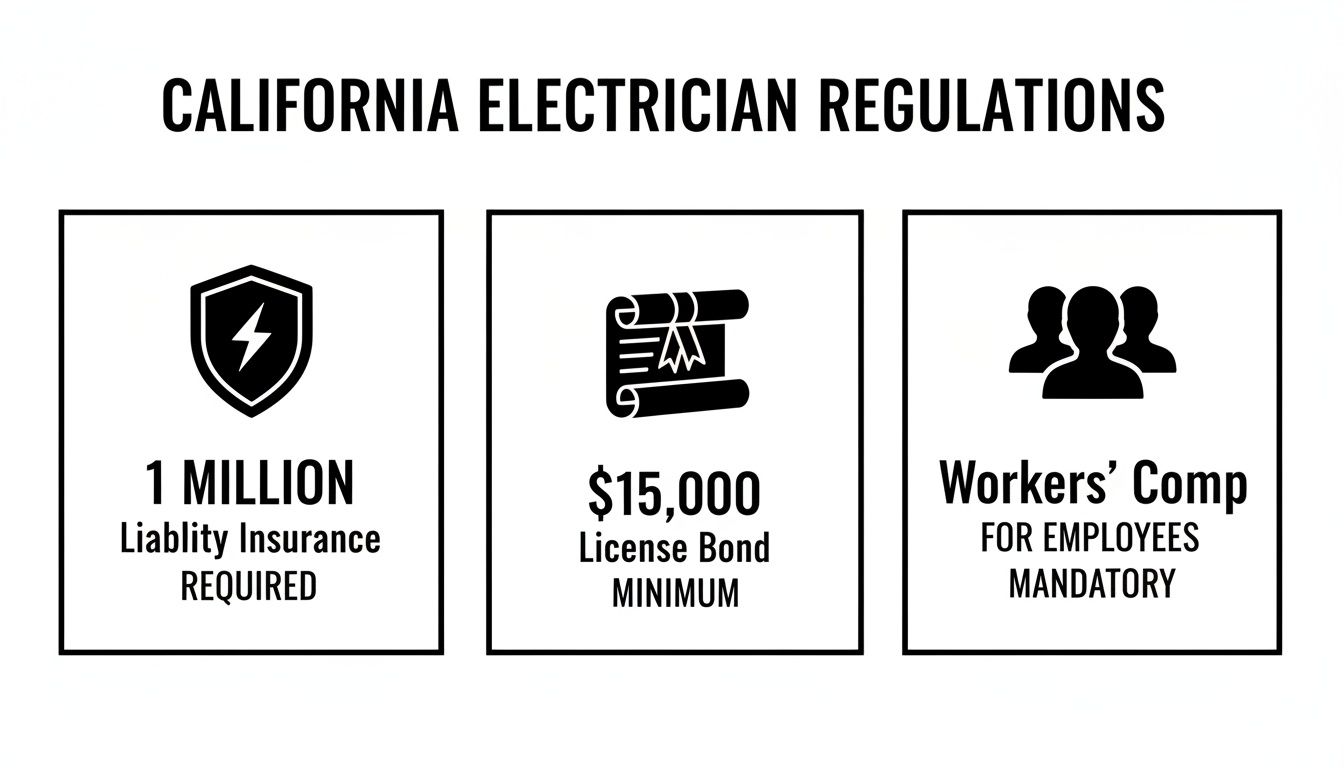
The visual below shows how liability insurance fits into the broader picture of an electrician's legal requirements in California.
As you can see, general liability is just one component of your responsibility, alongside your license bond and workers' compensation coverage. Each protects you from a different type of financial risk.
Sample Premiums for Different Business Scenarios
To make this more concrete, let’s examine some real-world examples. The figures below are typical premium ranges for different electrical businesses in California, but your final quote will depend on your specific details.
A useful way to think about it is that your premium reflects your "risk footprint." A larger business undertaking high-stakes projects has a bigger footprint, and the insurance cost reflects that.
Solo Electrician (Residential Focus)
A one-person operation focusing on residential service calls, remodels, and new home wiring with a flawless claims history can expect to pay between $600 and $1,500 annually for a standard general liability policy.
Small Firm (3-5 Employees, Mixed Work)
For a small company with a crew of 3-5 electricians performing a mix of residential and light commercial jobs, the costs increase. The larger payroll and more diverse work place annual general liability premiums in the range of $2,500 to $6,000.
Commercial Contractor (10+ Employees, High-Risk Work)
A larger contractor with 10+ employees specializing in industrial or high-voltage commercial projects faces the most significant risks. For a business of this scale, annual premiums ranging from $10,000 to $30,000 or more are common, depending heavily on their specific contracts and safety record.
Real-World Claims and How Insurance Responds

Insurance policies can feel like mere paperwork until the day they are needed. The true value of electrician's liability insurance becomes evident the moment something goes wrong on a job. Let's review a few real-world scenarios to see how having the right coverage can be the difference between a manageable issue and a business-ending catastrophe.
Consider these as case studies in business survival. Each one highlights a common risk in the electrical trade and demonstrates exactly how the appropriate policy is designed to intervene and protect you.
Claim 1: The Power Surge Disaster
An electrician is hired to upgrade the main service panel in an older home. The job appears to be completed without issue. However, hours later, a hidden wiring error sends a massive power surge through the house, causing devastating damage.
The surge destroys over $15,000 worth of the client's high-end electronics—the home theater, computers, and smart appliances are all rendered useless. The homeowner is furious and demands full replacement cost, threatening a lawsuit.
How Insurance Responded:
This is a classic general liability claim. Instead of facing this bill alone, the electrician contacted his insurance provider. An adjuster investigated, confirmed the damage was a direct result of the work, and the policy paid the homeowner for the destroyed equipment, minus the electrician’s deductible.
Without that policy, the electrician would have faced a $15,000 bill and a contentious legal battle. With coverage, the problem was resolved.
Claim 2: The Faulty Design Advice
A commercial client hires an electrical contractor to design the complete lighting and power system for a new retail store. Based on the client's stated needs, the electrician recommends a specific layout. Unfortunately, the design cannot handle the store's high-tech POS and security systems, leading to daily crashes and operational chaos.
The store owner sues, claiming the flawed advice led to $50,000 in lost revenue and the cost to redesign and reinstall the entire system.
How Insurance Responded:
This issue did not involve physical damage, so general liability would not apply. This is where the electrician’s Professional Liability (or E&O) insurance became crucial. The policy covered the attorney's fees to defend the contractor and ultimately paid a settlement for the client's financial losses.
Claim 3: The Accidental Job Site Fire
During a complex commercial installation, an employee accidentally drops a tool onto live wiring. The resulting arc flash ignites nearby construction materials. Before the fire is extinguished, it causes $75,000 in damage to the structure. To complicate matters, the employee suffers moderate burns to his hands and arms.
This single incident created two significant financial threats: a lawsuit from the general contractor for property damage and a substantial injury claim from the employee.
How Insurance Responded:
This complex situation triggered two different policies working in tandem:
- General Liability: This policy handled the property damage claim, covering the $75,000 to repair the building.
- Workers' Compensation: This paid for the employee's medical treatment, physical therapy, and a portion of his lost wages while he was unable to work.
In our trade, a single mistake can carry a high price. Across the U.S., the average general liability claim is $38,000 per incident. Considering California businesses already face premiums that are 22% higher than the national average, operating without coverage is an enormous gamble. Data shows that insured businesses recover 95% faster from claims, while 40% of uninsured businesses are forced to close permanently after a disaster.
When it comes to bodily injury claims, the potential costs can be staggering. Using a personal injury settlement calculator can provide a rough estimate of a claim's potential value, reinforcing the critical importance of liability protection.
Securing the Right Coverage for Your Business
You now have a solid understanding of the different types of electrician's liability insurance. The next step is to translate that knowledge into a tangible plan that protects your business. This is about more than satisfying a CSLB requirement; it is about building a financial firewall around everything you have worked to create.
While the process might seem daunting, it is straightforward if broken down into steps. Following a simple checklist ensures you acquire the exact coverage you need without paying for unnecessary extras. This approach puts you in control of your company's future.
Your Step-by-Step Purchasing Guide
Before engaging an agent, the first step is to conduct a thorough self-assessment of your business. This analysis is the foundation for receiving a truly accurate and fair quote.
Here is a clear path to get you started:
Assess Your Unique Business Risks: You cannot obtain the right coverage until you know what you are protecting. Are you primarily engaged in low-voltage residential jobs, or do you work on high-risk industrial sites with complex machinery? Your specific risk profile is the single most important factor in determining your needs.
Gather Your Documents: To get an accurate quote, an underwriter requires specific details. Having this information ready will streamline the process:
- Your CSLB license number.
- Your annual gross revenue and total payroll figures.
- A clear list of services offered, especially any high-risk work.
- Your company's claims history from the last 3-5 years.
Compare Quotes from Multiple Carriers: This is critical. Never accept the first offer you receive. Rates, terms, and policy details can vary significantly between insurance companies. Partnering with an expert can save you substantial time and money.
Working with an independent agency like ISU Insurance Services provides a significant advantage. Instead of you spending hours contacting numerous companies, one agent shops the market for you. They leverage direct access to over 300+ carriers to find the policy that best fits your business.
Partnering with an Independent Agent
The primary benefit of using an independent agent is that they work for you, not for a single insurance carrier. Their role is to be your advocate—to match your business with the right policy by comparing coverage details and finding competitive pricing that fits your budget. This partnership offers expert guidance and helps ensure no dangerous gaps in your protection are overlooked.
The final step is to initiate the process. With your business details prepared, you are ready to find a policy that delivers both compliance and true peace of mind.
Frequently Asked Questions
Even with a firm grasp of the basics, some questions may remain. This is perfectly normal. Let's address a few of the most common inquiries we receive from electricians to clarify what your policy truly covers.
Does General Liability Insurance Cover My Tools?
This is a significant and common misconception. The answer is no. Your general liability policy is designed to protect you from claims made by third parties—for example, property damage or injuries you cause to a client or a bystander. It does not cover your own business property.
To protect your expensive tools and equipment from theft, damage, or loss, you need a different type of coverage, typically called Tools and Equipment Insurance (or Inland Marine). This is an essential policy that can be easily added to your insurance package.
Do I Need Workers' Comp for Myself in California?
This is a nuanced issue. As a sole proprietor in California with no employees, the state does not legally mandate that you purchase workers' compensation insurance for yourself. However, there is a major caveat.
Most general contractors and many clients will require you to provide proof of workers' comp before allowing you on a job site as a standard contractual requirement. Furthermore, the moment you hire anyone—even a single part-time helper—you are legally mandated to carry workers' comp for them.
What Is the Difference Between Per Occurrence and Aggregate Limits?
Understanding this distinction is critical to appreciating the true value of your policy. Your "per occurrence" limit is the maximum amount your insurance company will pay for any single claim. Your "aggregate limit" is the total amount they will pay for all claims combined during your one-year policy period.
Think of it this way: A policy with a $1 million per occurrence and $2 million aggregate limit means you are covered up to $1 million for one major accident. If you had another, separate claim later that year, you would have another $1 million of coverage available. Once you reach the $2 million total for the year, you are financially responsible for any further claims.
Can I Get a Discount for Bundling Insurance Policies?
Absolutely. In fact, bundling is one of the most effective ways to secure better coverage at a lower cost. Insurance carriers prefer to consolidate your business under one provider and will offer significant discounts for doing so.
A Business Owner's Policy (BOP) is an excellent example, combining General Liability with Commercial Property insurance into one package. Adding your Commercial Auto policy can increase the savings even further. The best way to discover these discounts is to work with an independent agent who can shop the market and find the carrier that offers the best value for your specific needs.
Ready to secure the right protection for your electrical business without overpaying? The team at ISU Insurance Services can help. Get a tailored quote from ISU Insurance Services to compare options from over 300 carriers and build a plan that fits your needs perfectly.