
Why Understanding Earthquake Insurance Rates Matters for California Homeowners
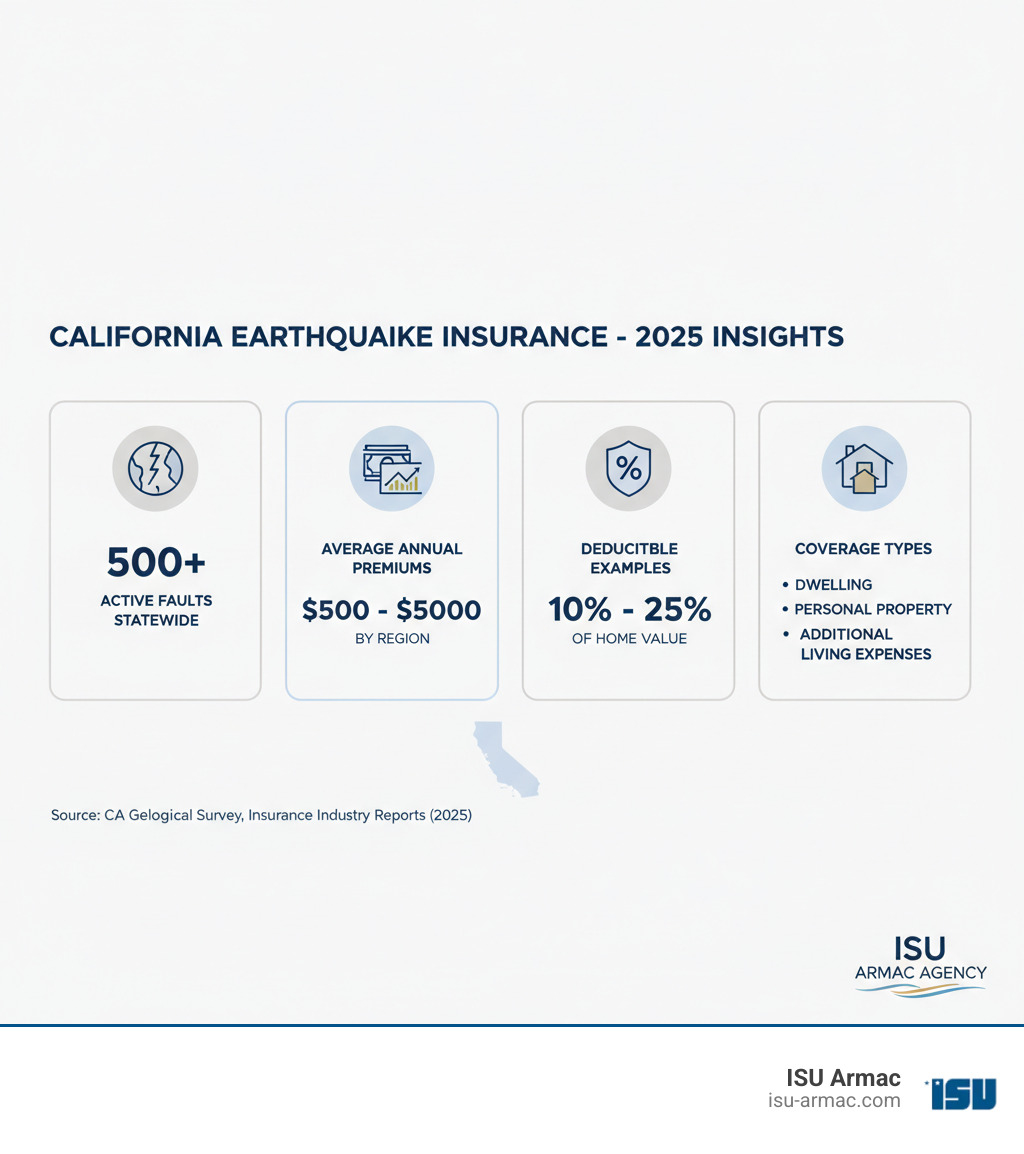
Earthquake insurance rates California vary widely, with annual premiums for a single-family home typically ranging from $800 to $1,874. Costs can be as low as $500 in lower-risk areas or exceed $5,000 in high-risk zones like Irvine. Deductibles are usually 10% to 25% of your home’s insured value, and key rate factors include your home’s location, age, and construction type.
Living in California means living with earthquake risk. With over 500 active faults, the question isn’t if the ground will shake, but when. Standard homeowners insurance excludes earthquake damage, leaving you financially exposed. Without separate coverage, you could face catastrophic repair costs, from foundation work costing over $10,000 to structural damage in the hundreds of thousands.
This guide will help you understand what drives earthquake insurance rates, what coverage costs, and how to make an informed decision. I’m Ryan McEachron, CEO of ISU Insurance Services ARMAC Agency. With decades of experience serving Victorville and the High Desert, I’ve helped countless residents steer their options. Let me help you protect your most valuable asset.
Understanding the Average Cost of Earthquake Insurance in California

When homeowners ask about earthquake insurance rates California, they want a straight answer on cost. While there’s no single figure, the typical annual premium falls between $800 and $1,500, with some policies for single-family homes averaging closer to $1,874 per year. This range reflects the real differences in earthquake risk across the state.
A helpful rule of thumb is that for every $100,000 of coverage, you’ll generally pay between $500 and $1,000 in annual premiums. For a home with a $400,000 rebuild cost, that means roughly $2,000 to $4,000 per year. It’s a significant investment, but it protects against catastrophic repair costs.
Regional differences highlight the risk variations. Average premiums are about $1,739 in San Diego and $1,927 in San Francisco. The statewide range is even wider, from as low as $500 in areas like Fremont to nearly $5,000 in high-risk zones like Irvine. These prices reflect seismic hazards based on fault proximity, soil conditions, and building codes.
Because of this, a personalized quote is far more useful than a statewide average. Your specific location and home will determine your actual premium. At ISU Armac, we shop multiple carriers to find the best rate for your situation. For a deeper dive, see our guide on what is the average cost of earthquake insurance in california.
Key Factors That Influence Earthquake Insurance Rates California
This section explains the ‘why’ behind your earthquake insurance rates California.
Your Home’s Location and Proximity to Faults
Where you live is the most significant factor. Proximity to an active fault line increases risk and your premium. The soil type beneath your home is also critical; soft or sandy soil amplifies shaking, while bedrock is more stable. Insurers use sophisticated models considering seismic activity and geology to assess risk at a neighborhood level. You can explore your area’s risk on the National Seismic Hazard Map and learn more about CA earthquakes.
Your Home’s Characteristics
Your home’s structure directly impacts your rates. Home age is key, as newer homes built to modern seismic codes are cheaper to insure. For example, premiums for new homes can be 40% lower than for homes 16-25 years old. Construction materials also matter; flexible wood-frame homes are less expensive to insure than vulnerable unreinforced masonry homes, which can cost $2,000 more annually. The number of stories and foundation type also influence the calculation.
You can lower your premium with seismic retrofitting. Strengthening your home with foundation bolting and cripple wall bracing can earn discounts up to 20% from the California Earthquake Authority, especially for pre-1960 frame homes. These upgrades improve safety and make a compelling case when asking, is earthquake insurance worth it in california?
Your Chosen Policy and Deductible
Your coverage choices are the final factor. The dwelling coverage limit (your home’s rebuild cost, not market value) and personal property limits directly affect your premium. The most significant choice is your deductible, which is a percentage (5% to 25%) of your coverage amount. A higher deductible lowers your premium but increases your out-of-pocket cost. For a $400,000 policy with a 10% deductible, you’d pay the first $40,000. The CEA offers options from 5% to 25%, though some homes (e.g., over $1M or older, un-retrofitted) are restricted to 15% or higher. Some policies allow separate deductibles for dwelling and personal property, offering more flexibility. We can help you find a policy that meets your needs and budget.
What Your California Earthquake Insurance Policy Actually Covers (and What It Doesn’t)
Understanding what your policy covers—and what it doesn’t—is crucial, as it works differently from standard homeowners insurance.

Standard Coverage Inclusions
A typical earthquake policy provides a safety net for seismic damage:
- Dwelling Coverage: Protects the physical structure of your home (foundation, walls, roof). Your limit should reflect the cost to rebuild, not the market value.
- Personal Property Coverage: Covers your belongings, like furniture and electronics, with limits typically from $5,000 to $200,000.
- Loss of Use (ALE): Also known as Additional Living Expenses, this covers temporary housing and other costs if your home is unlivable during repairs. CEA policies include this with no deductible.
- Building Code Upgrades: Helps pay for required upgrades to meet current building codes during repair. CEA policies include a base of $10,000, with options to increase it.
- Emergency Repairs: Many CEA policies cover the first $1,500 of urgent repairs without a deductible.
- Loss Assessment Coverage: For condo owners, this helps pay your share of assessments for repairs to common areas, with CEA coverage up to $100,000.
For a complete breakdown, see our guide on what does california earthquake insurance cover.
Common Exclusions to Be Aware Of
Knowing what isn’t covered prevents surprises:
- Fire Damage: Fire damage following an earthquake is covered by your standard homeowners policy.
- Flood or Tsunami: Damage from quake-triggered floods or tsunamis requires separate flood insurance.
- Landscaping and External Structures: Pools, fences, driveways, and landscaping are typically not covered.
- Vehicles: Damage to cars is covered by the comprehensive portion of your auto insurance.
- Masonry Veneer: Exterior brick or stone facing is often excluded or requires a much higher premium.
- Damage After 72 Hours: Most policies only cover damage that occurs within 72 hours of the initial quake.
Understanding High Deductibles for earthquake insurance rates california
Earthquake insurance deductibles are high, typically 10% to 25% of your coverage limit. For a home insured for $400,000 with a 15% deductible, you would be responsible for the first $60,000 of damage. These high deductibles help keep premiums from becoming unaffordable for catastrophic, widespread events.
The California Earthquake Authority offers deductible options from 5% to 25%, though some homes (valued over $1M or older, un-retrofitted homes) are restricted to a minimum of 15%. Choosing a higher deductible lowers your annual premium but increases your out-of-pocket risk. You can explore deductible options from the CEA to find the right balance. At ISU Armac, we help you work through these numbers to find coverage that protects your home without breaking your budget.
How to Get the Best Earthquake Insurance in California
Finding the right earthquake insurance is manageable with the right information.
The Role of the California Earthquake Authority (CEA)
The California Earthquake Authority (CEA) is a publicly managed, not-for-profit entity created in 1996 to provide residential earthquake insurance. Its rates are not for profit but are based on science-based rates reflecting your property’s actual seismic risk. The CEA is financially sound, with sufficient reserves to pay claims even after a major event. You cannot buy a policy directly from the CEA; they are sold through participating insurance companies and work with your existing homeowners policy. Learn more about California Earthquake Authority insurance.
Where and How to Purchase a Policy
Earthquake insurance is not legally required in California. However, state-regulated insurers must offer it to you in writing every two years. The most common way to buy a policy is through your current homeowners provider if they are participating residential insurers with the CEA. Alternatively, you can purchase a stand-alone policy from a private insurer. A critical point: you cannot buy coverage immediately after a major quake, as insurers impose a waiting period of 30-60 days. Don’t wait for a disaster to strike. Our guide on how to buy earthquake insurance walks you through the process.
How to Estimate Your Specific earthquake insurance rates california

To get a personalized estimate, use the free online CEA Premium Calculator. You’ll need your home’s address, year built, construction type, square footage, and retrofitting status. The tool lets you experiment with different coverage limits and deductibles to see how they affect your premium. This helps you find a balance between affordable premiums and manageable out-of-pocket costs. While the calculator provides an estimate, you’ll need to work with an insurer to get a final quote.
As an independent agency serving Victorville, Apple Valley, Hesperia, Oak Hills, and Southern California, ISU Armac can shop multiple carriers for you. We compare CEA options and private policies to find the best earthquake insurance rates California for your unique situation. Contact us for a personalized consultation.
Frequently Asked Questions about California Earthquake Insurance
We hear many questions from homeowners across Southern California. Here are answers to the most common ones.
Is earthquake insurance mandatory in California?
No, earthquake insurance is not legally required. However, state-regulated homeowners insurance companies must offer it to you in writing every other year, giving you the option to purchase it.
Is it worth getting earthquake insurance in California?
This is a personal decision based on your financial situation and risk tolerance. Consider the potential out-of-pocket costs for repairs: foundation work can exceed $10,000, and a full rebuild can cost hundreds of thousands. For most families, covering a catastrophic loss without insurance is not feasible. Federal aid is also limited and typically comes as low-interest loans, not grants. FEMA cannot duplicate insurance benefits after a major disaster. For many, the peace of mind is worth the investment.
Can I get a discount on my earthquake insurance?
Yes. The most significant discounts on earthquake insurance rates California come from seismic retrofitting. The California Earthquake Authority offers discounts of up to 25% for older homes that have been properly retrofitted. Common retrofits include bolting the house to its foundation and bracing cripple walls. These upgrades not only lower your premium but also make your home significantly safer.
Protect Your Biggest Asset from the Next Big One
Living in California means being prepared for earthquakes. While earthquake insurance rates California can seem high, the cost of rebuilding without coverage is financially devastating for most families. Standard homeowners policies don’t cover quake damage, and federal aid is typically limited to loans that must be repaid.
Assessing your personal risk is the first step. Could your finances withstand major structural repairs or a complete rebuild? For most, the answer is no. Earthquake insurance is about protecting your largest asset and ensuring your financial security.
At ISU Armac, we serve as your neighbors in Victorville, Apple Valley, Hesperia, and Oak Hills. As an independent agency, we work for you, not a single insurance company. We shop multiple carriers to find coverage that fits your budget and provides real peace of mind.
The best time to get coverage is now, before the next quake hits and waiting periods kick in. For a comprehensive look at your options, explore our earthquake insurance California solutions. Contact us today to find the right protection for your home and family.