
Why Nonprofit Organizations Need Comprehensive Liability Protection
Errors and omissions insurance for nonprofits protects organizations from costly lawsuits arising from professional mistakes, negligent advice, or failure to deliver promised services. While most nonprofits carry Directors & Officers (D&O) insurance to protect board members, this coverage typically excludes professional services – creating a dangerous gap that could threaten your mission and financial stability.
Quick Answer: E&O Insurance for Nonprofits
- What it covers: Professional mistakes, negligent advice, failure to deliver services
- Who needs it: Nonprofits providing counseling, consulting, education, or grant administration
- Cost: Median of less than $50/month for most nonprofits
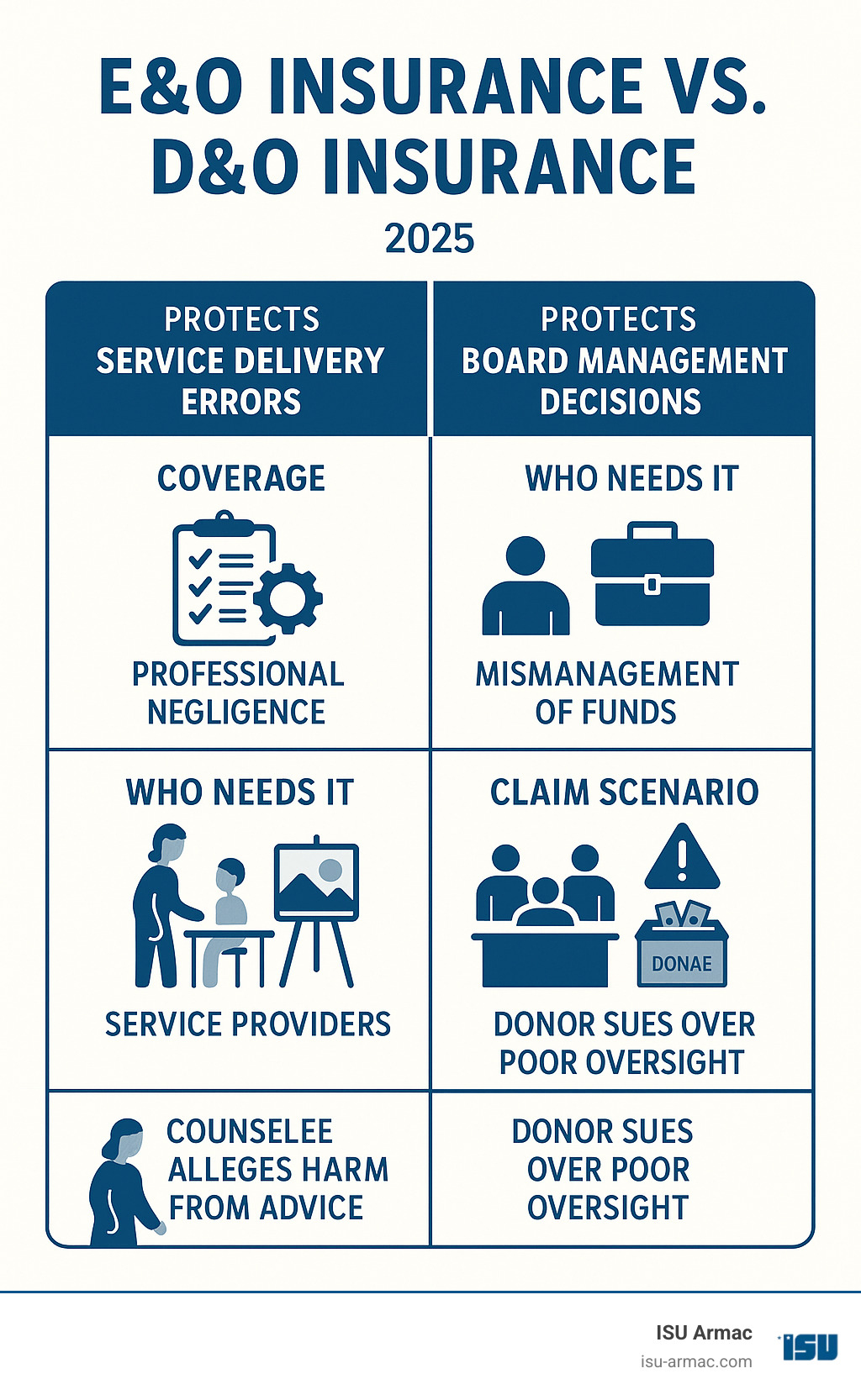
- Key difference from D&O: D&O protects board decisions; E&O protects service delivery
- Why it matters: Legal defense costs can exceed $100,000 even for baseless claims
Nonprofits face unique risks that many organizations don’t fully understand. A counseling center where staff fails to recognize warning signs, an animal shelter that skips a background check, or a foundation providing informal advice at a conference – these scenarios can all trigger expensive lawsuits that D&O insurance won’t cover.
The reality is stark: most nonprofits mistakenly believe their D&O coverage is sufficient protection. However, D&O policies almost always contain specific professional services exclusions, meaning they don’t cover claims related to the actual services your organization provides to the community.
As Ryan McEachron, CEO of ISU Insurance Services ARMAC Agency, I’ve helped numerous Victorville-area nonprofits understand the critical importance of securing proper errors and omissions insurance for nonprofits to protect their mission-driven work. My experience on the Victorville City Council and with local community organizations has shown me how even well-intentioned nonprofits can face unexpected liability exposure.
Easy errors and omissions insurance for nonprofits glossary:
- errors and omissions insurance
- errors and omissions insurance cost
- errors and omissions insurance coverage
The Critical Difference: E&O vs. D&O Insurance
Many nonprofit leaders think they have complete protection once they purchase Directors and Officers insurance. Unfortunately, this common assumption creates a dangerous blind spot that could leave your organization vulnerable to costly lawsuits.
The truth is, D&O and E&O insurance work together like two different shields, each protecting against distinct types of risks. Understanding how they complement each other is essential for keeping your nonprofit truly safe.

What is Directors & Officers (D&O) Liability?
D&O insurance acts as a personal safety net for your board members and officers. It protects their personal assets when someone claims they made poor management decisions, breached their fiduciary duty, or committed other wrongful acts while governing your organization.
Think of it this way: if a major donor sues your board for allegedly mismanaging funds, or if a former employee files a wrongful termination lawsuit, D&O insurance steps in to cover legal costs and potential settlements. This protection often extends to employment practices liability as well, covering claims of harassment or discrimination.
Without this coverage, board members could face personal financial ruin simply for volunteering their time to serve your mission. That’s why D&O insurance helps you attract and retain quality leadership – people are more willing to serve when they know their personal assets are protected.
What is Errors & Omissions (E&O) Liability?
While D&O protects your leadership’s decisions, errors and omissions insurance for nonprofits protects the actual services your organization provides. This coverage focuses on the day-to-day professional work performed by your nonprofit entity, employees, and volunteers.
E&O insurance becomes crucial when clients or beneficiaries claim your organization made professional mistakes, provided negligent services, or failed to deliver promised work. Whether you’re providing counseling services, administering grants, or offering educational programs, this coverage protects against claims that your professional services caused financial harm or failed to meet expectations.
The key difference is clear: D&O protects the people making decisions, while E&O protects the organization delivering services. For more detailed information about this coverage, visit our guide on Errors and Omissions Insurance.
The Critical Coverage Gap
Here’s where many nonprofits get caught off guard: D&O policies almost always contain professional services exclusions. This means if someone sues your organization over the quality or delivery of your professional services, your D&O policy won’t cover it.
This misconception of complete coverage leaves many well-intentioned nonprofits with incomplete protection. Imagine your nonprofit provides consulting advice to another organization, and they later claim your guidance was negligent and caused them financial loss. Your D&O policy would likely deny this claim because it arose from professional services, not management decisions.
The solution requires separate policies working together. D&O handles governance and management claims, while errors and omissions insurance for nonprofits handles service delivery claims.
| Feature | Directors & Officers (D&O) Insurance | Errors & Omissions (E&O) Insurance |
|---|---|---|
| Who is Protected | Individual directors, officers, and board members | The nonprofit entity, employees, and volunteers providing services |
| What is Covered | Management decisions, breach of fiduciary duty, employment practices | Professional mistakes, negligence, failure to deliver services |
| Typical Claim Example | Donor sues board for alleged fund misuse; wrongful termination lawsuit | Counseling negligence claim; incorrect grant administration advice |
Understanding this critical difference helps ensure your nonprofit has truly comprehensive protection. Many organizations find this gap only after facing a claim that falls through the cracks between their coverages. Don’t let that happen to your mission-driven work.
Why Your Nonprofit’s Services Create E&O Risks
Running a nonprofit means you’re in the business of helping others, but every act of service creates potential liability. Whether you’re counseling families in crisis, managing grants for other organizations, or providing educational workshops, each interaction carries the risk of claims that only errors and omissions insurance for nonprofits can protect against.

The reality is that many nonprofit services fall under what insurance companies consider “professional services,” even when they don’t feel particularly professional. That friendly advice you gave at a conference? The grant paperwork you help smaller organizations steer? These seemingly routine activities can trigger expensive lawsuits if something goes wrong.
Claims Arising from Professional Services
Think about the core work your nonprofit does. If you provide counseling services like mental health support or crisis intervention, you’re vulnerable to claims of misdiagnosis or failure to prevent harm. One missed warning sign could lead to a lawsuit, regardless of your staff’s good intentions.
Educational programs create their own risks. When you run workshops, tutoring sessions, or community education, participants expect accurate, helpful information. If your curriculum proves inadequate or your advice leads to negative outcomes, you could face claims for professional negligence.
Grant administration might seem like straightforward paperwork, but it’s actually a high-risk professional service. When you manage or disburse grants for others, timing and accuracy matter enormously. Miss a deadline or send the wrong amount, and you could be looking at significant financial liability.
Even consulting advice – whether formal or informal – can create problems. That casual conversation at a nonprofit conference where you shared what worked for your organization? If another nonprofit follows your advice and suffers losses, they might decide to sue you for negligent guidance.
The challenge is that these activities often don’t feel like “professional services” in the traditional sense. You’re just trying to help. But in our increasingly litigious society, good intentions don’t provide legal protection. Recent cases of nonprofit lawsuits show that organizations face claims ranging from wrongful termination to fund misuse, highlighting why comprehensive liability coverage is essential.
Understanding Vicarious Liability
Here’s where things get particularly tricky: your nonprofit can be held responsible for mistakes made by people who don’t even work for you directly. This concept, called vicarious liability, means you’re on the hook when employees, volunteers, independent contractors, or vendors make professional errors while working on your behalf.
Imagine hiring a freelance accountant who makes a significant error that harms a donor financially. Even though they’re not your employee, your nonprofit could face a lawsuit for their professional negligence. The same applies when you engage consultants who provide faulty advice to your beneficiaries – your organization bears the liability risk.
This is why errors and omissions insurance for nonprofits needs to cover not just your direct staff, but also those third parties acting on your behalf. You can outsource the work, but you can’t outsource the responsibility.
Common Scenarios of E&O Claims Against Nonprofits
Real-world examples help illustrate just how easily these situations can arise. Picture a counseling center where staff fails to recognize suicidal ideation in a teenager who later attempts self-harm. The family could sue for professional negligence, claiming inadequate training or care protocols.
Or consider an animal shelter that skips a background check during a busy adoption event. If that adopted pet is later abused, the original owner or animal welfare advocates might sue the shelter for negligent adoption procedures.
Sometimes the risks come from trying to help other organizations. When a foundation director gives informal advice at a conference based on their endowment success, they’re creating potential liability. If a smaller nonprofit follows that advice and incurs losses, they might sue the foundation for negligent guidance.
Grant fund disbursement errors create particularly expensive problems. Send the wrong amount, miss a deadline, or make a calculation mistake, and you could face claims from both recipients and funders. These administrative errors might seem minor, but they can trigger major financial consequences.
Even simple failure to submit paperwork can lead to lawsuits. When a social services nonprofit employee forgets to file a client referral, causing that person to miss out on critical support services, the organization faces potential claims for professional negligence.
The common thread in all these scenarios? They involve well-meaning nonprofits trying to do good work, but facing legal consequences when things go wrong. Without proper E&O coverage, these claims can threaten both your mission and your organization’s financial survival.
Anatomy of an E&O Policy: Coverage, Benefits, and Cost
When you’re looking at errors and omissions insurance for nonprofits, it’s important to understand what you’re actually getting for your investment. Think of an E&O policy as your organization’s professional safety net – one that’s designed specifically for the unique challenges nonprofits face every day.

Key Components and Benefits of errors and omissions insurance for nonprofits
The heart of any good E&O policy lies in its comprehensive protection. Legal defense costs represent perhaps the most valuable component of your coverage. Even if someone files a completely baseless claim against your nonprofit, you’ll still need attorneys, court appearances, and investigation work. These costs can quickly spiral beyond $100,000, which is why having insurance cover these expenses from day one is crucial.
As nonprofit consultant Lindsey Baker Bower puts it, “Nonprofit liability insurance helps protect your organization from a variety of issues common to the field. This is often the difference between a nonprofit closing its doors and one that continues to survive and thrive.” That’s exactly what we see here in the Victorville area – organizations that plan ahead stay focused on their mission.
Beyond defense costs, your policy covers settlements and judgments when claims are resolved against your organization. This includes monetary damages, and in some cases, non-monetary relief like emotional distress awards. Some policies even extend to punitive damages where state law allows.
The scope of who’s protected under a quality E&O policy is refreshingly broad. Your nonprofit entity itself gets coverage, along with your employees, volunteers, interns, and even independent contractors providing services on your behalf. This comprehensive approach recognizes how modern nonprofits actually operate – with diverse teams of paid staff and dedicated volunteers working together.
Many policies include retroactive coverage, which protects you for services provided before your policy started, assuming you weren’t aware of any problems when you purchased coverage. Some insurers also offer worldwide coverage for work done globally, as long as any resulting claim gets filed in the United States, its territories, or Canada.
Perhaps most importantly, E&O insurance provides reputation protection and mission continuity. When your organization can handle claims professionally without draining operating funds, you maintain community trust and keep serving those who need you most.
Factors That Influence Your E&O Insurance Cost
Here’s some encouraging news: errors and omissions insurance for nonprofits typically costs less than $50 per month for most organizations. However, your specific premium depends on several key factors that insurers use to assess your risk profile.
The type of services your nonprofit provides plays the biggest role in determining cost. Organizations offering medical counseling or financial advice face higher premiums than those providing general community education or advocacy work. This makes sense – the potential for costly errors varies significantly between different service types.
Your annual revenue gives insurers insight into your organization’s scope and complexity. Generally, higher revenue suggests more extensive operations, which can mean more opportunities for professional errors. Your number of employees and volunteers follows similar logic – more people delivering services means more potential touch points where mistakes could occur.
Your organization’s claims history significantly impacts pricing. A clean track record helps keep costs down, while previous E&O claims signal higher risk to insurers. This is why implementing strong risk management practices from the start pays dividends over time.
Policy limits directly affect your premium – higher maximum payouts cost more in monthly premiums. Your deductible amount works in the opposite direction: choosing to pay more out-of-pocket before insurance kicks in reduces your monthly costs. Finally, your location matters, as insurance costs vary by state and region based on local legal environments and historical claim patterns.
The best way to understand your specific costs is through a customized quote that reflects your nonprofit’s unique situation. For detailed information about pricing factors, check out our comprehensive guide on Errors and Omissions Insurance Cost.
How to Secure the Right Errors and Omissions Insurance for Nonprofits
Getting errors and omissions insurance for nonprofits doesn’t have to feel overwhelming. Think of it like planning a community event – you need to understand your audience, know what resources you have, and work with the right people to make it happen successfully.
Step 1: Assess Your Organization’s Unique Risks
Before you start shopping for coverage, take a step back and really examine what your nonprofit does on a daily basis. This isn’t about your beautiful mission statement hanging in the lobby – it’s about the nitty-gritty work that happens every single day.
Start by reviewing all services your organization provides. Are you offering counseling sessions? Running educational workshops? Managing grants for other organizations? Providing consulting advice to smaller nonprofits? Each of these activities creates different types of professional liability risks.
Next, analyze your contracts carefully. Look at agreements with clients, funding partners, and collaborating organizations. These documents often outline specific professional standards you’re expected to meet and may even require certain levels of insurance coverage.
Don’t forget to evaluate volunteer roles in this process. Your volunteers might be the heart of your organization, but they’re also providing professional services that could create liability. A volunteer grant writer, a retired teacher leading literacy programs, or a former counselor facilitating support groups – they’re all potentially creating professional liability exposure for your organization.
Take time to identify potential error points in each service you provide. What could go wrong? Where might miscommunication happen? What advice could be misunderstood or misapplied? Finally, document these risk points thoroughly. This detailed assessment will be incredibly valuable when you’re discussing coverage options with an insurance professional.
Step 2: Understand the Policy Language
Insurance policies have a well-deserved reputation for being written in complex legal language that can make your eyes glaze over. But understanding the key terms is crucial for getting the right protection. As insurance experts often note, these policies are written much like legal documents, making them challenging for most people to steer without help.
Pay special attention to exclusions – these are the situations your policy won’t cover. If you’re looking at adding E&O coverage to an existing D&O policy, make sure you understand how these exclusions interact. Some policies might exclude certain types of professional services that are central to your mission.
Understand the conditions that must be met for your coverage to apply. Know exactly who falls under the definition of insured – does it include your staff, volunteers, and any independent contractors working on your behalf?
One critical distinction to grasp is whether your policy is claims-made versus occurrence based. Most E&O policies are claims-made, meaning they cover claims filed during the policy period, regardless of when the incident actually happened. This is different from occurrence-based coverage, which protects against incidents that happen during the policy period, no matter when someone files a claim.
For additional guidance on insurance terminology, you can reference resources about reviewing the legal language of insurance.
Step 3: Work with an Independent Insurance Expert
This final step might be the most important one for your nonprofit’s long-term protection. Trying to steer errors and omissions insurance for nonprofits on your own is like trying to write a grant proposal in a language you don’t speak – technically possible, but probably not going to end well.
An independent insurance expert will help you gather all necessary documents about your nonprofit’s operations, financial situation, and service delivery methods. They’ll know exactly what information insurers need to provide accurate quotes.
The real value comes in their ability to compare quotes from multiple carriers. At ISU Armac, our unique approach means we can shop your coverage with various insurance companies, ensuring you’re not stuck with whatever one company offers. This competitive process often results in better coverage options and more competitive pricing.
Working with an expert also means your coverage gets custom to your specific needs. We don’t believe in cookie-cutter solutions because every nonprofit faces different risks. A counseling center needs different protection than a grant-making foundation, and your policy should reflect those differences.
Most importantly, we help you find the best rates without sacrificing coverage quality. Our relationships with multiple carriers mean we can leverage competition to your advantage, often finding savings you wouldn’t find on your own.
Throughout this process, you’ll leverage our expertise to understand complex insurance terms, steer the application process, and make informed decisions about your nonprofit’s protection. Our goal is to make this process as straightforward as possible, so you can focus on what you do best – serving your community.
Conclusion
Your nonprofit’s mission is too precious to risk losing to an unexpected lawsuit. Whether you’re running a counseling center, managing grants, or providing educational services, every day brings opportunities to make a difference – and unfortunately, opportunities for things to go wrong.

The harsh reality is that D&O insurance alone simply isn’t enough. While it protects your board members from management decisions, it leaves your actual services completely exposed. That counseling session, that grant advice, that educational workshop – none of these are covered by D&O policies, which typically exclude professional services entirely.
This is where errors and omissions insurance for nonprofits becomes absolutely essential. It’s the missing piece that protects what matters most: your organization’s ability to serve your community. When a client claims your advice was negligent, or when an administrative error leads to financial harm, E&O coverage steps in to handle legal costs that could otherwise drain your resources and threaten your mission.
Think about it this way – you’ve worked too hard building your nonprofit to let one professional mistake bring it all down. The good news? Most nonprofits pay less than $50 per month for this crucial protection. That’s a small price for the peace of mind that comes with knowing your organization can weather unexpected storms.
At ISU Armac, we’ve helped countless Victorville-area nonprofits steer these insurance decisions. We understand that every dollar matters in your organization, which is why we shop multiple carriers to find you the best coverage at the most affordable rates. Our goal isn’t just to sell you a policy – it’s to make sure you have the right protection so you can focus on what you do best: changing lives in your community.
Don’t wait until a claim arrives to find the gaps in your coverage. Proactive protection today means your mission can continue thriving tomorrow.
Ready to ensure your nonprofit is doing good, protected? Get a quote for your nonprofit’s E&O insurance today.