
Introduction: Your First Line of Defense on the Job Site

General liability for construction is essential insurance that protects contractors from third-party claims for bodily injury, property damage, and personal or advertising injury. Here’s what you need to know:
- What it covers: Legal defense costs, settlements, and judgments when your work causes injury or damage to others
- Typical limits: $1 million per occurrence / $2 million aggregate for small to medium contractors
- Why it matters: A single job site accident lawsuit can bankrupt your business without proper coverage
- Who needs it: Every contractor, from one-person operations to large general contractors
Construction is a high-risk industry with daily hazards. Third-party claims for bodily injury and property damage are not just possible; they’re common.
The financial impact of these incidents can be devastating. According to industry data, a single large settlement from a liability claim could financially ruin a contractor. This is why general liability insurance is fundamental protection. It acts as a form of risk transfer, shifting the financial burden of accidents from your business to the insurance carrier.
Beyond protecting your assets, general liability insurance helps you meet the legal obligations required by most construction contracts, licenses, and state regulations. Many clients won’t hire a contractor who can’t provide proof of adequate coverage.
I’m Ryan McEachron, Chief Executive Officer of ISU Insurance Services ARMAC Agency in Victorville, where I’ve spent decades helping contractors steer general liability for construction and build comprehensive protection plans. Through my work with local businesses and my service on the Victorville City Council, I’ve seen how the right insurance protects livelihoods and enables contractors to work with confidence.
Explore more about General liability for construction:
- completed operations liability
- premises and operations liability
- public liability insurance cover
What is General Liability Insurance for Construction?

At its core, general liability for construction, or Commercial General Liability (CGL), protects your business from financial losses due to third-party claims of bodily injury, property damage, or personal and advertising injury. It is the foundational coverage for contractors.
Think of it as a shield. If a visitor trips at your Victorville job site or a ladder damages a client’s floor, our general liability for construction policy steps in. It covers legal defense costs, settlements, and judgments up to your policy limits, protecting you from costly lawsuits.
This “risk transfer” is vital. The insurance carrier assumes the financial risk of accidents, protecting your assets and future. A valid general liability for construction policy is also often a legal obligation for licenses, contracts, and commercial leases.
Core Coverages: What’s Protected?
A general liability for construction policy primarily addresses three key areas of third-party claims:
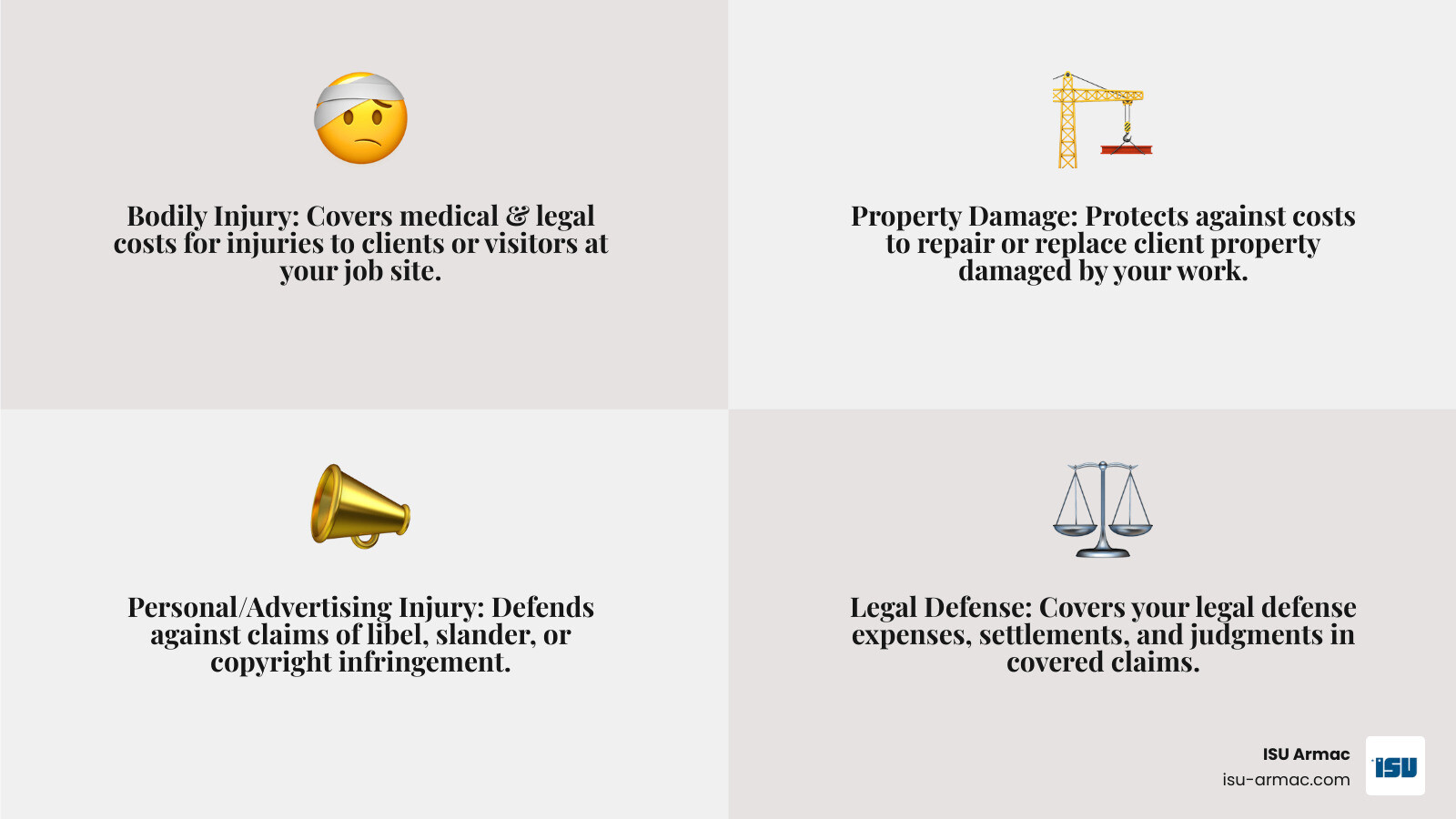
- Bodily Injury: This covers physical harm to non-employees. For example, if a delivery driver slips on debris at your Hesperia job site, the policy helps cover their medical bills and your legal defense costs.
- Property Damage: This protects against damage to someone else’s property. If your crew damages a client’s landscaping in Oak Hills or a pipe bursts causing water damage, our policy helps pay for repairs or replacement.
- Personal and Advertising Injury: This important coverage addresses non-physical harm, such as libel, slander, or copyright infringement in your advertising. If your marketing uses a copyrighted image, this coverage can help with legal expenses.
These are often bundled under Premises and Operations Liability, which covers claims from injuries or damages on your premises or during your operations. For a deeper dive, explore What does general liability insurance cover for a contractor?.
The Importance of Completed Operations Coverage
Claims can arise long after a project is finished. This is where Completed Operations Liability is indispensable.
This extends your general liability for construction protection to claims from your completed work. For example, if a roof you installed in Victorville leaks a year later causing water damage, this coverage would respond to the claim. Without it, you could be personally liable.
Latent defects—flaws that emerge over time—are common. California’s “statute of repose” allows claims years after project completion, making this long-term protection crucial for insulating your business from future liabilities.
Understanding Policy Limits and Exclusions
Every general liability for construction policy has limits and exclusions that define your coverage.
Policy Limits: There are two main limits:
- Per-Occurrence Limit: The maximum your policy pays for a single claim or incident. A $1 million per-occurrence limit means the insurer pays up to $1 million for one claim.
- Aggregate Limit: The total maximum your policy pays for all claims within a policy period (usually one year). A common limit is $1 million per occurrence / $2 million aggregate. Learn more on our General Liability Insurance Coverage page.
Common Exclusions: General liability is broad but doesn’t cover everything. Common exclusions include:
- Employee Injuries: Covered by Workers’ Compensation insurance.
- Professional Errors (E&O): Requires a separate Professional Liability policy for claims from design flaws or faulty advice.
- Damage to Your Own Work: GL typically doesn’t cover repairing your own faulty work, only the resulting damage to third-party property or injury.
- Contractual Liability: Liability you assume under a contract is often excluded.
- Pollution: Requires specialized Contractor’s Pollution Liability insurance.
- Intentional Damage: Policies do not cover damages from intentional acts.
Understanding these limitations helps identify coverage gaps and build a comprehensive insurance program.
Key Factors Influencing Your General Liability for Construction Policy

The cost of general liability for construction isn’t one-size-fits-all; it’s influenced by factors unique to your business. We customize policies to fit your needs, starting with a thorough risk assessment to ensure you get the right coverage without overpaying.
How is the cost of general liability for construction calculated?
Your premium is determined by several factors. We shop multiple carriers to find you the best coverage at competitive rates based on:
- Risk Exposure: The type of work you do (e.g., roofing vs. painting) directly impacts risk.
- Contractor Specialty: Your specific craft, whether a general contractor or a specialized tradesperson, influences perceived risk.
- Annual Revenue: Higher revenue often correlates with more projects and higher potential for claims.
- Claims History: A history of frequent or large claims will likely increase premiums.
- Employee Headcount: More employees can increase the chance of accidents.
- Geographic Location: Costs vary by location. Our local expertise in Apple Valley, Victorville, Hesperia, and Oak Hills helps steer regional differences.
As Forbes notes, the general liability insurance cost for contractors depends on risk exposure, where your company is located, the age of your business and more. We ensure your business profile is accurately assessed for a fair quote. Explore more at How is general liability insurance calculated for contractors?.
Navigating Jurisdictional and Project Requirements
Your policy is also shaped by external requirements from state laws and specific projects.
While not always mandated by California law, operating without general liability for construction is nearly impossible. The Contractors State License Board (CSLB) recommends it, and most clients require proof of coverage before you can bid on a job. For more, see Is general liability insurance required by law?.
Client contracts often stipulate specific limits and endorsements, like higher limits or adding the client as an “additional insured.” “Waivers of subrogation” are also common, preventing your insurer from seeking reimbursement from the client if they are partially at fault.
Large projects may demand project-specific policies. For example, NYC’s specific project insurance requirements dictate multi-million dollar limits for high-risk work. This highlights the need for custom coverage. We work with our Southern California contractors to meet all contractual requirements, ensuring you’re compliant and protected.
Building a Comprehensive Safety Net: Essential Insurance for Contractors
General liability for construction is the bedrock of your protection, but it’s just one piece of the puzzle. The construction industry’s unpredictable nature requires a comprehensive approach. To safeguard your business in Southern California, a full suite of policies is necessary for complete protection.
General Liability vs. Professional Liability (E&O)
It’s common to confuse general liability for construction with Professional Liability (Errors & Omissions or E&O). They cover different risks:
| Feature | General Liability for Construction | Professional Liability (Errors & Omissions) |
|---|---|---|
| What it Covers | Physical bodily injury to third parties, physical property damage to third parties, personal and advertising injury. | Financial losses suffered by third parties due to your professional mistakes, negligence, errors, or omissions. |
| Type of Harm | Physical harm or damage | Financial harm (e.g., missed deadlines, design flaws, faulty advice, project delays). |
| When it Applies | Accidents that cause physical damage or injury during operations or after completion. | Claims arising from your professional services, advice, or design work. |
| Examples | A client trips on a ladder at your job site; you accidentally damage a neighbor’s fence during excavation. | A design flaw in your plans leads to structural issues; faulty advice causes a client financial loss. |
| Key Phrase | “Did your work cause physical injury or damage?” | “Did your professional service cause financial loss?” |
GL covers physical harm, while E&O covers financial loss from professional mistakes. For contractors offering design-build or project management services, both policies are essential. Dive deeper with our Errors & Omissions Insurance Contractors Guide.
Other Must-Have Contractor Insurance Policies
Beyond GL and E&O, a secure construction business in Apple Valley or Victorville needs specialized coverages:
- Workers’ Compensation: Legally required in California if you have employees. It covers medical costs and lost wages for employees injured on the job.
- Commercial Auto Insurance: Personal auto policies don’t cover business use. You need a Commercial Auto Insurance policy for vehicles used to transport tools, materials, or employees.
- Builder’s Risk Insurance: Also known as Course of Construction insurance, this protects the structure, materials, and equipment from perils like fire, theft, and weather during construction.
- Inland Marine (Tools & Equipment) Insurance: This covers your tools and equipment against theft, loss, or damage while in transit or at a job site, which GL typically doesn’t.
- Commercial Umbrella Insurance: This provides extra liability protection above your other policy limits (GL, auto, employer’s liability). It kicks in when a catastrophic claim exceeds your primary limits.
Together, these policies create a robust Construction Insurance program that lets you operate with confidence.
Ensuring Your Coverage is Watertight
Having a general liability for construction policy is a start, but not enough. Proactive risk management means regularly reviewing your coverage to ensure it’s watertight and addresses all gaps, which is vital in a litigious state like California.
How to Assess and Address Coverage Gaps
Assessing coverage gaps is crucial for protecting your business. Here’s how we help:
- Regular Policy Reviews: Review policies annually or when your business changes (e.g., new project types, more staff). Changes can impact your risk profile and insurance needs.
- Understanding Exclusions: Pay close attention to exclusions. Common ones like damage to your own work or professional errors require separate policies. We help you understand these nuances.
- Reading the Full Policy (and Endorsements): A Certificate of Insurance (COI) is only a summary. The full policy document and its endorsements legally define your coverage. We help you review these documents and clarify any jargon.
- Primary and Non-Contributory Clauses: For subcontractors, ensure their policies are “primary and non-contributory.” This means their insurance pays first on a claim involving their work, a critical protection for general contractors.
The best way to ensure your coverage is adequate is to work with experienced professionals. Our team can guide you through How to get contractors insurance that fits your business.
The Role of Subcontractors and Independent Contractors
Subcontractors and independent contractors add another layer of insurance complexity that must be managed.
A common misconception is that a general contractor’s policy covers subcontractors. This is false. Are subcontractors covered under contractors insurance? Each sub, from electricians to painters, needs their own general liability for construction policy.
As a general contractor, it is paramount to:
- Verify Subcontractor Insurance: Always require proof of insurance from every subcontractor before they start work.
- Requiring COIs: Obtain current Certificates of Insurance (COIs) from all subcontractors as initial evidence of coverage.
- Additional Insured Status: Insist that subcontractors name your company as an “additional insured” on their policy. This provides you with direct protection under their policy for claims arising from their work.
Research shows it is important to make sure subcontractors carry general liability insurance to protect them and you from claims related to their negligence. Failure to do so can leave you liable for their mistakes.
Frequently Asked Questions about General Liability for Construction
We often hear similar questions from contractors in Apple Valley, Victorville, Hesperia, and Oak Hills. Here are some of the most common inquiries about general liability for construction:
Does general liability cover faulty workmanship?
Generally, general liability for construction does not cover repairing your own faulty work (e.g., a poorly installed window). However, it will typically cover resulting third-party damage or injury. If that window causes water damage or falls and injures someone, the GL policy would respond to those claims. Learn more in our article, Does contractor insurance cover poor workmanship?.
Do I need general liability if I’m a small, one-person operation?
Yes. The risk of causing property damage or injury exists regardless of your business size. A sole proprietor in Hesperia faces similar liability risks as a large contractor. Furthermore, most clients and general contractors require you to carry general liability for construction to get hired. It’s essential for securing work.
What is a Certificate of Insurance (COI) and is it enough?
A Certificate of Insurance (COI) is a snapshot of your coverage, showing policy limits and effective dates. It’s essential for proving you have insurance, but it is not the policy. The actual policy documents, including endorsements and exclusions, legally define your coverage. Relying only on a COI is risky; always review the full policy to understand its terms and limitations.
Secure Your Business with the Right Partner
In the high-stakes world of construction, general liability for construction is a non-negotiable necessity. It’s the fundamental protection that lets you operate confidently, knowing an accident won’t derail your success. A comprehensive plan for Southern California contractors extends beyond GL, including a suite of policies customized to your risks. Proactive protection is always less costly than reactive damage control.
Partnering with an Expert
Navigating commercial insurance is complex, but you don’t have to do it alone. As an independent agent, ISU Armac is an invaluable partner. Unlike captive agents, we shop multiple carriers to find the best coverage at the lowest rates for your needs in Apple Valley, Victorville, or elsewhere in Southern California. We customize policies to fit your operations, ensuring no gaps in your protection.
Ready to see how much you can save and how much better your coverage can be? Get a Commercial Insurance Quote from us today.
Take the Next Step in Protecting Your Livelihood
Don’t wait for a claim to happen to find you’re underinsured. The peace of mind that comes with knowing your business, employees, and future are secure is priceless. We invite you to take the next step in safeguarding your livelihood. Reach out to our experienced team at ISU Armac for personalized advice and comprehensive solutions. Let us help you build an insurance program as strong and reliable as the structures you create.
Learn more about our General Liability Insurance services and secure your business today.