
Why Commercial Vehicle Liability Insurance Matters for Your Business
Commercial vehicle liability insurance is crucial for protecting your business from the financial consequences of an at-fault accident involving a work vehicle. Here’s a quick overview:
What It Is:
- Coverage for third-party bodily injuries and property damage caused by your business vehicle.
- Includes legal defense costs if your business is sued over an accident.
- Required by law in most states for any vehicle used for business.
Who Needs It:
- Any business that owns, leases, or rents vehicles.
- Companies whose employees drive for work, even in personal vehicles.
- Contractors, delivery services, trucking companies, and food services.
Typical Coverage Amounts:
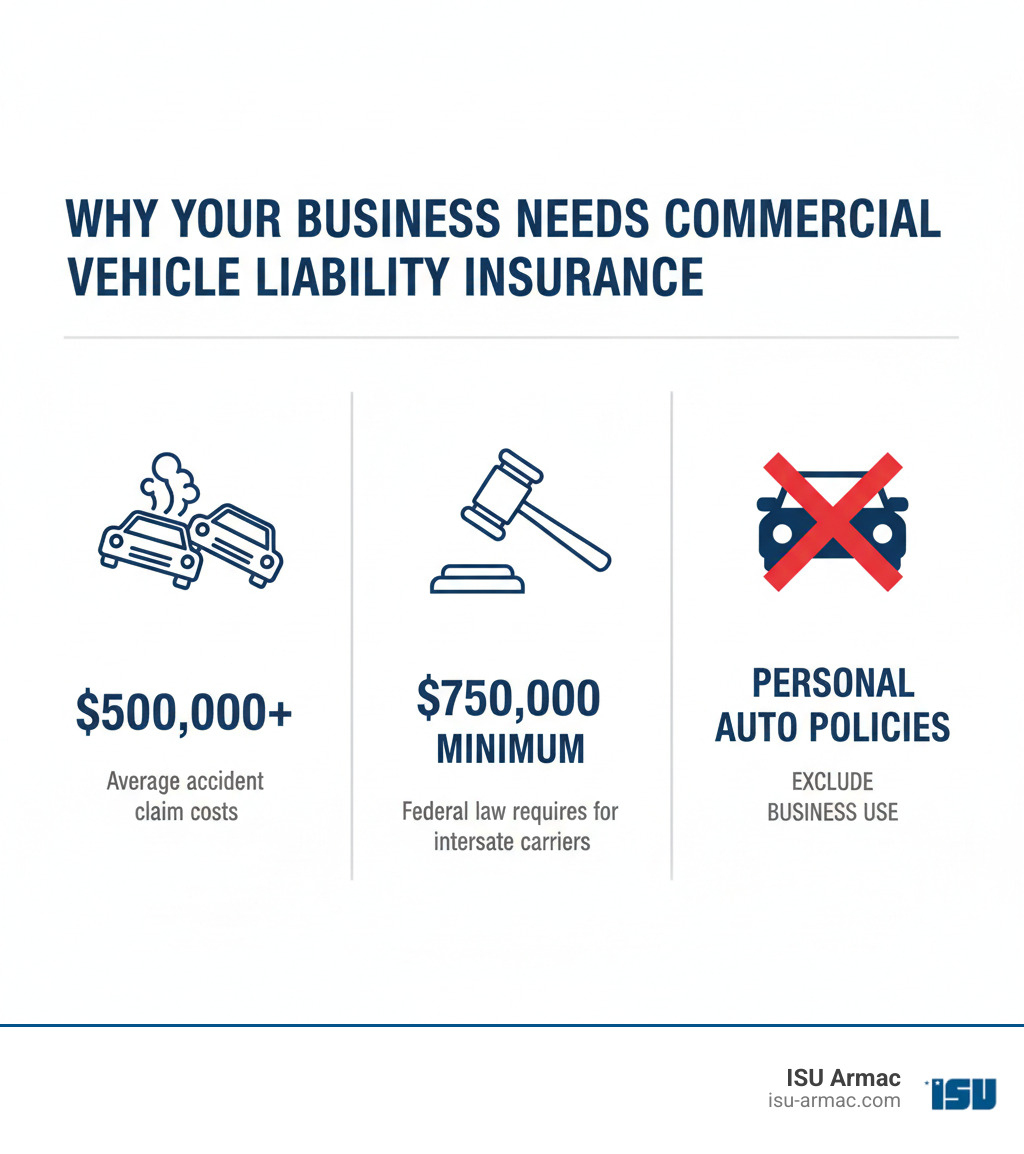
- Federal minimum: $750,000 for interstate carriers.
- Recommended: $500,000 to $1 million for most businesses.
- Hazardous materials carriers: $5,000,000 minimum.
Key Components:
- Bodily injury liability (medical bills, lost wages)
- Property damage liability (repairs to other vehicles or property)
- Legal defense costs (attorney fees, court expenses)
For business owners in Victorville and Southern California, this coverage is non-negotiable. A single accident could threaten your entire business, and personal auto insurance will not cover work-related incidents, leaving you dangerously exposed.
I’m Ryan McEachron, CEO of ISU Insurance Services ARMAC Agency. Since 1995, I’ve specialized in helping local businesses secure the right commercial vehicle liability insurance, ensuring they get comprehensive protection without overpaying.
What is Commercial Auto Liability and Who Needs It?
If your business uses vehicles for any work-related purpose, from a single delivery van to a fleet of trucks, you need specialized protection. Commercial vehicle liability insurance is essential for safeguarding your company’s future.

What is commercial vehicle liability insurance?
Commercial vehicle liability insurance is your business’s financial safety net. It is the part of a commercial auto policy that covers the costs of injuries and property damage to others when your business vehicle causes an accident. Without it, your business is personally responsible for those costs.
It has two main parts: Bodily injury liability covers medical bills, lost wages, and legal defense costs if someone is hurt. Property damage liability pays for repairs to someone else’s car, building, or other property that your vehicle damages.
Crucially, personal auto insurance does not cover business use. Personal policies are for commuting and personal errands, and a claim during business use will likely be denied. If you use a personal vehicle for work, you need to know when you need commercial auto insurance. Commercial vehicle liability insurance is specifically designed for the higher risks of business operations. To learn more, see what commercial auto insurance covers.
Why is it important for your business?
This coverage is a smart investment in protecting everything you’ve built. Here’s why it’s so important:
- Lawsuit Protection: Accidents involving commercial vehicles can lead to devastating lawsuits. Proper insurance shields your company’s assets from legal judgments.
- Business Continuity: A major accident can create costs that could bankrupt your business overnight. With coverage, your business can absorb the financial shock and continue operating.
- Client Requirements: Many companies require proof of liability insurance before signing a contract. Having the right coverage opens doors to bigger and better opportunities.
- Legal Compliance: Nearly every state requires liability insurance for commercial vehicles, with federal laws imposing even stricter rules for interstate carriers. Operating without it can lead to fines and suspension of your license.
- Peace of Mind: Knowing your business is protected allows you to focus on growth instead of worrying about potential accidents. That freedom is invaluable.
Our guide on navigating business auto insurance can help you compare options and find the right policy for your operation.
Understanding Your Commercial Vehicle Liability Insurance Policy
Understanding your commercial vehicle liability insurance policy is key to ensuring your business is truly protected. At its core, the policy has two main pillars that cover you when your vehicle causes an accident.
Bodily Injury Coverage pays for medical bills, hospital stays, lost wages, and even funeral expenses for people injured in an accident where your business is at fault. Critically, it also covers your legal defense–attorney fees, court costs, and expert witnesses–if you are sued.
Property Damage Coverage pays to repair or replace someone else’s property, such as their car, building, or fence, that your vehicle damages. Like bodily injury coverage, it includes the cost to defend your business in court if the property owner sues.
Many policies bundle these into a Combined Single Limit (CSL). Instead of separate limits for injuries and property damage, you get one total amount (e.g., $1,000,000) that can be used flexibly for all damages from a single accident. Some policies also offer Medical Payments coverage, which pays for medical expenses for you and your passengers regardless of fault. For more details, see our guide on How does commercial auto insurance work?
Minimum Requirements vs. Recommended Protection
There’s a huge difference between the legal minimum coverage and the amount needed to actually protect your business.
Federal regulations are strict for interstate carriers, requiring a minimum of $750,000 in auto liability. For those hauling hazardous materials, the minimum jumps to $5,000,000. For official guidance, see the FMCSA’s overview of minimum financial responsibility requirements: FMCSA financial responsibility.
State requirements are often much lower, sometimes mirroring personal auto limits of just $25,000 or $50,000. These minimums are dangerously inadequate. Imagine your driver causes an accident with damages totaling $400,000. If you only carry a state minimum of $100,000, your business is on the hook for the remaining $300,000. This could come straight from your business accounts, potentially forcing you to sell assets or close down. This isn’t a scare tactic; it’s a reality we’ve seen play out. For a regional look, our Commercial Auto Insurance NJ Complete Guide details the specifics in a complex market.
Recommended Coverage Limits for Commercial Vehicle Liability Insurance
If legal minimums aren’t enough, what should you carry? We typically recommend $500,000 to $1 million in commercial vehicle liability insurance as a starting point for most businesses. This range reflects the real-world cost of serious accidents today.
Your specific needs depend on your vehicle types, industry risk, and business assets. The more you have to lose, the more coverage you need. For businesses with significant assets or higher-risk operations, a commercial umbrella policy provides an extra layer of protection above your primary limits at a reasonable cost. Understanding how these choices affect your premium is also important, which we break down on our page about the Cost of Commercial Auto Insurance.
Common Exclusions and Gaps
Even the best policy has limits. Knowing what isn’t covered helps you fill gaps in your protection.
- Your Own Vehicle’s Damage: Liability covers damage you cause to others. To cover your own vehicle, you need separate Physical Damage (Collision and Comprehensive) coverage.
- Intentional Damage: No policy covers deliberate acts.
- Your Cargo: Liability doesn’t protect the goods you’re hauling. For that, you need Motor Truck Cargo or Inland Marine insurance.
- Employee Injuries: Injuries to employees on the job are covered by Workers’ Compensation insurance, not auto liability.
- Personal Belongings: Items like laptops or phones stolen from a vehicle are typically not covered by a commercial auto policy.
- Unlisted Drivers: There can be restrictions for drivers not specifically listed on your policy.
- Employee Use of Personal Vehicles: If an employee uses their own car for business errands, your standard commercial auto policy won’t cover it. You need a special endorsement called Hired and Non-Owned Auto insurance to protect your business in this common scenario. We explain this further here: Does commercial auto insurance cover personal use?
Commercial vs. Personal Auto Insurance: Key Differences
It’s a common and dangerous misconception that personal car insurance is sufficient for business use. The truth is, personal and commercial vehicle liability insurance are fundamentally different products designed for different risks. Understanding these distinctions is vital to protecting your business.
Personal auto policies are for everyday activities like commuting and errands. The moment you use a vehicle to transport clients, deliver goods, or haul equipment, you’ve entered business use territory. Nearly every personal policy excludes business activities, meaning your insurer will likely deny a claim if an accident occurs during work, leaving you personally liable.
Commercial policies recognize that business operations carry greater risk, so they offer much higher liability limits—often $500,000 to $1 million or more, compared to the lower limits of personal policies. They are also designed to cover employees and other authorized drivers, whereas personal policies are typically limited to you and your family. Finally, commercial insurance can cover a wide range of vehicles, from box trucks to vans with custom equipment, that personal policies will not.
While commercial vehicle liability insurance costs more, the premium reflects the real risk and provides the robust protection your business needs. Trying to save money with a personal policy is a gamble you can’t afford to lose.
| Feature | Personal Auto Insurance | Commercial Auto Insurance |
|---|---|---|
| Purpose of Use | Personal activities, commuting, errands, and leisure driving | Business operations including deliveries, client visits, equipment transport, and passenger services |
| Coverage Limits | Lower limits designed for individual exposure, often $100,000-$300,000 | Higher limits reflecting business risk, typically $500,000 to $1 million or more |
| Vehicles Covered | Standard personal vehicles like cars, SUVs, and personal pickup trucks | Full range including specialized commercial vehicles, vans, box trucks, semi-trucks, and modified vehicles |
| Who is Covered | Policyholder and immediate family, limited permissive use for others | Business entity, all employees, and authorized drivers operating vehicles for business purposes |
| Premium Costs | Generally lower due to limited personal use exposure | Higher premiums reflecting increased road time, greater accident exposure, and higher potential claims |
If you use a vehicle for both personal and business tasks, you may wonder if you need both types of coverage. We address this in our guide: Do I need both commercial and personal auto insurance?
Decoding the Costs: What Influences Your Premium?
There’s no simple answer to the cost of commercial vehicle liability insurance. Your premium is a personalized calculation based on your business’s unique risk profile–an assessment of how likely your vehicles are to be in an accident and how costly it might be.
Several key factors influence your premium:
- Industry: High-risk professions like trucking or construction naturally have higher premiums than a business where driving is infrequent.
- Vehicles: The number, type, size, and weight of your vehicles are critical. A fleet of semi-trucks costs more to insure than a single pickup.
- Driver Records: The driving history of everyone behind the wheel matters. Clean records can lower your rates, while accidents or violations will increase them.
- Operating Area: Businesses in dense urban areas typically pay more than those in rural regions due to higher traffic and accident potential. Your radius of operation–local, regional, or interstate–also plays a role.
- Cargo: Hauling hazardous materials significantly increases liability and premiums.
- Claims History: A history of frequent or costly claims signals higher risk to insurers, leading to higher premiums.
- Coverage Choices: Higher liability limits and lower deductibles increase your premium but provide stronger protection.
- Safety Measures: Implementing driver training, vehicle maintenance programs, and telematics can demonstrate a commitment to safety and may qualify you for discounts.
For example, 2024 industry data shows median monthly costs for commercial auto insurance can range from $210 to $220 for contractors and general businesses, with averages being higher depending on specific circumstances.
At ISU Armac, we shop multiple carriers to match your risk profile with insurers who specialize in your industry, finding you the best coverage at competitive rates. For a deeper dive into pricing, check out our page on How much does commercial auto insurance cost?.
Securing Your Coverage and Enhancing Protection
Finding the right commercial vehicle liability insurance is just the first step. An experienced agent can help you build a complete protection strategy for your business. At ISU Armac, we’ve spent years helping businesses in Victorville and throughout Southern California understand not just what they need, but why they need it.
How to Get a Commercial Vehicle Liability Insurance Quote
Getting a quote should be a straightforward process. When you contact us, we’ll gather the necessary information to find you comprehensive coverage at a competitive rate. Be prepared to provide:
- Vehicle Information: Make, model, year, VIN, gross vehicle weight, and how each vehicle is used.
- Driver Details: Names, dates of birth, and driving records for all drivers.
- Business Operations: Your industry, typical travel radius, and the goods or services you provide.
As an independent agent, we shop multiple carriers on your behalf. This allows us to compare policies and prices to find the best value–where quality coverage meets affordability. We’ll then walk you through the quotes and help you customize a policy that fits your business perfectly. To get started, you can request a Commercial Auto Insurance Quote Online, but we recommend a conversation to discuss your unique needs.
Additional Coverages and Endorsements
Your basic liability policy is the foundation, but additional coverages are needed to create a complete safety net. Here are some of the most important ones:
- Hired and Non-Owned Auto Insurance: This crucial endorsement protects your business when employees use their personal vehicles for work or when you rent vehicles.
- Commercial Umbrella Policy: This provides an extra layer of liability protection that kicks in after your primary policy limits are exhausted. It’s a cost-effective way to add millions in coverage.
- Trailer Interchange Coverage: Essential for truckers, this covers physical damage to non-owned trailers in your possession under an interchange agreement.
- Physical Damage Coverage: This protects your own vehicles. It includes collision coverage for accident damage and comprehensive coverage for theft, vandalism, fire, and other non-collision events. We explore this for truckers on our Semi Truck Physical Damage Insurance page.
- Motor Truck Cargo Insurance: If you haul goods for others, this covers loss or damage to the cargo itself.
- Inland Marine Insurance: This protects your tools, equipment, and other business property while in transit or at a job site.
By strategically combining these coverages, we build an insurance portfolio that addresses your specific risks, providing real protection for your business.
Frequently Asked Questions about Commercial Auto Liability
We’ve helped businesses across Southern California navigate commercial vehicle liability insurance for years. Here are answers to the questions we hear most often.
Does Commercial Auto Liability Cover Legal Fees and Defense Costs?
Yes. This is a fundamental and valuable feature of your policy. Your commercial vehicle liability insurance typically covers the legal costs to defend your business in a lawsuit resulting from a covered accident. This includes attorney fees, court costs, and expert witness fees, up to your policy limit. Critically, these costs are often covered even if the lawsuit is frivolous or you are ultimately found not at fault.
How Do Insurance Companies Handle Claims?
The claims process is designed to be as smooth as possible during a stressful time. Here are the typical steps:
- Report the Incident: You or your driver must report the accident to your insurance provider promptly. Most carriers offer 24/7 reporting.
- Investigation: An adjuster is assigned to investigate the claim. They will gather evidence, review police reports, and interview witnesses to determine the facts.
- Evaluation: The adjuster determines who was at fault and assesses the third-party injuries and property damage.
- Resolution: The insurance company pays for covered losses–such as medical bills, vehicle repairs, and legal settlements–up to your policy limits. The insurer also handles communication with other parties and their attorneys.
What Are the Risks of Not Having Adequate Coverage?
Operating without adequate commercial vehicle liability insurance is potentially catastrophic for a business. The risks are severe:
- Out-of-Pocket Costs: You would be personally responsible for all damages and legal fees from an at-fault accident, which can easily run into hundreds of thousands or even millions of dollars.
- Bankruptcy and Asset Seizure: A single large claim could bankrupt your company. Courts can order the seizure of business assets–vehicles, equipment, bank accounts–to satisfy judgments.
- Legal Penalties: Operating without legally required insurance can result in heavy fines, suspension of your business license, and even criminal charges.
- Reputational Damage: An uninsured accident can destroy your business’s reputation and client trust.
- Loss of Business: Many clients require proof of insurance before they will work with you. Inadequate coverage will lock you out of valuable contracts.
The bottom line is that skimping on coverage puts your entire business, your employees’ livelihoods, and your financial future on the line.
Conclusion
Running a business with vehicles on the road means facing real risks every day. Whether you’re making deliveries in Victorville, hauling equipment in Hesperia, or meeting clients across Southern California, commercial vehicle liability insurance isn’t just a budget item–it’s the foundation that protects everything you’ve built.
This guide has shown that this coverage protects you from devastating accident costs, covers legal fees, and keeps your business compliant. You now know the difference between inadequate minimums and the robust protection your business truly needs. A personal auto policy simply won’t cover business use, a lesson many learn the hard way.
The good news is that getting the right protection doesn’t have to be complicated.
That’s where we come in. At ISU Armac, we’ve been helping business owners in Victorville, Apple Valley, Oak Hills, and throughout the High Desert protect their livelihoods since 1995. As an independent agency, we work for you, not an insurance company. We shop multiple carriers to find you the best commercial vehicle liability insurance at the most competitive rates–just custom protection designed for your business.
Your business deserves to operate without the constant worry of “what-if.” Let’s get your vehicles properly protected so you can focus on growth.
Get a customized commercial auto insurance quote for your business today.