
Why Every Business Owner Needs to Understand Commercial General Liability Coverage
Commercial general liability coverage explained in simple terms: it’s insurance that protects your business when someone else gets hurt or their property gets damaged because of your business operations. This coverage handles the legal costs and payouts when customers, vendors, or other third parties file claims against your company.
Here’s what CGL insurance covers:
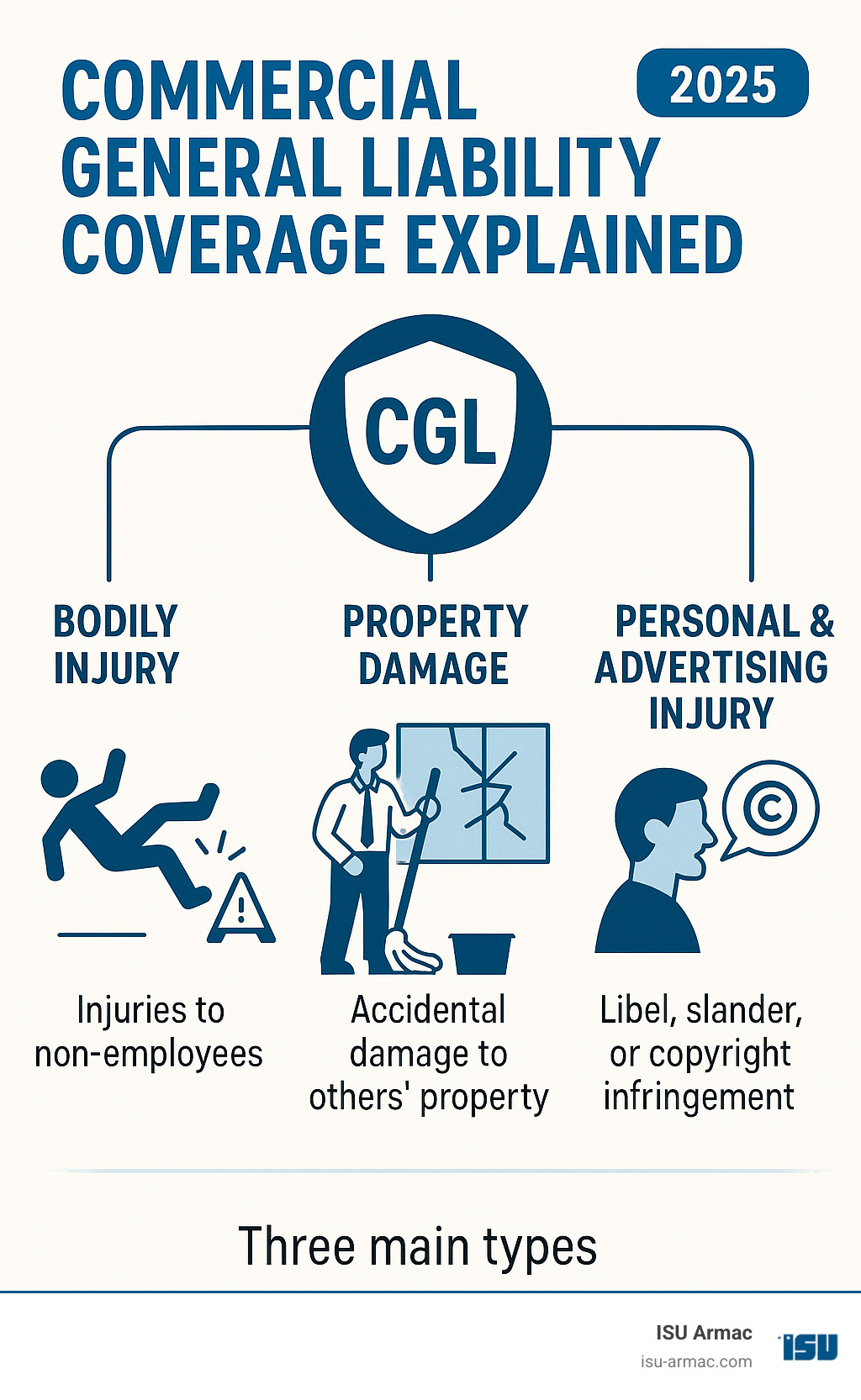
- Bodily injury – When someone gets hurt on your property or because of your business activities
- Property damage – When you accidentally damage someone else’s property
- Personal and advertising injury – Claims of libel, slander, or copyright issues in your marketing
- Legal defense costs – Attorney fees and court costs, even for frivolous lawsuits
- Medical payments – Small medical bills to avoid bigger claims later
The average cost ranges from $300 to $1,000 annually for $1 million in coverage, making it one of the most affordable ways to protect your business from potentially devastating lawsuits.
What CGL doesn’t cover:
- Your own business property
- Employee injuries (that’s workers’ comp)
- Professional mistakes (that’s E&O insurance)
- Company vehicles (that’s commercial auto)
I’m Ryan McEachron, CEO of ISU Insurance Services ARMAC Agency in Victorville, where I’ve helped countless High Desert business owners steer the complexities of commercial general liability coverage explained through practical, real-world guidance. With over two decades in the insurance industry and deep roots in our community, I’ve seen how the right coverage protects local businesses from unexpected financial disasters.
Commercial general liability coverage explained word roundup:
- commercial premises liability insurance
- completed operations liability
- products completed operations liability
What is Commercial General Liability (CGL) Insurance?

Picture this: you’re running a successful restaurant in Victorville when a customer slips on a freshly mopped floor and breaks their wrist. Suddenly, you’re facing medical bills, legal fees, and potentially thousands in damages. This is exactly where commercial general liability coverage explained becomes your business’s superhero.
Commercial General Liability insurance is your business’s essential safety net against the unexpected mishaps that come with serving the public. Think of it as the foundational layer of protection that every business owner needs, whether you’re running a small retail shop or managing a construction crew across the High Desert.
The Insurance Services Office (ISO) standardized CGL policies back in 1986, replacing the older “comprehensive” general liability coverage. This standardization means that no matter where your business operates, you can count on consistent protection under the ISO policy form. It’s become so fundamental that CGL is now the most common business insurance policy in America.
Understanding what CGL insurance covers is crucial for every business owner because it protects against third-party liability claims. This means it covers injuries or damages to other people, not your own business property or employees. The coverage focuses on four main areas: premises liability (accidents that happen on your property), business operations (injuries that occur during your day-to-day work), products-completed operations (problems that arise from your finished work or products), and personal injury claims like libel or slander.
When a customer trips over a loose carpet in your Apple Valley store or your landscaping team accidentally damages a client’s sprinkler system in Hesperia, CGL steps in to handle the legal costs, medical bills, and repair expenses. Without this protection, a single lawsuit could potentially wipe out years of hard work and savings.
The beauty of CGL lies in its comprehensive approach to protecting your business from the liability risks that come with interacting with customers, vendors, and the general public every single day.
Commercial General Liability Coverage Explained: What a Standard Policy Includes
When you dive into commercial general liability coverage explained, you’ll find that a standard policy does much more than just pay for damages. Think of it as having a skilled legal team on standby, ready to defend your business at a moment’s notice.
The real power of CGL insurance lies in what’s called the “duty to defend.” This means your insurance company will step up to handle lawsuits against your business, even if the claims turn out to be completely false or frivolous. Those legal bills can pile up fast – we’re talking attorney fees, court costs, and expert witness expenses. The good news? These defense costs typically don’t eat into your policy limits, giving you extra protection when you need it most.

Every standard CGL policy breaks down into three main coverage areas, each designed to protect your business from different types of risks. Let’s walk through what each one covers and why it matters for your business.
Coverage A: Bodily Injury and Property Damage
This is the heart and soul of your CGL policy – the coverage that handles the most common (and often most expensive) claims businesses face.
Bodily injury coverage steps in when someone gets physically hurt because of your business operations. This isn’t just about obvious injuries like broken bones from a slip and fall. The coverage extends to sickness, disease, and even death that results from an incident at your business. Some policies even recognize mental injuries and emotional distress as bodily injuries, even when there’s no physical harm involved.
Picture this common scenario: A customer walks into your Victorville retail store on a busy Saturday afternoon. Someone spilled a drink near the checkout counter, and despite your best efforts, the customer slips and takes a hard fall. They end up with a broken wrist, miss two weeks of work, and decide to sue for medical bills, lost wages, and pain and suffering. That’s exactly when bodily injury coverage becomes your financial lifesaver.
Property damage coverage protects you when your business accidentally damages someone else’s belongings. This includes not just the immediate damage, but also the loss of use of that property while it’s being repaired or replaced.
Here’s where it gets interesting – this coverage includes what’s called the products-completed operations hazard. This means you’re protected even after your work is finished. Let’s say your electrical contracting business in Apple Valley completes a wiring job, but three months later, a faulty connection causes a small fire at the client’s property. Even though your crew finished the job months ago, your CGL policy would still cover the resulting damage.
Coverage B: Personal and Advertising Injury
While Coverage A handles physical problems, Coverage B tackles the more subtle but equally damaging world of reputation and advertising issues. In our digital age, where a single social media post can go viral, this protection has become increasingly valuable.
This coverage protects your business against libel and slander claims – those written or spoken statements that can damage someone’s reputation. It also covers false arrest or detention if your security staff goes too far, malicious prosecution if you pursue legal action without proper grounds, and wrongful eviction situations for property managers and landlords.
The advertising side gets particularly interesting. Copyright infringement claims can pop up when you accidentally use someone else’s creative work in your marketing materials. We’ve also seen cases involving the misappropriation of advertising ideas where businesses get accused of stealing a competitor’s marketing concept.
Here’s a real-world example: Imagine your restaurant launches a new social media campaign featuring what you think is royalty-free music, but it turns out the track is copyrighted. The artist’s legal team comes knocking with a lawsuit. Coverage B would handle your defense costs and any settlement payments.
Coverage C: Medical Payments
This might be the most misunderstood part of CGL insurance, but it’s also one of the smartest features. Medical payments coverage works completely differently from the other two sections because it operates on a no-fault basis.
Here’s what makes it special: when someone gets hurt on your property or because of your business operations, this coverage can pay their immediate medical expenses without anyone having to prove you were at fault. The coverage limits are typically much lower than your main policy limits, but that’s intentional.
Think of medical payments as a goodwill gesture that can prevent small problems from becoming big lawsuits. A customer visits your Hesperia office and trips over a loose carpet edge, scraping their knee badly enough to need a few stitches at urgent care. Instead of waiting for lawyers to determine fault, medical payments coverage can take care of that $300 medical bill right away.
This quick response often stops minor incidents from escalating into major bodily injury claims. It’s a small investment that can save you from much larger problems down the road, while also showing your customers that you care about their wellbeing.
Understanding CGL Policy Types and Structures
When it comes to commercial general liability coverage explained, the devil is truly in the details. Understanding how your policy is structured can mean the difference between being fully protected and facing unexpected gaps in coverage. At ISU Armac, we help business owners across the High Desert steer these complexities by breaking down the technical jargon into plain English.
Your CGL policy isn’t just a simple “yes or no” for coverage. It operates within specific limits, comes with certain costs, and follows particular structures that determine exactly when and how much protection you receive. Think of it like buying a car – you need to understand not just that it gets you from point A to point B, but also its gas mileage, safety features, and maintenance costs.
The policy limits represent the maximum amount your insurer will pay for covered claims, while premiums are what you pay to maintain this protection. Deductibles determine your out-of-pocket costs before insurance kicks in, though many CGL policies don’t include deductibles for liability coverage. Your insurer conducts a thorough risk assessment of your business to determine these factors, looking at everything from your industry type to your location in Southern California.

Claims-Made vs. Occurrence Policies
One of the most important distinctions in CGL coverage is whether your policy follows a claims-made or occurrence structure. This difference affects when a claim is covered and can have significant implications for your business protection.
| Feature | Claims-Made Policy | Occurrence Policy |
|---|---|---|
| Coverage Trigger | Covers claims reported during the policy period | Covers incidents that occur during the policy period |
| Policy Period Relevance | Must have active policy when claim is filed | Coverage applies regardless of when claim is filed |
| Tail Coverage Needs | Requires extended reporting period for full protection | No additional coverage needed after policy ends |
Occurrence policies are more straightforward and common for CGL coverage. If an incident happens while your policy is active, you’re covered – even if the claim isn’t filed until years later. For example, if a customer is injured at your Victorville business in 2024 but doesn’t file a lawsuit until 2026, an occurrence policy from 2024 would still provide coverage.
Claims-made policies work differently. They cover claims that are both reported and filed during the active policy period. These policies include a retroactive date – incidents before this date aren’t covered, even if you file a claim during the active policy period. If you switch insurers or cancel a claims-made policy, you’ll likely need extended reporting period (tail coverage) to protect against future claims for past incidents.
How CGL Policy Limits and Costs are Determined
Your CGL policy operates with two primary limit structures that work together to define your protection level. The per-occurrence limit is the maximum amount the insurer will pay for any single incident or claim. The general aggregate limit represents the total maximum the insurer will pay for all covered claims during your policy period, regardless of how many separate incidents occur.
Several key factors influence the cost of your CGL coverage. Your industry risk plays a major role – a consulting firm typically pays less than a construction company because the potential for accidents differs significantly. Your business revenue indicates the scale of your operations and potential exposure. The number of employees you have affects both the likelihood of incidents and the scope of your business activities.
Your claims history is perhaps the most controllable factor. A clean record demonstrates good risk management and typically results in lower premiums. Your business location also matters – operating in different areas of California can affect your rates based on local lawsuit trends and regulations.
The high costs of lawsuits make choosing the right limits essential. A single serious injury claim can easily exceed $100,000, while major incidents can reach into the millions. Working with an experienced agent helps ensure you’re not underinsured while avoiding unnecessary coverage that inflates your premiums.