
The Power of Pooling: Why Small Businesses Are Joining Forces for Health Coverage
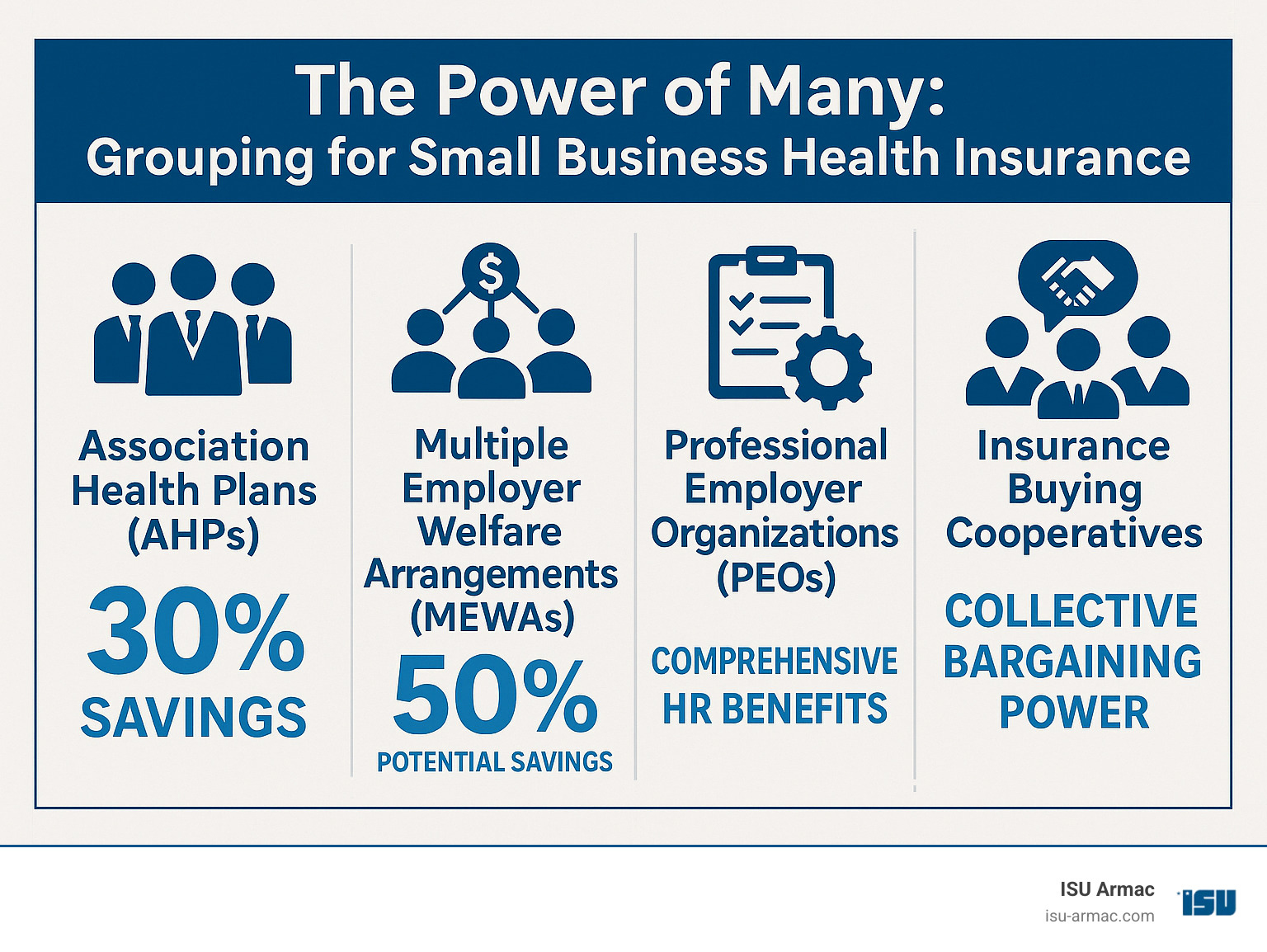
Can small businesses group together for health insurance? Yes. Small businesses can join forces through several proven methods to access better health coverage at lower costs:
- Association Health Plans (AHPs): Join industry or professional associations.
- Multiple Employer Welfare Arrangements (MEWAs): Pool with other employers to spread risk.
- Professional Employer Organizations (PEOs): Partner through co-employment arrangements.
- Insurance Buying Cooperatives: Form purchasing groups for collective bargaining power.
Rising healthcare costs disproportionately affect small businesses, which often face premium increases of 7% annually and struggle to compete for top talent. By banding together, small businesses create a collective force. This pooling spreads risk and provides negotiating leverage that rivals large corporations.
With 85% of employees citing health benefits as key to their loyalty, the fact that only 55% of small firms offer coverage presents a significant challenge. Grouping together offers a solution. Beyond significant savings—over 50% on healthcare premiums for some—it provides access to the same advantages large companies enjoy.
I’m Ryan McEachron, CEO of ISU Insurance Services ARMAC Agency. I’ve spent decades helping businesses in Victorville and across the High Desert answer the question: can small businesses group together for health insurance? I’ve seen how the right grouping strategy transforms a company’s ability to attract and retain talent.
Simple guide to can small businesses group together for health insurance terms:
- small business employee health insurance options
- can a small business pay for individual health insurance
- shop small business health options program
Why Grouping for Health Insurance is a Game-Changer for Small Businesses
For many small business owners, the annual insurance renewal meeting is a source of dread due to climbing premiums and the challenge of retaining employees who seek better benefits elsewhere. The question can small businesses group together for health insurance is no longer just a question—it’s a lifeline.

Lower Premiums and Access to Better Plans
When small businesses join forces, they become part of a larger, more stable pool. Insurance companies favor this because larger groups mean more predictable costs and lower risk. The savings can be substantial, with association health plan premiums often $1,900 to $4,100 lower annually than small group markets and $8,700 to $10,800 lower than individual coverage. For example, Clark County Health Plan Association members save 30 percent on premiums. Beyond cost, grouping open ups access to large group market plans with broader networks and more comprehensive benefits, rivaling those of Fortune 500 companies.
Increased Negotiating Power
Grouping transforms small businesses into a powerful collective. Instead of being a small fish, your group becomes a highly sought-after client, giving you collective bargaining power to negotiate better rates, improved benefits, and more favorable terms. You’re no longer just accepting rates; you’re helping to dictate them.
Employee Loyalty and Retention
Since 85% of small business employees say health benefits impact their loyalty, offering robust coverage is a powerful retention tool. It sends a clear message that you value your team’s health and security. Healthy employees are productive employees, and lower turnover reduces hiring costs and improves team chemistry. In a competitive job market, great benefits can be the deciding factor for top candidates.
Tax Benefits
Your contributions to group health insurance premiums are typically tax-deductible, lowering your overall tax burden. Furthermore, the Small Business Health Care Tax Credit can cover up to 50% of premium costs for qualifying businesses, providing a significant financial incentive for offering coverage.
Competing with Larger Companies
Grouping for health insurance levels the playing field, allowing you to compete with larger companies for talent. You can offer comparable high-quality plans, neutralizing a key advantage that bigger corporations once held. This creates fairness in the health insurance landscape, giving you the tools to attract the best employees while maintaining your unique small business culture.
For more detailed information on how these benefits can transform your business, explore our guide on Group Health Insurance Benefits.
How Can Small Businesses Group Together for Health Insurance? Key Pathways Explained
The answer to “can small businesses group together for health insurance” is a clear yes, but knowing how is key. Each pathway is a different tool designed to transform your small business into part of something bigger, giving you access to group purchasing power.

Association Health Plans (AHPs): Leveraging a Common Bond
AHPs bring together multiple employers who share a “common bond,” such as being in the same industry, profession, or geographic area. Local chambers of commerce often sponsor successful AHPs. Once the grouped businesses reach the 51-employee threshold, they qualify as a large group with significant negotiating power. The cost savings can be substantial, with AHP premiums projected to be $1,900 to $4,100 lower annually than small group rates. However, the regulatory landscape for AHPs is complex, and some plans may offer less comprehensive coverage, so careful review is essential.
For complete details about this option, visit our page on Association Health Plans for Small Business.
Multiple Employer Welfare Arrangements (MEWAs): Strength in Numbers
MEWAs operate on the principle of spreading financial risk across many employers. Instead of your business bearing the full weight of claims, the risk is distributed, creating more predictable costs. Most MEWAs offer fixed monthly payments, which helps with budgeting. Businesses with 1-50 employees, including sole proprietors, can typically join. The underwriting process, which involves employee health questions, allows MEWAs to price risk accurately and offer competitive rates, with some businesses saving over 30% on health insurance. MEWAs are subject to both federal ERISA and state regulations, which vary by location.
To learn more about how MEWAs could benefit your business, check out our insights on MEWA insurance.
Professional Employer Organizations (PEOs): The Co-Employment Solution
PEOs offer a comprehensive partnership through a co-employment model. The PEO becomes the employer of record for tax and benefits purposes, while you retain full control over daily operations. This gives your business access to the PEO’s massive employee pool and its large group health plans, which often rival those of Fortune 500 companies. Beyond health insurance, PEOs handle payroll, workers’ compensation, and HR compliance. While PEOs charge administrative fees, many businesses find the cost savings, risk reduction, and time savings to be a worthwhile trade-off.
For a deeper dive into whether a PEO solution is right for your small business, visit our page on PEO solutions.
Other Critical Health Coverage Options and Eligibility Rules
If traditional grouping models don’t fit, other pathways exist, especially for micro-businesses or those interested in government-sponsored programs.
What if I Only Have One Employee?
Even with just one non-owner employee, you may qualify for group health insurance as a “group of two.” This typically provides more affordable options than individual plans. However, eligibility rules are state-specific.
- Husband-and-Wife Business Eligibility: Under ACA rules, a married couple running a business generally cannot qualify for a small group plan on their own. They need at least one W-2 employee who is not an owner or owner’s spouse.
- Payroll Requirements for Family Members: A common workaround is to legitimately employ a family member, such as a child 16 years or older. This person must be legally able to work, formally hired, and typically work at least 30 hours per week to create a qualifying group.
For detailed guidance on securing coverage for your very small team, check out our resource on How to Get Small Business Health Insurance.
SHOP Marketplace and Health Reimbursement Arrangements (HRAs)
The Affordable Care Act introduced solutions like the SHOP marketplace and HRAs for small businesses.
- Overview of the SHOP Program: The Small Business Health Options Program (SHOP) is a marketplace for employers with up to 50 full-time equivalent employees. It offers flexibility in choosing plans and contribution levels.
- Small Business Health Care Tax Credit: Businesses with 1-25 employees that enroll through SHOP and contribute at least 50% of employee premiums may qualify for this tax credit. It can cover up to 50% of the premiums you pay, making coverage much more affordable.
- HRAs as an Alternative: Health Reimbursement Arrangements (HRAs) are employer-funded accounts that reimburse employees for qualified medical expenses, including individual health insurance premiums.
- QSEHRA (Qualified Small Employer HRA): For employers with fewer than 50 employees who don’t offer a group plan. It allows for tax-free reimbursement up to an annual limit.
- ICHRA (Individual Coverage HRA): Offers more flexibility for any size employer. You provide tax-free funds for employees to buy their own individual plans, giving them choice and you predictable costs.
For more details on SHOP plans, visit the official resource at healthcare.gov. To understand exactly how the SHOP program works for your business, explore our comprehensive guide on the SHOP Small Business Health Options Program.
How to Choose the Right Group Health Plan

Knowing that small businesses can group together for health insurance is the first step; the next is choosing the right plan. Breaking the decision down into manageable steps makes it much easier.
- Assess Employee Needs: Is your workforce mostly young singles or families? Do they have preferred doctors? What can they afford for deductibles? Understanding your team’s priorities is the first step to finding a plan that works for them.
- Determine Your Budget: Look beyond monthly premiums to consider deductibles, co-payments, and out-of-pocket maximums. Decide how much your business will contribute toward employee premiums.
- Compare Provider Networks: A great plan is useless if an employee’s trusted doctor isn’t covered. Ensure the plan’s network includes the hospitals and physicians your team uses. Grouping options like AHPs and PEOs often provide broader networks.
- Understand Plan Types: HMOs typically cost less but require referrals for specialists. PPOs offer more flexibility but have higher premiums. High-deductible plans with Health Savings Accounts (HSAs) can be a great option for healthier teams seeking lower monthly costs.
- Review Compliance: Any chosen plan must meet federal and state regulations, including ACA and ERISA rules. Working with an experienced agent is invaluable for navigating this complex regulatory maze.
This table compares how the main grouping options stack up:
| Feature | Association Health Plans (AHPs) | Multiple Employer Welfare Arrangements (MEWAs) | Professional Employer Organizations (PEOs) | SHOP Marketplace (ACA) |
|---|---|---|---|---|
| Cost Potential | Significant savings vs. small group/individual | High potential savings, especially for healthy groups (up to 50%+) | Access to large group rates, but with administrative fees | Standard small group rates, potential for tax credit |
| Control | High (direct relationship with insurer/administrator) | High (direct relationship with MEWA administrator) | Shared (PEO handles HR/benefits, you manage employees) | High (direct relationship with insurer) |
| Administration | Managed by the AHP sponsor/administrator | Managed by the MEWA administrator | Managed by PEO (payroll, HR, benefits) | Managed by employer (or broker) |
| Regulation | ERISA (federal), some state oversight, complex regulatory history | ERISA (federal), significant state oversight | State-specific licensing/registration, co-employment laws | ACA compliant, federal and state oversight |
| Commonality | Required (industry, profession, geography) | Usually not required, just pooling of unrelated employers | No commonality requirement among client businesses | No commonality required, just small business status |
| Benefits | Flexible, can be robust (large group market access) | Flexible, can be robust | Very robust (access to large group benefits from PEO’s pool) | Standardized, 10 EHBs, can choose levels |
| Eligibility | Member of a qualifying association | Businesses 1-50 employees (incl. sole proprietors) | Any size business (often small-mid sized) | Businesses 1-50 FTEs |
The right choice depends on your specific situation. The key is matching the solution to your actual needs.
Frequently Asked Questions About Grouping for Health Insurance
Here are answers to the most common questions we receive from business owners exploring their group health insurance options.
How do AHPs handle pre-existing conditions and essential health benefits?
Association Health Plans must follow the same rules as other group health plans regarding pre-existing conditions; they cannot deny coverage or charge more based on health history. The rules for Essential Health Benefits (EHBs) are more nuanced. Small group ACA plans must cover ten specific benefit categories. Since many AHPs operate as large group or self-insured plans, they have more flexibility in structuring benefits and are not always required to cover all ten EHBs as comprehensively. It is crucial to carefully review the plan details to understand what is covered.
For the complete picture on how AHPs work within large group market rules, check out our detailed guide on Association Health Plans for Small Business.
What are the main tax implications for my business?
The tax advantages are significant. First, premiums you pay for employee group health insurance are typically a tax-deductible business expense. Second, if you have fewer than 25 full-time equivalent employees, you may qualify for the Small Business Health Care Tax Credit, which can cover up to 50% of the premiums you pay. This credit generally requires purchasing coverage through the SHOP marketplace. Finally, businesses with 50 or more full-time employees are considered Applicable Large Employers (ALEs) and are subject to the Employer Shared Responsibility Provisions, which require offering affordable, minimum essential coverage to avoid potential penalties.
The IRS provides comprehensive guidance on these rules in their Questions and Answers on employer shared responsibility provisions.
How has the regulatory landscape changed for small businesses that group together for health insurance?
The regulatory environment for AHPs has seen significant changes. In 2018, the Department of Labor expanded access to AHPs, making it easier for small businesses to join together. However, a March 2019 federal court ruling vacated key parts of those rules, narrowing the definition of “employer” under ERISA. Today, this creates a “narrower pathway” for AHPs. A plan must generally be sponsored by a genuine employer group or association that exists for reasons other than simply providing health insurance, such as a chamber of commerce or trade association. States also retain significant authority to regulate MEWAs, including AHPs, adding a layer of consumer protection.
The DOL has issued a policy statement on the court ruling that clarifies the current landscape. The bottom line is that while the pathways are more defined, the opportunities for businesses to group together remain strong.
Conclusion: Find the Right Health Insurance Path for Your Business
As this guide shows, the answer to can small businesses group together for health insurance is not just yes—it’s a transformative strategy. Pooling resources through Association Health Plans, MEWAs, and PEOs can cut premiums by 30% to 50% and open up access to benefits that rival large corporations. From a two-person shop to a growing company, a solution exists.
The power of collective bargaining has leveled the playing field. By banding together, small businesses gain the same negotiating strength that big companies have always used to secure better deals. This investment in your team’s health fosters loyalty, boosts productivity, and gives you a competitive edge in today’s job market.
Navigating the rules around AHPs, MEWAs, and the ACA can be complex, which is why expert guidance is crucial. At ISU Armac, we have spent decades helping small businesses across the High Desert and Southern California find their ideal health insurance solution. From our offices in Victorville, Apple Valley, Hesperia, and Oak Hills, we understand the local market and the unique challenges you face.
Your business deserves the same advantages as large corporations. You can offer great benefits without breaking your budget. The options we’ve explored prove you can have both.
Ready to see what grouping together can do for your business? Explore your small business medical insurance options and get a quote today. Let’s find the path that works for you and your team.