

You finally found the house. Big sky, extra lot space, room for toys, maybe a pool, maybe a detached garage, maybe a view that sold you before you even got out of the car.
Then the insurance quote shows up and changes the conversation.
That happens all the time in Victorville. New homeowners expect the challenge to be price. Often, eligibility is the problem. A home that looks straightforward to a buyer can look risky to an underwriter because of wildfire exposure, roof condition, vent design, surrounding brush, flood pathways, or how far standard carriers have pulled back in the High Desert.
California's market pressure is real. The Terner Center at UC Berkeley reports the state had about 14.5 million housing units in 2023, with roughly 57% owner-occupied, and about 390,000 California households were already in the FAIR Plan by 2025, which shows how many owners couldn't get standard coverage in the voluntary market (Terner Center analysis of California's home insurance challenge). If you're buying in Victorville, that matters. You're not shopping in a normal market.
Your High Desert Dream Home Needs a Smart Plan
A lot of buyers come into the High Desert with the same assumption. Dry climate. Newer subdivisions. Plenty of sun. How complicated can homeowners insurance be?
More complicated than it looks.
The surprise usually hits after escrow starts moving. The lender wants proof of insurance. The buyer starts calling around. One carrier declines. Another asks for photos of the roof, eaves, and surrounding yard. Another offers a quote with terms that don't match what the buyer expected. At that point, people realize desert property insurance in Victorville CA isn't just a box to check. It's part of the purchase strategy.
Why Victorville properties get extra scrutiny
Insurers don't look at a High Desert home the same way they look at a suburban tract house in a lower-risk market. They look at the structure, the parcel, and the terrain around it.
A detached workshop, slope behind the property, aging roof, open eaves, nearby dry vegetation, or signs that stormwater collects near the home can all change the underwriting conversation. That's before you get into liability concerns from pools, rentals, or outbuildings.
Practical rule: In Victorville, the insurance question isn't "Do I need a policy?" It's "What kind of property profile am I presenting to the market?"
Start with availability, then compare coverage
You need a plan that starts with access to actual options. That means working from the beginning with someone who understands home insurance options for California property owners and knows how to position a High Desert home correctly with insurers.
If you wait until the last minute, you're negotiating under pressure. That's when people accept thin coverage, high deductibles they didn't notice, or policies that leave out important protections.
Unpacking High Desert Risks More Than Just Sun and Wind
Most buyers focus on weather. Underwriters focus on loss scenarios.
Victorville sits in a high-desert wildfire environment, so underwriting for desert property insurance is driven less by average rainfall and more by wildfire exposure, defensible-space conditions, and roof and vent construction details that affect ember intrusion and fire spread. In California, wildfire loss severity has pushed carriers to tighten eligibility and pricing in high-risk areas, which means properties with non-combustible roofing, boxed-in eaves, ember-resistant vents, and documented defensible space are materially easier to insure than similar homes without those features (California home insurance availability guidance).
Here's the risk picture most buyers need to understand:
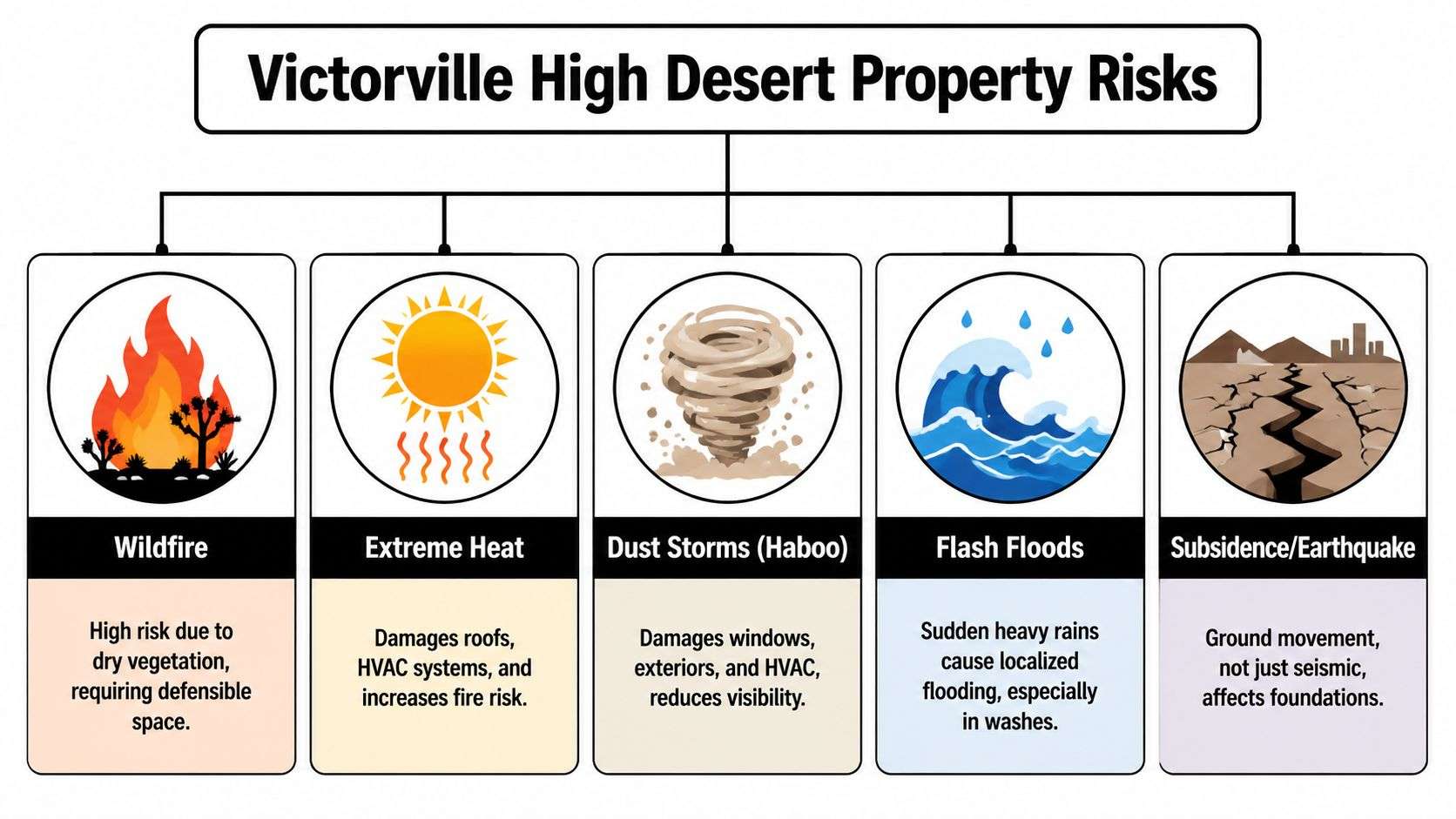
Wildfire isn't only about flames
A lot of homes don't ignite from a wall of fire. They ignite from embers.
That means the details matter. Roof type matters. Vent design matters. Eaves matter. The distance between dry vegetation and the structure matters. If an underwriter sees a home with vulnerable openings and poor defensible space, the file gets harder fast.
Flash flooding catches new owners off guard
People hear "desert" and assume low water risk. That's backwards. Hard ground and fast storms can send water where it shouldn't go, especially near washes, low spots, and poorly drained lots.
Standard homeowners insurance typically doesn't respond to flood damage. If your yard channels runoff toward the house or your lot sits in a problem area, you need to address that separately and early.
Wind, dust, and heat cause steady wear
Victorville homes take a beating from long-term exposure. High winds stress roofs and fencing. Dust gets into HVAC systems and openings around the structure. Extreme heat shortens the life of materials and can turn minor maintenance issues into claim situations after a storm or power event.
This is why insurers ask questions that seem picky. They're trying to figure out whether the property has been maintained in a way that lowers avoidable losses.
Ground movement is a real concern
Earthquake risk gets attention, but owners also need to think about broader ground movement and foundation stress. A crack in a slab isn't always treated the way homeowners expect under a standard policy.
If you're evaluating a property, ask direct questions about prior repairs, drainage corrections, and soil movement signs. Don't wait until after closing to find those surprises.
For one overlooked but useful prevention step, homeowners with laundry equipment should review this homeowner guide to dryer fire safety. In a dry climate, routine fire prevention inside the home matters just as much as brush clearance outside.
Decoding Your Insurance Policy What Is Actually Covered
A homeowners policy isn't one big blanket. It's a set of separate protections, and each one matters differently in the High Desert.
For the typical homeowners policy structure used in California, the technical coverage split matters. Dwelling coverage responds to sudden accidental perils like fire, wind, lightning, and vandalism. Personal property coverage protects contents. Liability coverage can extend to injuries or property damage caused by a covered loss, even away from the home. In practice, desert-property owners in Victorville should expect insurers to underwrite both the structure and the site risk, and to offer endorsements such as water-backup or extended loss-of-use only after the core wildfire and building-risk profile is acceptable (California homeowners coverage structure overview).

What each part does in real life
Think about your policy like this:
| Coverage part | What it usually does | Why it matters in Victorville |
|---|---|---|
| Dwelling | Repairs or rebuilds the house for covered damage | Fire and wind exposure make this the first place to review closely |
| Personal property | Covers belongings inside the home | Detached living patterns, garages, and storage create easy underinsurance problems |
| Liability | Responds if someone is injured or their property is damaged and you're legally responsible | Large lots, dogs, pools, rental activity, and detached structures increase exposure |
| Loss of use | Helps with temporary living costs after a covered loss | Hard to appreciate until the house becomes unlivable |
That first row gets most of the attention. It shouldn't be the only one.
A lot of High Desert homeowners under-focus on liability. That's a mistake. If someone gets hurt on your property, your issue isn't just repair cost. It's defense cost, claim handling, and potential payment to a third party.
What a standard policy usually doesn't cover
In these situations, people get blindsided.
A standard homeowners policy generally does not cover flood damage. It also doesn't automatically cover earthquake damage. In Victorville, both exclusions matter because buyers tend to focus on visible fire risk and ignore the perils that sit outside the base policy.
Buying the house without reviewing exclusions is easy. Recovering from an excluded loss is not.
Water backup can also be limited unless you add the right endorsement. The same goes for certain detached structures, higher-value contents, and business activity at home.
Why policy language matters more in a tight market
When standard markets pull back, buyers often accept whatever quote they can get. That's understandable, but it's risky.
A bare-bones policy may satisfy the lender while leaving major gaps in how your household uses the property. If you have a workshop, short-term guests, home business equipment, or expensive tools in a detached garage, ask those questions before binding coverage.
If roof condition is part of the underwriting issue, it's smart to review a contractor-facing explanation of 7 Summits Roofing's insurance claim help so you understand how roof replacement questions often intersect with claims and policy terms.
How Insurers Price Your Victorville Property Insurance
People ask why two similar homes can get very different insurance results. The short answer is that insurers don't price houses by zip code alone. They price risk at the property level, and in Victorville that difference can be sharp.
The biggest misunderstanding is this. Owners think the premium is mainly a shopping problem. In the High Desert, it often starts as a market-access problem.
Insurance availability, not just price, is a growing gap in Victorville and the High Desert. California's insurance regulator defines underserved communities using access measures, which underscores that the issue can be carrier availability rather than simple quote-shopping. In high-risk property markets, homeowners may need alternatives such as FAIR plans when standard coverage is hard to obtain, but these options are often more limited than regular policies (California underserved insurance market framework).
What underwriters are actually pricing
An underwriter is usually looking at a mix of factors such as:
- Construction details like roof material, roof age, vent type, siding, and whether the eaves are exposed or boxed in.
- Site conditions including slope, vegetation, access for fire response, drainage patterns, and proximity to open land.
- Claim exposure from pools, detached structures, rentals, dogs, or other liability-heavy features.
- Coverage choices like dwelling limit, endorsements, and the deductible you select.
Some of those you can control. Some you inherit when you buy the property.
Deductibles change the deal
A lower premium can come with more out-of-pocket risk after a loss. Before you accept a quote, test different scenarios with a homeowners insurance cost calculator so you're not comparing premium alone.
If one option saves money but leaves you exposed to a painful deductible or stripped-down coverage, it isn't the better deal. It's just the cheaper invoice.
FAIR Plan reality
The California FAIR Plan isn't a sign you failed. It's often a sign the standard market wouldn't take the risk.
That matters because FAIR Plan placements can require additional planning to fill coverage gaps. Homeowners who land there need to understand the policy structure, not just the premium. In Victorville, that's part of responsible buying now.
Practical Steps to Lower Premiums and Improve Insurability
Most homeowners focus on quote shopping first. I think that's backwards.
Start by making the property easier to insure. In a High Desert market, insurability improvements often do more than endless quote requests because they change how underwriters see the risk in the first place.

Industry guidance notes that high-risk homeowners policies may use percentage-based deductibles, often 1% to 5% of insured value, which can materially change out-of-pocket costs after a loss. That same guidance points consumers toward mitigation measures, which is exactly right. The better question isn't "Can I get insurance?" It's "What tradeoffs come with the policy I can obtain?" (high-risk homeowners deductible and mitigation guidance).
Focus on wildfire hardening first
If you do nothing else, do these:
- Create defensible space: Remove dead vegetation, trim back growth near structures, and keep roof valleys and gutters clear.
- Upgrade vulnerable openings: Ember-resistant vents and boxed-in eaves are not cosmetic upgrades. They directly affect wildfire vulnerability.
- Use better roof materials: Non-combustible roofing improves your profile with underwriters and reduces ember ignition risk.
- Document the work: Take clear photos and keep receipts. If an insurer asks for proof, vague descriptions won't help.
Fix the issues carriers hate
These are the problems that kill otherwise workable submissions:
- Deferred roof maintenance: Missing, curling, or visibly worn roofing makes everything harder.
- Poor drainage: If water runs toward the home, fix grading and drainage before you shop heavily.
- Unsafe detached structures: Sheds, garages, and workshops need to look maintained, secure, and properly built.
- Overgrown lots: Big parcels are great until they create a fire and liability problem.
Agent view: Clean up the property before you ask the market to trust it.
Add smart protection where it counts
Not every device earns the same attention from underwriters, but practical risk controls still help.
Consider water leak sensors, monitored security features, smoke detection upgrades, and HVAC maintenance records. These won't solve a severe wildfire profile by themselves, but they strengthen the overall presentation of the home.
A local independent agency such as ISU Insurance Services can also tell you which improvements are worth documenting before you resubmit a property to carriers. That's useful because not every upgrade changes underwriting in the same way.
Review the deductible like an adult decision
Don't pick a deductible because the premium looks nicer on paper.
Choose a deductible you could realistically absorb after a bad week, not a perfect month. In Victorville, where policy options can already come with tradeoffs, this is one of the most important decisions you'll make.
Why a Local Independent Agent Is Your Best Ally
A call-center script won't solve a Victorville insurance problem.
Desert property insurance in Victorville CA requires local judgment. The person helping you needs to understand why one roof gets approved and another doesn't, why a property near open land gets flagged, and why two homes on nearby streets can end up in different underwriting lanes.
The Insurance Information Institute reports that the average U.S. homeowners insurance premium increased 7.6% in 2021 versus 2020, and about 1 in 1,150 homeowners policies includes a liability claim for bodily injury or property damage caused to others. In a high-exposure market like Victorville, that makes expert comparison of limits, endorsements, and liability protection worth the effort because one claim can involve repair costs, legal defense, and third-party injury payments (Insurance Information Institute homeowners facts).
What an independent agent actually changes
An independent agent doesn't just collect your information and forward it.
They can compare multiple markets, spot underwriting red flags before submission, and help you decide when a policy with a lower premium is the wrong choice. That's the difference between shopping and advising.
Here are the three practical advantages:
- Market access: You aren't stuck with one carrier's appetite or one underwriting view.
- Local pattern recognition: A Victorville-based advisor has seen the same property issues show up again and again, which helps avoid preventable declines.
- Better fit on structure: If standard coverage is limited, a local expert can explain what pieces may need to work together and where the gaps usually appear.
Convenience matters too
Good advice still needs to be easy to act on. If you're juggling work, escrow, inspections, and lender requests, tools that manage insurance appointments with AI can help keep quote and review conversations from slipping through the cracks.
If you're still wondering whether working with an independent agency is meaningfully different, read this explanation of what an independent insurance agency does. It answers the question most Victorville buyers eventually ask after their first frustrating round of quote shopping.
The right agent doesn't just find a policy. They help you avoid buying the wrong one.
If you're buying, renewing, or struggling to place coverage on a High Desert home, ISU Insurance Services can help you review the property, identify the underwriting issues that matter, and compare realistic options for your situation before a deadline forces a bad decision.