
Why Car Insurance Rates Keep Climbing—and What You Can Do About It
How to lower insurance premiums is a concern for millions of drivers nationwide. Here’s the quick answer if you’re looking for immediate action steps:
- Increase your deductible from $500 to $1,000 to save 20-25% annually
- Drop collision/comprehensive coverage on older vehicles (saves ~$1,165/year)
- Bundle auto and home insurance for potential savings of $382/year
- Take a defensive driving course to save around $233-254/year
- Drive less than 10,000 miles annually for low-mileage discounts (~$116/year)
- Compare quotes from multiple insurers (median savings of $461/year when switching)
- Enroll in usage-based insurance programs for safe driving rewards (up to 30% off)
You’re not imagining it—car insurance really is getting more expensive. The average consumer now pays $2,679 per year for car insurance, with premiums up over 30% since 2023. Whether you’ve just opened your renewal notice with sticker shock or you’re simply looking to stretch your budget further here in Victorville and the High Desert, there are proven strategies to bring those costs down without sacrificing the protection you need.
The good news? Unlike many expenses you can’t control, car insurance costs can be reduced through smart policy adjustments, taking advantage of discounts, and making informed choices about your coverage. Some changes deliver immediate savings, while others build over time as you demonstrate responsible driving habits.
I’m Ryan McEachron, CEO of ISU Insurance Services ARMAC Agency in Victorville, and I’ve spent over two decades helping High Desert residents understand how to lower insurance costs while maintaining strong protection. In this guide, I’ll walk you through seven practical, proven strategies that can significantly reduce your premiums—backed by real data and industry insights.
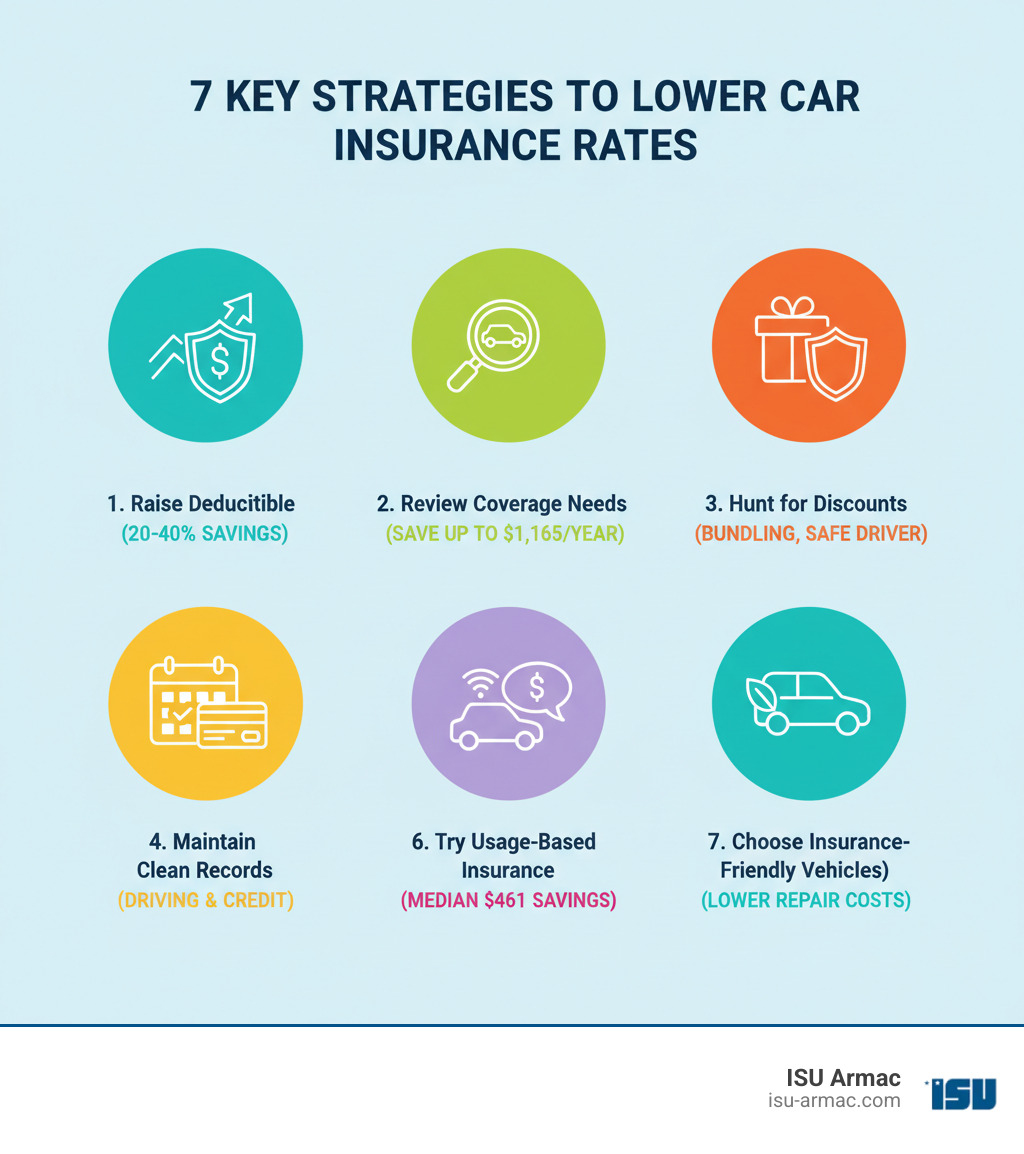
How to Lower Insurance by Adjusting Your Policy & Coverage
When you’re wondering how to lower insurance costs, the smartest place to start is right in your own policy. I’m not talking about cutting corners or leaving yourself vulnerable—quite the opposite, actually. This is about taking a clear-eyed look at what you’re paying for and making sure every dollar you spend on coverage makes sense for your situation today.
Think of your car insurance policy as a living document. Your deductible, your collision and comprehensive coverage, your liability limits—these aren’t decisions you make once and forget about. As your car ages, your financial situation changes, and your comfort with risk evolves, your policy should adapt too. The key is finding that sweet spot where you’re protected against what matters most while not overpaying for coverage that doesn’t make financial sense anymore.

1. Raise Your Deductible
Your deductible is simply the amount you pay out of your own pocket before your insurance steps in to cover a claim. And here’s the thing—insurers really like it when you’re willing to share more of the financial risk with them. They reward that confidence with lower premiums.
The numbers here are pretty straightforward. Bump your deductible from $500 to $1,000, and you’ll typically see your annual premium drop by 20 to 25 percent. If you’re comfortable going even higher with that $1,000 deductible, you could save 40 percent or more on your collision and comprehensive coverage costs. For many families here in the High Desert, that translates to hundreds of dollars back in their pockets each year.
But before you rush to raise that deductible, let’s talk reality for a second. That higher deductible means nothing if you can’t actually afford to pay it when you need to file a claim. If your car gets damaged and you’ve got a $1,000 deductible, you need $1,000 ready to go. So ask yourself honestly: do I have that amount sitting in my emergency fund? If the answer is yes, this strategy is probably your quickest win for how to lower insurance costs. If the answer is “not quite yet,” maybe start with a more modest increase while you build up those savings.
2. Review and Reduce Unnecessary Coverage
Here’s a conversation I have with clients all the time: you bought your car new ten years ago, and you’ve been faithfully paying for full coverage ever since. That made perfect sense back then. But today? That car has depreciated significantly, and you might be paying good money to insure something that’s worth a lot less than you think.
There’s a helpful rule of thumb in the insurance world called the “10 times the premium” rule. If your car’s current value is less than 10 times what you pay annually for collision and comprehensive coverage, it’s probably time to rethink those coverages. You can check your car’s actual market value in minutes at Kelley Blue Book. If you’re driving a 2010 sedan that’s worth $3,000, but you’re paying $600 a year for collision and comprehensive, the math just doesn’t add up anymore.
Dropping collision and comprehensive coverage on an older vehicle can save you about $1,165 per year. Even if you just drop collision coverage alone, you’re looking at $300 to $800 in annual savings. That’s real money that could go toward a new car fund, your emergency savings, or just making your monthly budget a bit easier to manage.
Now, let’s talk about the coverage you should never skimp on: liability. While California requires minimum liability coverage, those minimums are honestly pretty low compared to what a serious accident can cost. If you own a home here in Apple Valley or Victorville, have retirement savings, or other assets you’ve worked hard to build, you need liability limits that actually protect what you’ve built. Think of it this way: the minimum coverage protects you from breaking the law, but adequate coverage protects you from financial devastation.
For even stronger protection, consider an umbrella policy. For typically just $250 to $300 per year, you can add $1 million or more in additional liability coverage. It’s one of the best insurance values out there, especially if you have assets worth protecting.
The bottom line? Review your policy at least once a year, especially as your vehicles age or your financial picture changes. What made sense three years ago might not make sense today, and adjusting your coverage accordingly is one of the most effective ways to keep your costs in check while maintaining the protection you actually need.
Leverage Discounts and Good Habits for Big Savings
Beyond adjusting your policy’s structure, another powerful way to tackle how to lower insurance costs is through discounts and smart habits. Insurance companies actively reward responsible behavior, and by tapping into these opportunities, you can open up some serious savings. Your driving record, credit history, and willingness to accept new technology all factor into what you ultimately pay each month.
3. Hunt for Every Available Discount
Here’s a simple truth: insurance companies offer more discounts than most people realize, and they won’t always advertise all of them. That’s why one of the easiest strategies for how to lower insurance premiums is simply to ask what’s available.
Start with bundling policies. This is often the biggest money-saver. When you combine your auto insurance with homeowners or renters coverage, you can save up to 30 percent—that’s an average of $382 a year. At ISU Armac, we specialize in finding these multi-policy discounts across different carriers. Learn more about bundling your home and auto insurance to see how much you could save right here in the High Desert.
If you have multiple vehicles, a multi-car discount typically saves 5 to 15 percent when you insure them all with the same company. For families with young drivers in Victorville or Apple Valley, good student discounts reward teens who maintain strong grades—usually a B average or better. It’s a nice incentive that can offset some of those higher youth driver premiums.
Completing an approved defensive driving course demonstrates your commitment to safety and can save an average of $233 to $254 annually. This discount isn’t just for young drivers either—many insurers offer it to seniors who want to refresh their skills.
Installing anti-theft devices makes your vehicle less attractive to thieves, and insurers often pass those reduced risk savings directly to you. Similarly, if you’re working from home in Hesperia or Oak Hills and barely putting miles on your car, a low mileage discount could save you about $116 a year. Driving under 10,000 miles annually typically qualifies you, so if your commute has changed, definitely let your insurer know.
Don’t overlook smaller perks either. Loyalty discounts reward long-term customers with 5 to 20 percent off. Paying your premium in full upfront, setting up automatic payments, or going paperless can each trim a bit more off your bill. Some companies even offer discounts for professional affiliations, alumni associations, or employer groups.
The key is to ask about every single discount and apply for anything you qualify for. These savings add up quickly.
4. Maintain a Good Driving and Credit Record
Your personal track record matters enormously when it comes to insurance costs. In fact, maintaining a clean driving record and solid credit history are two of the most powerful long-term strategies for how to lower insurance premiums.
Your driving record is the foundation of affordable insurance. A spotless record with no accidents or violations keeps you in the safe driver category, which open ups the lowest rates and additional discounts. On the flip side, violations hit hard. A single at-fault accident can spike your annual premiums by over $1,000. A speeding ticket? That’s more than $500 extra per year. A DUI can add over $2,200 annually to your costs.
These violations don’t just disappear either. They typically stay on your record and impact your premiums for three to five years. The best approach is prevention: drive defensively, follow traffic laws, and avoid distractions. Safe driving isn’t just about protecting yourself and others on the road around Victorville—it’s also about protecting your wallet.
Your credit score also plays a surprisingly significant role in most states. Research consistently shows that people who manage their credit responsibly tend to file fewer insurance claims. That’s why most insurers use credit-based insurance scores to help determine your premium.
Building and maintaining good credit helps you qualify for better rates. Pay your bills on time, keep your credit utilization low, and check your credit report regularly for errors. While improving your credit is a longer-term strategy, it pays dividends across your entire financial life—including your insurance costs.
5. Accept Technology with Usage-Based Insurance
If you’re a safe driver who’s comfortable with technology, usage-based insurance programs offer a modern solution for how to lower insurance costs. These programs, also called telematics or driver monitoring, use data about your actual driving habits to reward you with lower premiums.
Here’s how it works: You either download a smartphone app or plug a small device into your car’s diagnostic port. This technology tracks things like your speed, braking patterns, acceleration, the times of day you drive, and your overall mileage. Drive safely and responsibly, and you earn discounts.
The savings can be substantial. Some programs offer up to 30 percent off your premium for consistently safe driving. The median savings sits around $120 annually, though some careful drivers in Hesperia and Apple Valley report saving over $900 per year.
These programs work especially well if you drive fewer miles or mainly stick to safe, predictable routes. Working from home? Mostly running local errands around Victorville? Telematics could significantly reduce your costs.
That said, it’s important to understand what you’re signing up for. Before enrolling, ask your insurer how they use and store your driving data. Find out whether unsafe driving could actually increase your premium rather than just limiting your discount. Some people love the accountability and savings these programs provide, while others prefer to keep their driving habits private.
For those willing to share their data and confident in their safe driving skills, usage-based insurance represents one of the most innovative ways to lower your premiums based on your actual behavior behind the wheel.
Shop Smart and Choose Wisely
Even with a perfectly optimized policy and a stack of discounts, mastering how to lower insurance still requires us to be smart shoppers. The insurance market is competitive, and rates can vary significantly between providers, even for the same coverage. Furthermore, the type of vehicle we choose to drive has a profound impact on our premiums, making smart car choices another critical component of our savings strategy.

6. Compare Quotes from Multiple Insurers
Here’s a strategy that might sound obvious, but it’s genuinely one of the most effective ways to reduce our insurance costs: shop around! We should never assume our current insurer is offering us the best rate. The insurance landscape is constantly shifting. Companies adjust their pricing strategies, new discounts emerge, and what was competitive last year might not be today.
The numbers tell a compelling story. Policyholders who switched insurers in the past five years saw a median annual savings of $461. That’s real money that could go toward a family vacation, emergency savings, or simply reducing monthly stress.
We should make it a habit to conduct an annual policy review and compare quotes from multiple insurers, ideally when our renewal notice arrives. But don’t wait for renewal if our life circumstances change. Significant life events like getting married, moving to a new neighborhood in Hesperia or Oak Hills, or even changing jobs can dramatically impact our rates. These moments are perfect opportunities to shop the market.
When comparing quotes, we need to ensure we’re comparing identical coverage. That means the same coverage limits, the same deductibles, and the same types of protection from each company. Otherwise, we’re comparing apples to oranges, and the “cheaper” quote might actually leave us underinsured.
This is where working with an independent insurance agent like us at ISU Armac becomes invaluable. Unlike agents who represent just one company, we work with multiple insurance carriers. We can shop the market on your behalf, accessing a wider range of options and potentially finding better overall value and personalized service right here in Southern California. We do the legwork of comparing quotes while ensuring you’re getting comprehensive protection, not just the lowest number on paper.
7. Choose an Insurance-Friendly Car
The type of car we drive has a direct and substantial impact on our insurance rates, and it’s a factor we can control when making a new vehicle purchase. Understanding how to lower insurance costs extends to our choice of wheels, and making smart decisions at the dealership can save us money for years to come.
Insurers consider several vehicle-specific factors when calculating our premiums. The vehicle’s price matters because more expensive cars cost more to replace if totaled. But here’s where it gets interesting: the cost to repair often matters even more than the sticker price. Newer cars, especially those with advanced driver-assistance features and complex electronics, are significantly more expensive to repair after even minor accidents. A simple bumper repair on a modern car can cost thousands more than on an older model due to embedded sensors, cameras, and sophisticated technology. Those safety features are wonderful for protecting us, but they do come with higher repair bills that insurers factor into our premiums.
On the positive side, cars with higher safety ratings and features that reduce the risk of injuries often qualify for lower premiums. Advanced airbags, automatic emergency braking, and lane departure warnings can all work in our favor. We can check vehicle safety ratings from the IIHS before buying to see how our potential purchase stacks up.
The likelihood of theft also plays a role. Models that are frequently stolen or vandalized will have higher comprehensive coverage costs, plain and simple.
Before we buy a new or used car, we should always check into its insurance costs. We can get a quote for a specific make and model from our insurer before making the purchase. This simple step can prevent sticker shock on our insurance premium after we’ve already committed to a vehicle. Choosing a car that is known for its affordability to repair, good safety record, and lower theft rates is a smart long-term strategy for managing our insurance expenses here in Victorville and throughout the High Desert.
Frequently Asked Questions about Lowering Insurance
Navigating car insurance can feel overwhelming, and we hear that from our clients in Victorville, Apple Valley, and throughout the High Desert every day. When it comes to how to lower insurance, certain questions come up time and again. Let me address the most common concerns we encounter, so you can make informed decisions about your coverage.
How much liability coverage do I really need?
This is honestly one of the most important questions you can ask. Here’s the truth: while every state requires a minimum amount of liability coverage, those minimums are often woefully inadequate to truly protect you financially if something serious happens.
Think about it this way—if you cause an accident that results in severe injuries to multiple people or significant property damage, and your liability limits are too low, you become personally responsible for everything above what your policy pays out. That means your home equity, your savings, your retirement accounts—all of it could be at risk in a lawsuit.
Most insurance professionals recommend much higher limits than state minimums. A common guideline is at least $100,000 per person for bodily injury, $300,000 per accident for bodily injury, and $100,000 for property damage. You’ll often see this written as 100/300/100 coverage.
If you own a home here in Southern California or have built up substantial savings, I strongly encourage you to consider an umbrella policy. For just $250 to $300 added to your annual premiums, a $1 million umbrella policy sits above your auto and home coverage, providing an extra layer of protection that can safeguard everything you’ve worked so hard to build. The right amount of coverage really comes down to assessing your personal assets and your comfort level with financial risk.
When is it a good idea to drop collision and comprehensive coverage?
This question requires careful thought, because the answer is different for everyone. The decision to drop collision and comprehensive coverage is fundamentally about balancing the money you save on premiums against the financial risk you’d take on if your car were damaged or stolen.
The general rule of thumb we use is this: if your annual premium for collision and comprehensive coverage exceeds 10 percent of your vehicle’s current market value, it’s probably time to consider dropping these coverages. This situation typically applies to older vehicles that have depreciated significantly over time.
Let me give you a real-world example. If your car is worth $3,000 according to resources like Kelley Blue Book, and you’re paying $400 a year for collision and comprehensive with a $500 deductible, you’re essentially paying a substantial percentage of the car’s value just for the coverage. If you had a total loss, you’d receive perhaps $2,500 after your deductible—and you’ve already paid $400 for that year’s coverage.
Before making this decision, ask yourself one key question: Can I comfortably afford to repair or replace this car entirely out of my own pocket if something happens? If you own the car outright (no loan or lease requiring these coverages) and you have an emergency fund that could handle the replacement cost, then dropping collision and comprehensive can save you hundreds or even over $1,165 annually. That’s real money you could be putting toward other financial goals.
How does my driving record affect my insurance rates?
Your driving record is hands-down one of the most powerful factors determining what you pay for car insurance. It’s essentially your report card as a driver, and insurers take it very seriously.
If you maintain a clean driving record—free of accidents and moving violations—you signal to insurance companies that you’re a low-risk driver. This qualification opens the door to lower base rates and additional safe driver discounts that can meaningfully reduce your premiums.
On the flip side, violations and accidents can hit your wallet hard. A single at-fault accident can increase your annual premiums by over $1,000. A speeding ticket typically adds more than $500 to your yearly costs. And a DUI? That’s the most severe impact, often raising premiums by over $2,200 annually. These surcharges don’t just disappear overnight, either—they typically stick around on your record affecting your rates for three to five years.
But here’s the encouraging part: your driving record isn’t set in stone. If you’ve had violations in the past, you can actively work to improve your record over time. By consistently driving safely, avoiding traffic violations, and potentially taking a defensive driving course, you demonstrate responsible behavior that insurers reward. Time is on your side—as those old violations age off your record, you’ll see your premiums gradually decrease. Safe driving isn’t just about protecting yourself and others on the road; it’s also one of the most reliable long-term strategies for how to lower insurance costs.
Conclusion
You’ve just learned seven powerful strategies for how to lower insurance premiums—and the best part? You don’t have to implement them all at once to see results. Even making one or two changes, like raising your deductible or bundling your policies, can put hundreds of dollars back in your pocket this year.
The key takeaway is simple: taking a proactive approach to your insurance puts you back in financial control. Instead of passively accepting whatever renewal notice arrives in the mail, you now have the tools to actively manage your costs. Whether it’s shopping around for better rates, maintaining that clean driving record, or simply asking about every available discount, each action you take chips away at that premium.
Here in Victorville, Apple Valley, Hesperia, and Oak Hills, we at ISU Armac see how much these strategies can help our neighbors. As an independent agency, we’re uniquely positioned to shop multiple carriers on your behalf—something captive agents working for a single company simply can’t do. This means more options, better coverage, and often significantly lower rates for you, all without the hassle of calling around yourself.
Rising insurance costs might be the national trend, but that doesn’t mean you’re powerless. Armed with the right knowledge and a partner who genuinely cares about your financial well-being, you can fight back against those increases.
Ready to see how much you could save? Let’s have a conversation about your current coverage and explore what’s possible. And if you’re looking for even more ways to save, learn more about bundling your home and auto insurance with us—it’s one of the fastest ways to open up substantial discounts.
Don’t wait for your next renewal shock. Take charge of how to lower insurance costs today, and let’s work together to find you the protection you need at a price that makes sense.