
Why Travel Agents Need Protection Against Professional Liability Claims
Errors and omissions insurance for travel agents protects your business when clients sue over booking mistakes, missed connections, or supplier failures. This professional liability coverage pays for legal defense costs and settlements when travel arrangements go wrong—even if you did everything right.
Key Coverage Areas:
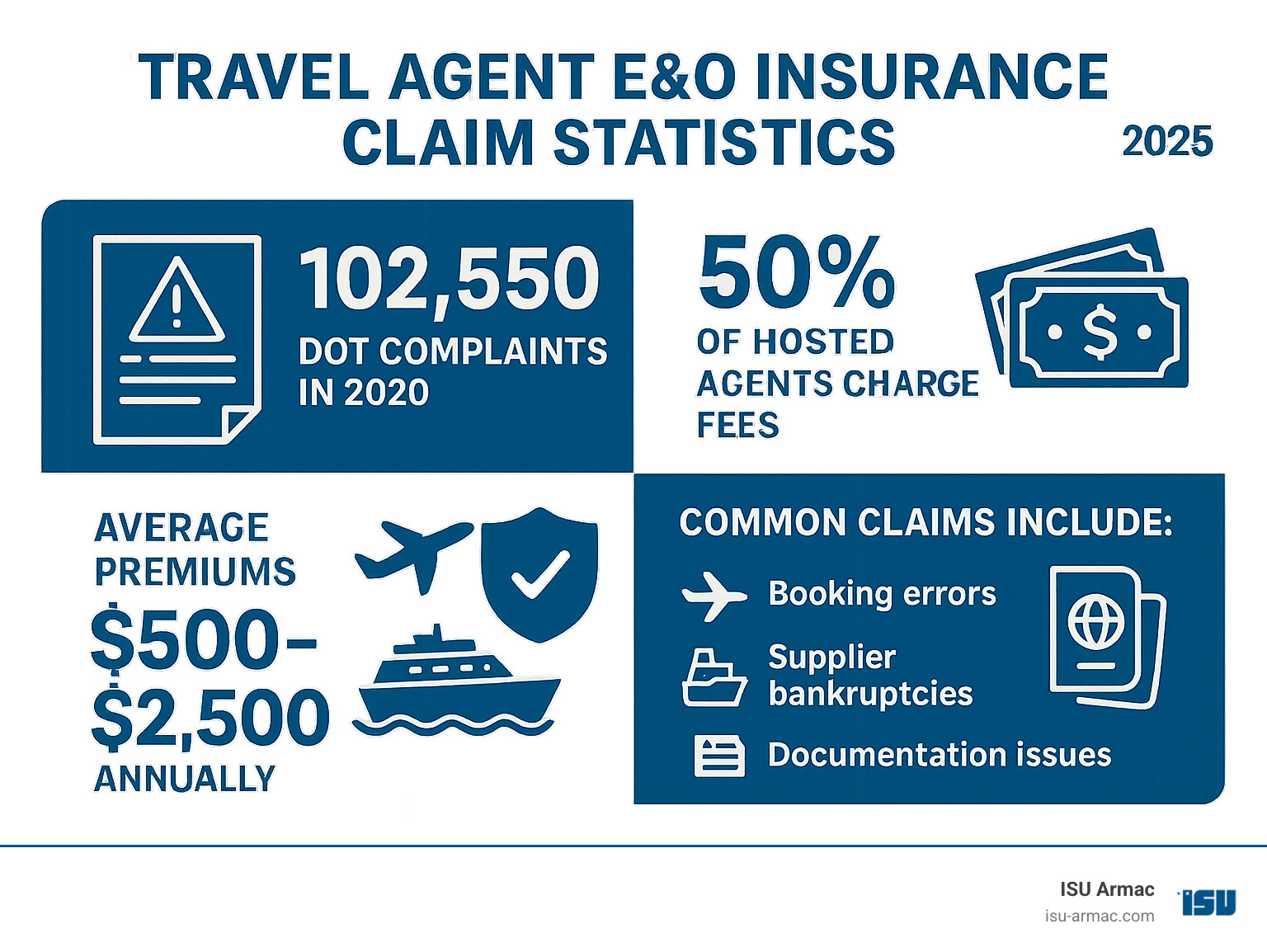
- Booking errors – Wrong dates, hotels, or destinations
- Supplier failures – Cruise line bankruptcies or tour operator defaults
- Documentation issues – Visa requirements or passport problems
- Legal defense – Attorney fees and court costs up to policy limits
- Settlement costs – Judgments and negotiated claim resolutions
The travel industry faces increasing litigation risks. In 2020 alone, clients filed over 102,000 complaints with the U.S. Department of Transportation against airlines and travel agencies. Nearly 50% of hosted travel agents now charge service fees, making them more vulnerable to professional liability claims when trips don’t go as planned.
Whether you’re an independent contractor or work under a host agency, understanding E&O coverage protects your income and reputation. Host agency policies often carry high deductibles and may not cover all your activities.
I’m Ryan McEachron, CEO of ISU Insurance Services ARMAC Agency, with over 25 years of experience helping professionals secure appropriate errors and omissions insurance for travel agents and other liability coverages.
Related content about errors and omissions insurance for travel agents:
- errors and omissions insurance for insurance agents
- errors and omissions insurance for life insurance agents
- errors and omissions insurance for real estate agents
Why “Errors and Omissions Insurance for Travel Agents” Matters
Picture booking what seems like the perfect honeymoon to San Jose, Costa Rica—only for your clients to find at the airport that their tickets read San Jose, California. Those beachfront memories? Gone. And the first call—plus a potential lawsuit—lands on your desk.
Legal defense can exceed $50,000 even when you followed every procedure. One claim can drain cash flow, stall growth, and erase years of goodwill.

Whether you operate under a host agency or on your own, you’re exposed—even when supplier failures are beyond your control. Host-agency deductibles can be steep, and shared limits may evaporate after only a few claims.
The Essentials of Errors and Omissions Insurance for Travel Agents
Errors and omissions (E&O) insurance—also called professional liability—responds when clients allege your services caused financial harm. Most policies are claims-made, meaning the incident and the resulting claim must fall within your active coverage period.
Key protections include:
- Negligence claims from booking mistakes or bad advice
- Legal defense costs, often the most expensive element of a lawsuit
- Settlements or judgments up to your policy limits
- Vendor insolvency coverage when a cruise line or tour operator collapses
- Personal-injury protection for libel and slander
- Defense costs paid outside the policy limits on better forms
Do Travel Agents Legally Need E&O in the U.S. or Canada?
Few U.S. states mandate E&O, yet hosts, consortia, and many suppliers require proof of coverage before allowing you to book. Canada is stricter: ACTA membership and Ontario’s TICO registration both demand professional liability limits, while British Columbia adds exam and bonding rules.
Charging service fees, booking outside your host’s accreditation, or arranging destination weddings all heighten liability—making standalone coverage essential.
What an E&O Policy Covers—and What It Doesn’t
Understanding exactly what your errors and omissions insurance for travel agents covers can save you from costly surprises when you need it most. Think of E&O insurance as your safety net for honest mistakes and client misunderstandings—not as a get-out-of-jail-free card for everything that goes wrong.
Your E&O policy typically steps in when you make booking errors like sending a family to the wrong San Jose (Costa Rica instead of California, anyone?). It also covers situations where you provide misinformation about destinations or fail to catch important visa and document requirements that leave clients stranded at the airport.
One of the most valuable aspects of modern travel agent E&O policies is supplier bankruptcy protection. When cruise lines suddenly fold or tour operators disappear overnight, your clients often look to you for compensation. Your policy can help cover these losses even though the supplier’s failure wasn’t your fault.
The coverage extends to personal injury claims like libel and slander if a client claims you damaged their reputation. Some policies even include basic protection against copyright infringement if you accidentally use someone else’s photos in your marketing materials.
However, E&O insurance has clear boundaries. Bodily injury and property damage aren’t covered—that’s what general liability insurance handles. The policy won’t protect you from fraudulent acts or intentional deception. If you deliberately mislead clients or pocket money that should go to suppliers, you’re on your own.
Cyber liability issues like data breaches require separate coverage, which is increasingly important as travel agents handle sensitive client information. Employment-related claims and moral hazard situations where you benefit from the mistake are also excluded.
The moral hazard exclusion is particularly tricky for travel agents. If you quote a client $4,000 for a trip that actually costs $5,000 and keep the difference, that’s not covered. But if a client misses their cruise connection because you failed to warn them about passport renewal times, that honest mistake typically falls under coverage.
As Travel Weekly notes, many common travel agent claims fall into exclusion categories, making it crucial to understand your policy’s specific language before you need to file a claim.
Claims-Made vs. Occurrence Policies Comparison
Most errors and omissions insurance for travel agents policies use a “claims-made” structure rather than “occurrence” coverage. This means your policy only responds when both the incident and the resulting claim happen during your active policy period.
Claims-made policies include a retroactive date that limits coverage to professional acts occurring after a specific date. If you switch insurance companies, you’ll need tail coverage to protect against claims filed after your policy expires. The trade-off is lower initial premiums that gradually increase as your policy matures.
Occurrence policies cost more upfront but provide more straightforward coverage. They protect against incidents that happen during the policy term regardless of when claims are filed. However, most travel agent E&O carriers prefer the claims-made approach because it’s more predictable and cost-effective.
For new travel agents, claims-made policies offer an affordable entry point into professional liability protection. Established agencies with stable operations might prefer occurrence coverage for its simplicity, but the premium difference often makes claims-made the practical choice.
The key is maintaining continuous coverage without gaps. Even a single day without E&O insurance can create a permanent hole in your protection that no future policy can fill.
Buying the Right Policy & Provider
Shopping for errors and omissions insurance for travel agents can feel overwhelming, but focusing on the right features makes the process much simpler. Most travel agents need at least $1 million in coverage—this has become the industry standard because legal defense costs alone can easily reach six figures.
Think of your E&O policy like a safety net. You want it strong enough to catch you if something goes wrong, but you don’t want to pay for more protection than you actually need. The key is finding that sweet spot between adequate coverage and reasonable cost.
Coverage limits come in two parts: per-occurrence and aggregate. The per-occurrence limit is the maximum your policy pays for a single claim. The aggregate limit is the total amount available for all claims during your policy year. A typical policy might offer $1 million per occurrence with a $2 million aggregate limit.
Deductibles work just like your car insurance—you pay the first portion of any claim. Higher deductibles mean lower premiums, but make sure you can afford the out-of-pocket cost if something happens. Many travel agents choose deductibles between $2,500 and $5,000 to balance savings with affordability.
One crucial feature to look for is “defense costs outside limits” coverage. This means legal fees don’t count against your policy maximum. Without this feature, a $50,000 legal defense bill reduces your $1 million policy to $950,000 for settlement purposes.
When choosing an insurance carrier, stick with companies that have AM Best ratings of A- or better. These ratings measure financial strength—you want to be confident your insurer can pay claims when needed. Companies specializing in travel industry coverage often understand your unique risks better than generic business insurers.
Host agency coverage gaps create a common problem for independent contractors. Your host agency’s policy might not cover you for activities outside their accreditation or may carry high deductibles that you’re responsible for paying. Always verify what protection you actually have before assuming you’re covered.
Our commercial services at ISU Armac include shopping multiple carriers to find the best combination of coverage and price for your specific situation.
Key Factors That Affect Premiums
Your errors and omissions insurance for travel agents premium depends on several factors, with most policies ranging from $500 to $2,500 annually for $1 million in coverage. Understanding these factors helps you manage costs while maintaining adequate protection.
Annual sales volume is usually the biggest factor in determining your premium. An agent booking $500,000 in travel annually faces more exposure than someone booking $100,000. However, the relationship isn’t always linear—experienced agents with strong procedures often get better rates despite higher sales.
Your specialty matters too. Agents focusing on luxury cruises or trip travel typically pay more than those booking standard vacation packages. Group travel and destination weddings also increase premiums because they involve more complex arrangements and higher potential losses.
Claims history significantly impacts pricing. Even one claim can increase your rates for several years. This is why many agents choose higher deductibles to avoid filing smaller claims that might not justify the long-term premium increases.
Years in business and professional training can work in your favor. Established agents with clean records often receive better rates. Completing continuing education courses and maintaining professional certifications demonstrates risk management to insurers.
Independent contractors working under host agencies can often secure basic coverage starting around $350 annually, though these policies typically have limited scope and higher deductibles.
Multi-policy discounts can reduce your overall insurance costs. Bundling your E&O coverage with general liability or cyber insurance often provides meaningful savings while ensuring all your business risks are properly covered.
What to Look For in Policy Documents
Reading your E&O policy might not be exciting, but understanding key provisions prevents unpleasant surprises during claims. Insurance policies are legal contracts, and the details matter when you need protection most.
The retroactive date establishes when your coverage begins for prior acts. If you switch carriers, make sure your new policy’s retroactive date matches your previous coverage start date. Any gap could leave you exposed to claims from work performed during the uncovered period.
Defense costs treatment varies significantly between policies. “Defense costs outside limits” means legal fees don’t reduce your available coverage for settlements. “Defense costs inside limits” means a $100,000 legal defense reduces your $1 million policy to $900,000 for settlement purposes.
Sub-limits reduce coverage for specific claim types. For example, your policy might provide $1 million for professional liability but only $50,000 for cyber-related claims. Understanding these limits helps you decide if you need additional coverage endorsements.
Territory coverage defines where your protection applies. Most policies offer worldwide coverage, but some restrict protection to domestic travel or specific regions. Make sure your coverage matches where you book travel for clients.
Crisis response coverage reimburses emergency assistance costs when clients face travel disruptions. This valuable endorsement can cover expenses for rebooking flights, finding alternative accommodations, or arranging emergency transportation when suppliers fail.
The extended reporting period or “tail coverage” becomes important when switching carriers or retiring. This provision allows you to report claims after your policy expires for incidents that occurred during the policy period.
Pay special attention to exclusions—these define what’s not covered. Common exclusions include bodily injury, property damage, and intentional acts. Understanding these limitations helps you identify where you might need additional insurance coverage.

Cost, Claims & Risk-Reduction Tips
Real-world cases highlight why errors and omissions insurance for travel agents is indispensable. While most host agencies report only a handful of claims, each can be financially devastating.
Typical Claim Amounts
- Wrong-airport booking — $8,000 in extra travel costs
- Missed cruise due to documentation errors — $25,000
- Supplier default that stranded 50 clients — about $200,000 in combined lawsuits
- Visa oversight resulting in denied boarding — $15,000
Sample Defense Costs
- Safari accident lawsuit — $178,821 in attorney fees
- Boat incident settlement — $325,000
Risk-Reduction Best Practices
- Document every client decision and sign-off
- Double-check visa, passport, and health requirements
- Use written agreements clarifying your role and limits
- Stay current through continuing education
- Secure personal data with strong cyber practices
- Communicate proactively when circumstances change
Steps to File an E&O Claim Smoothly
- Notify your insurer within 48 hours of any incident
- Preserve all related emails, contracts, and receipts
- Avoid admitting fault; stick to facts
- Cooperate fully with your carrier’s claims team and counsel
- Take reasonable steps to reduce further loss
- Keep organized records of all claim activity
Additional Insurance to Bundle With E&O
Bundling E&O with complementary policies such as General Liability Insurance Coverage or cyber liability often lowers overall premiums while closing coverage gaps.
Frequently Asked Questions about Errors and Omissions Insurance for Travel Agents
What types of claims does E&O actually pay?
Errors and omissions insurance for travel agents covers the professional mistakes that keep you awake at night worrying about your business. The policy steps in when clients suffer financial losses due to your professional services—or what they perceive as inadequate services.
Your E&O policy typically pays for booking errors like sending a family to the wrong San Jose (California instead of Costa Rica), misinformation claims when you provide incorrect advice about destinations or requirements, and documentation oversights such as failing to inform clients about visa requirements that result in denied boarding.
One of the most valuable aspects is coverage for supplier bankruptcies and defaults. When cruise lines or tour operators suddenly fail, clients often look to their travel agent for compensation, even though you had no control over the situation. Your policy also covers personal injury claims like libel and slander if clients claim you damaged their reputation.
However, the policy draws clear lines about what it won’t cover. Moral hazard situations where you benefit from the error are excluded—like pocketing the difference between what you charged and what you paid. Intentional fraud, bodily injury, property damage, and employment-related claims also fall outside coverage. These exclusions exist to prevent abuse while still protecting you from genuine professional liability risks.
Are independent contractors covered under a host-agency policy?
This question touches on one of the biggest misconceptions in the travel industry. Many independent contractors assume their host agency’s errors and omissions insurance for travel agents automatically covers them completely, but the reality is more complicated.
Most host agency policies do provide some coverage for independent contractors, but often with significant limitations. You might face high deductibles ranging from $2,500 to $10,000, and you’re sharing policy limits with all other contractors under that host. If multiple contractors have claims in the same year, the policy could become exhausted.
Even more concerning, you may not be covered for bookings made outside your host’s accreditation or for specialized services not explicitly covered in their policy. Some host policies also exclude coverage for contractors who charge separate service fees or operate under their own business names.
Before relying solely on host coverage, ask these critical questions: What’s my specific deductible amount? Are all my booking sources covered? What happens if I need to file a claim—do I control the process or does the host agency? How are legal fees handled, and will I have input on settlement decisions?
Many successful independent contractors choose to supplement host coverage with their own policy to ensure complete protection and control over their claims process.
How can I lower my E&O premium without sacrificing protection?
Smart travel agents know that reducing premiums doesn’t mean accepting inadequate coverage. Several proven strategies can lower your errors and omissions insurance for travel agents costs while maintaining the protection your business needs.
The most immediate impact comes from increasing your deductible. Moving from a $2,500 to a $5,000 deductible can reduce your premium by 15-20%. If you have strong cash flow and rarely file claims, this higher deductible might never come into play, but the annual savings add up quickly.
Bundling your E&O with other business insurance creates significant discounts. When you combine professional liability with general liability, cyber coverage, or other business policies, carriers often provide multi-policy discounts of 10-25%. This approach also simplifies your insurance management with one agent handling all your coverage needs.
Implementing documented risk management procedures demonstrates to insurers that you’re serious about preventing claims. Carriers often provide discounts for agents who complete continuing education courses, maintain detailed client communication records, and follow documented booking procedures.
Specializing in lower-risk travel segments can also reduce premiums. Agents focusing on leisure travel to established destinations typically pay less than those booking trip tours or travel to high-risk regions. However, don’t let premium savings drive you away from profitable niches—just make sure you’re getting proper coverage for your specific risks.
At ISU Armac, we shop multiple carriers to find the best combination of coverage and cost for your unique situation. Our ability to compare options from different insurers often results in significant savings while maintaining comprehensive protection. Sometimes the solution isn’t just finding cheaper insurance—it’s finding the right insurance that provides better value for your specific needs.
Conclusion
Travel agents face an increasingly complex liability landscape that makes errors and omissions insurance for travel agents more crucial than ever. With over 102,000 travel-related complaints filed annually and clients becoming more litigious, what starts as a simple booking error can quickly escalate into a business-threatening lawsuit.
The beauty of E&O coverage lies in its ability to transform potentially devastating legal battles into manageable insurance claims. Instead of facing six-figure legal bills and settlement costs alone, you have professional support and financial protection when things go wrong.
Maintaining continuous coverage is absolutely essential. Gaps in your policy can leave you vulnerable to claims from past bookings, even years later. Whether you’re just starting out as an independent contractor or you’ve been in the travel business for decades, having your own E&O policy provides better protection and genuine peace of mind than relying solely on host agency coverage.
At ISU Armac, we’ve spent over 25 years helping professionals throughout Southern California and beyond protect their businesses from unexpected liability claims. Our unique ability to shop multiple carriers means you get the best possible coverage at competitive rates. We understand that every travel agent’s situation is different, and we take the time to find protection that fits your specific needs and budget.
Don’t let one mistake or frivolous lawsuit destroy everything you’ve built in the travel industry. The cost of errors and omissions insurance for travel agents is minimal compared to the financial devastation of facing a major claim without coverage. Contact us today for a comprehensive quote that includes E&O and other essential business coverages.
Our experienced team will help you build a complete protection strategy so you can focus on what you do best – creating incredible travel experiences for your clients. For more detailed information about professional liability coverage, visit our guide on What is Errors & Omissions Liability Insurance? to learn how this essential coverage protects your business from the unexpected.