Permanently attached rooftop solar panels are commonly included under dwelling coverage, while ground-mounted and detached systems often fall under a different coverage part. The answer still depends on your policy, installation type, ownership arrangement, exclusions, limits, and deductible.
You may be asking this after a windstorm rattled your Victorville roof, after a brushfire sent ash across your property, or while reviewing a solar financing agreement before installation. The short answer is usually favorable for an owned, permanently attached rooftop array, but “covered” doesn't tell you whether the policy will pay enough to replace the equipment, repair the roof, remove and reinstall the panels, or absorb the deductible.
That distinction matters in California's High Desert. Wind, brushfire exposure, intense sun, and roof access can turn a straightforward equipment claim into a larger property-loss question. Before you assume your policy is adequate, confirm where the panels are installed, who owns them, which coverage part applies, and how the policy values the loss.
Table of Contents
- What California Homeowners Should Know About Solar Panel Coverage
- How Coverage Changes by Installation Type
- Covered Perils and Common Exclusions
- When an Endorsement or Separate Policy May Be Needed
- How to Verify Your Solar Coverage
- California Solar Coverage Scenarios
- What to Do After Solar Panel Damage
- Key Questions to Ask Your California Agent
What California Homeowners Should Know About Solar Panel Coverage
A permanently attached rooftop solar system is commonly treated as part of the home under Coverage A, or dwelling coverage, rather than as personal property. That general treatment is supported by consumer insurance guidance describing most rooftop solar systems as covered by standard homeowners policies and by insurer guidance explaining that residential solar installations are typically included with the dwelling when permanently attached. You can review the California solar panel insurance explanation and the broader solar panel homeowners insurance guidance for that baseline.
But the baseline isn't a promise that every loss, every mounting method, or every ownership arrangement will be handled the same way. A Victorville homeowner with owned panels bolted to the main roof is in a different position from a homeowner with a leased array, a ground-mounted system, or panels on a detached garage.
Three facts determine the coverage conversation
Ownership comes first. Owned and financed systems may be part of the homeowner's insured property, subject to the policy. A leased or power-purchase-agreement system may place repair obligations and insurance responsibilities on the third-party owner. Read the contract before relying on your homeowners policy.
Installation method changes the coverage bucket. Roof-integrated and rack-mounted panels attached to the house commonly fit dwelling coverage. Ground arrays, detached-structure installations, and some solar carports may be treated as other structures instead.
Policy wording controls the result. Endorsements, exclusions, scheduled limits, valuation language, and deductibles can change the practical payout even when the equipment is generally insured.
Practical rule: Don't stop at “solar is covered.” Ask which coverage part applies and whether its limit is large enough for the entire system and the work required to restore the property.
Solar arrays in the Victorville area can represent a substantial household investment. If the system is classified under a smaller limit or the policy doesn't address removal and reinstallation, a severe-weather claim can leave a significant out-of-pocket gap. The installation-based comparison below is the fastest way to identify that risk.
How Coverage Changes by Installation Type
Two homeowners can own similar panels, inverters, and wiring yet receive different claim treatment because the equipment is attached to different parts of the property. The key issue isn't only the solar technology. It's the physical relationship between the array and the insured residence.
Coverage A for attached rooftop systems
Coverage A, dwelling coverage, generally applies to permanently attached rooftop panels because the array becomes part of the home's structure. The dwelling limit, dwelling deductible, replacement-cost provisions, and roof-related terms may therefore govern the loss.
That doesn't mean the insurer automatically pays every expense. The adjuster may examine the cause of damage, the policy's exclusions, the condition of the roof, and whether removal and reinstallation are included. A homeowner should also confirm whether damaged matching equipment or related electrical components receive the same valuation treatment.
Coverage B for detached and ground-mounted arrays
Coverage B, other structures coverage, commonly handles property separated from the main dwelling, such as a detached structure or a ground-mounted solar array. A typical default limit is 10% of Coverage A, as described in this California coverage explanation for ground-mounted systems.
For example, a dwelling limit of $500,000 would typically produce $50,000 in other-structures coverage under that default structure. Those figures come directly from the cited California insurance explanation. Whether that amount is enough depends on the system, the supporting structure, site work, electrical equipment, and restoration costs.
Coverage C for removable property
Coverage C, personal property coverage, is more relevant to portable or removable components than to a permanently installed rooftop array. It may not provide the same limit or valuation treatment as dwelling coverage, and it can include different exclusions.
| Installation Type | Typical Coverage Part | Deductible That Applies | Common Gap |
|---|---|---|---|
| Permanently attached roof array | Coverage A, dwelling | Usually the dwelling deductible, subject to policy terms | Removal, reinstallation, matching, or valuation limitations |
| Ground-mounted array | Coverage B, other structures | Usually the applicable property deductible | Other-structures limit may be too low |
| Detached garage or shed array | Often Coverage B | Usually the applicable property deductible | Structure and equipment may compete for the same limit |
| Portable or removable component | Coverage C, personal property | Personal-property deductible, if applicable | Lower limit, exclusions, or different valuation |
| Solar carport not attached to the home | Often Coverage B | Usually the applicable property deductible | Misclassification and insufficient structure limit |
The same hailstorm can therefore produce different results based on mounting and wiring. Even correctly classified equipment can still be excluded for a particular cause of loss, which makes the peril analysis just as important.
Covered Perils and Common Exclusions
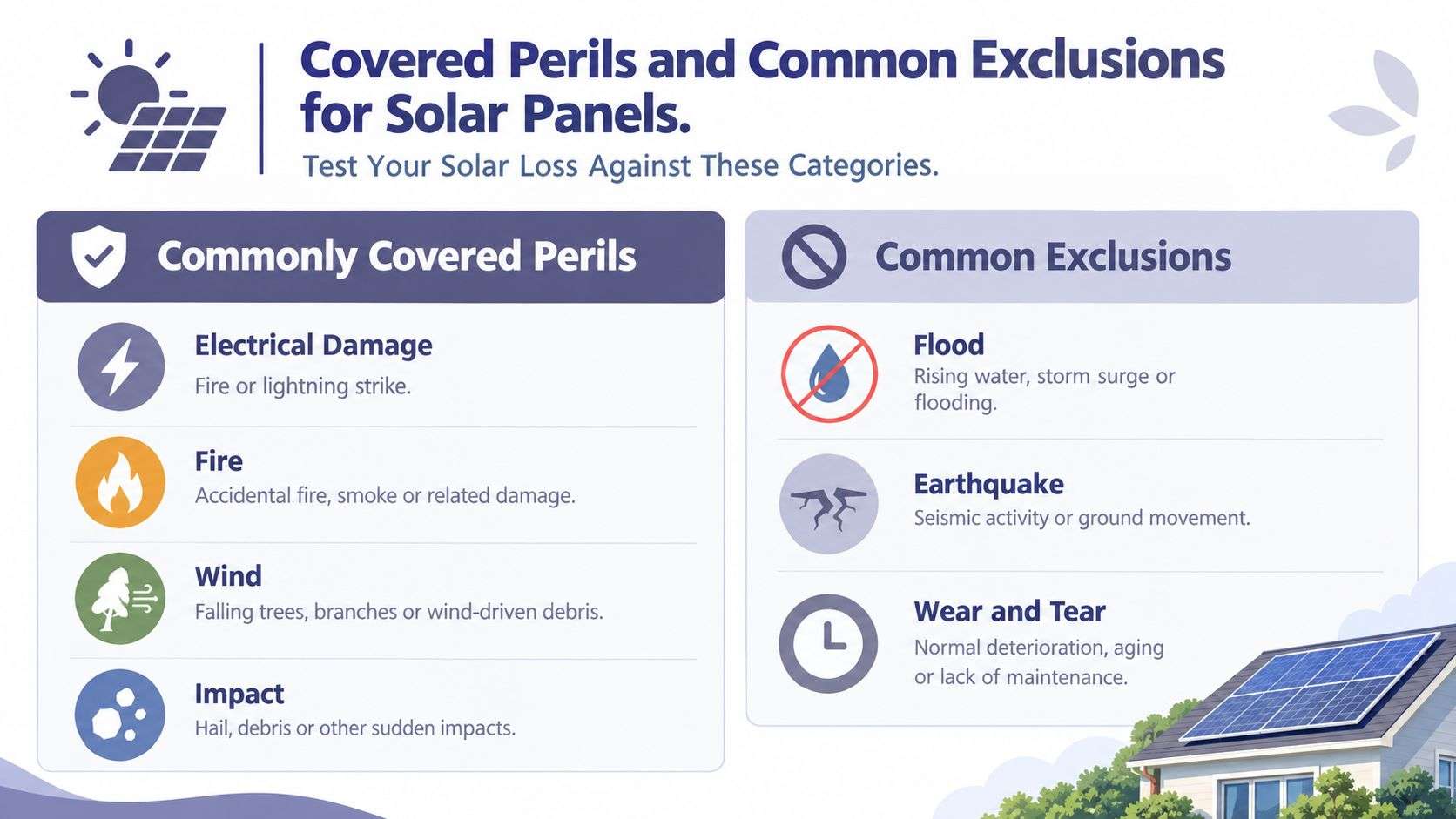
Test a solar loss against the policy in four steps. First, identify the event. Second, check whether the policy covers that event. Third, look for an exclusion or limitation. Fourth, apply the correct deductible and limit.
Commonly covered perils
Policies commonly respond to sudden, accidental events such as wind, hail, lightning, fire, smoke, vandalism, theft, and certain falling objects, subject to the specific policy form. Industry claims data helps explain why these details matter. Verisk recorded $6.4 million in solar claims during 2020 and 2021, with an average claim of about $3,700. More than half of that claim amount came from the top five states, and roughly two-thirds of the claims involved hail while one-third involved fire, according to Verisk's solar claims analysis.
Conditional or limited causes
Some causes depend heavily on wording and circumstances. Roof collapse, falling objects, smoke, and electrical damage may be covered when they result from an insured event, but exclusions or sublimits can change the answer. A power surge, for example, may require specific equipment-breakdown language or may be limited by the policy.
Common exclusions
Expect careful review of earthquake, flood, wear and tear, gradual deterioration, pest damage, manufacturer defect, faulty installation, and maintenance-related damage. These exclusions don't mean every related loss is automatically denied, but they do mean the event and the source of damage must be established.
For Victorville homeowners, wind and wildfire deserve focused attention. Flood and earthquake damage are often misunderstood as risks that a standard homeowners policy automatically handles. Review the wildfire insurance guidance for homeowners and confirm whether separate protection is needed for hazards outside the homeowners form.
Before assuming coverage, ask:
- Is the peril listed? Confirm whether the policy uses named perils or broader open-perils wording.
- Does an exclusion override it? Read exclusions for earth movement, water, installation, maintenance, and electrical damage.
- Does a limit apply? Look for sublimits affecting equipment, detached structures, or matching.
- Which deductible applies? Verify whether it's a flat amount or a percentage tied to a specific peril.
When an Endorsement or Separate Policy May Be Needed
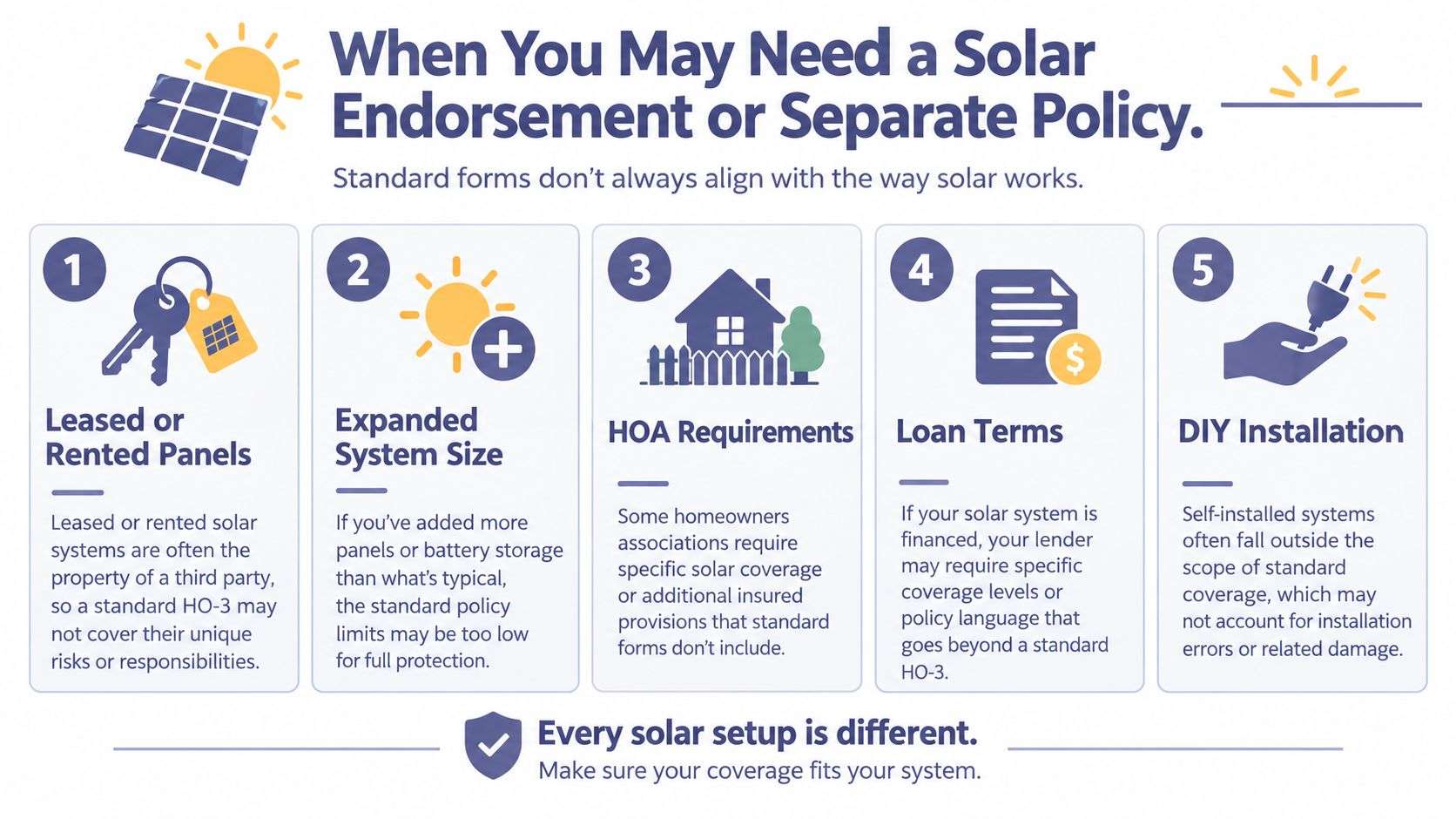
A standard homeowners form can provide a useful starting point, but it may not match the way your solar system is owned, installed, financed, or repaired. An endorsement or separate policy becomes worth discussing when the system sits outside the ordinary rooftop assumption.
Leased or power-purchase-agreement systems
If a third party owns the panels, that owner may carry the equipment insurance. Your contract may require prompt notice, access for inspection, or cooperation after damage. The gap appears when the homeowner assumes the personal policy controls while the agreement assigns repair responsibility elsewhere.
Give the insurer and contract administrator the ownership documents, equipment schedule, and proof of the third party's insurance. Don't cancel or modify coverage based on a verbal statement.
Financed systems
A lender may require evidence of property coverage, replacement terms, or a particular limit. The financing agreement can also identify the borrower's obligations after a loss. Provide the lender requirements, purchase contract, installation certificate, and declarations page so the agent can compare the required protection with the actual policy.
Ground-mounted, detached, or carport arrays
The largest structural concern is often the Coverage B limit. If the array is away from the home, ask whether an other-structures endorsement can raise the limit or whether a separate solar policy makes more sense. Underwriters may request photographs, site plans, electrical details, permits, and an itemized replacement estimate.
High-value systems
A premium system, battery installation, or expanded array may exceed the practical limit available under the existing policy. Request a written valuation review rather than relying on the original home limit, especially after an addition or upgrade.
Roof-skirted and tile-mounted arrays
Roof restoration can require panel removal, temporary storage, flashing work, and reinstallation. Ask specifically whether those costs are included, how matching equipment is handled, and whether the policy pays replacement cost or actual cash value.
California associations also have special documentation issues in some multifamily common-area roof situations. Under Civil Code section 4746, an association can require an owner to maintain homeowner liability coverage and provide proof within 14 days of approval and annually afterward, as explained in this California solar insurance discussion. If your installation involves a shared roof, provide the association's requirements before binding coverage. For earthquake-related planning, review this California earthquake home insurance resource.
How to Verify Your Solar Coverage
A policy review should produce documents, not general reassurance. Start before a claim, while you can still correct a limit or clarify an ownership arrangement.
Follow the policy trail
Locate the declarations page. Confirm the dwelling limit reflects the home's current condition and improvements after the solar installation. The page also identifies deductibles and listed endorsements.
Read Coverage A. Look for language addressing permanently attached equipment, dwelling components, roof work, replacement cost, and matching. Don't assume an installation certificate changes the policy automatically.
Review Coverage B. If the system is ground-mounted, on a detached garage, or on another separate structure, identify the available other-structures limit and determine whether the array shares that limit with other property.
Read exclusions and conditions. Search for wording involving earth movement, flood, wind, hail, electrical damage, faulty workmanship, wear, deterioration, and maintenance. Confirm whether any solar-specific endorsement modifies those provisions.
Match ownership to paperwork. Keep the panel and inverter purchase contracts, loan or lease agreements, power-purchase documents, installer certificates, permits, warranties, photographs, and equipment specifications together.
Confirm the deductible and valuation
Ask whether wind or hail carries a separate deductible, particularly if your policy has High Desert underwriting conditions. Confirm whether the equipment is settled at actual cash value or replacement cost, and ask whether roof removal and reinstallation are included in the covered scope.
Roof maintenance can also affect underwriting and claims documentation. For a practical discussion of related maintenance concerns, review these soft wash roof cleaning insurance risks before arranging work near mounted equipment.
Request written confirmation of the coverage part, applicable limit, deductible, valuation method, and removal or reinstallation treatment. A written answer gives you something concrete to compare with your installation contract and lender or lessor obligations.
California Solar Coverage Scenarios
Owned rooftop panels damaged by wind
A Victorville homeowner owns rack-mounted panels permanently attached to the main roof. A severe wind event damages the panels and shingles. The likely coverage conversation begins with Coverage A, but the adjuster still needs to determine whether wind is covered, which deductible applies, and whether the roof work includes panel removal and reinstallation.
The homeowner should provide the declarations page, installation invoice, panel specifications, photographs from before and after the event, and any roof inspection records. The next step is a written scope review, including matching and roof restoration terms. Roof-matching language can materially affect the repair plan, so don't accept an equipment-only estimate without reviewing the full property scope.
Leased panels after a covered event
A California homeowner has leased panels on the roof. Damage occurs during a covered event, but the leaseholder owns the array. The lease agreement and its insurance provisions may control equipment replacement, while the homeowner's policy may address covered damage to the residence itself, subject to its terms.
The homeowner should notify the insurer and leaseholder promptly, preserve the contract, and follow required notice and access procedures. The deductible and payment path depend on the applicable agreements and policies, not just on who lives in the home.
Ground-mounted array affected by brushfire
A Palmdale resident owns a ground-mounted system near the house. A brushfire damages the array. The relevant question is whether the system falls under Coverage B, how much of that limit remains available, and whether fire is covered under the policy.
The homeowner should gather site photographs, the purchase contract, a replacement estimate, and the declarations page. If the system exceeds the available other-structures limit, an endorsement or separate policy may have been necessary before the loss. After the claim, the homeowner should ask for the coverage determination and limit calculation in writing.
| Scenario | Triggered Coverage | Deductible Applied | Key Documentation | Recommended Action |
|---|---|---|---|---|
| Owned rooftop array damaged by wind | Usually Coverage A, subject to policy | Applicable dwelling or peril deductible | Declarations, installation records, photos, roof records | Review full roof and solar scope |
| Leased rooftop array damaged by a covered event | Contract and applicable property coverage | Depends on responsible policy and agreement | Lease, notice terms, insurer documents | Notify both responsible parties promptly |
| Ground array damaged by brushfire | Often Coverage B, subject to policy | Applicable property or fire deductible | Site plan, ownership records, limit page, estimate | Compare replacement cost with Coverage B |
These scenarios aren't claim guarantees. They show why ownership and placement must be verified before anyone predicts the outcome.
What to Do After Solar Panel Damage
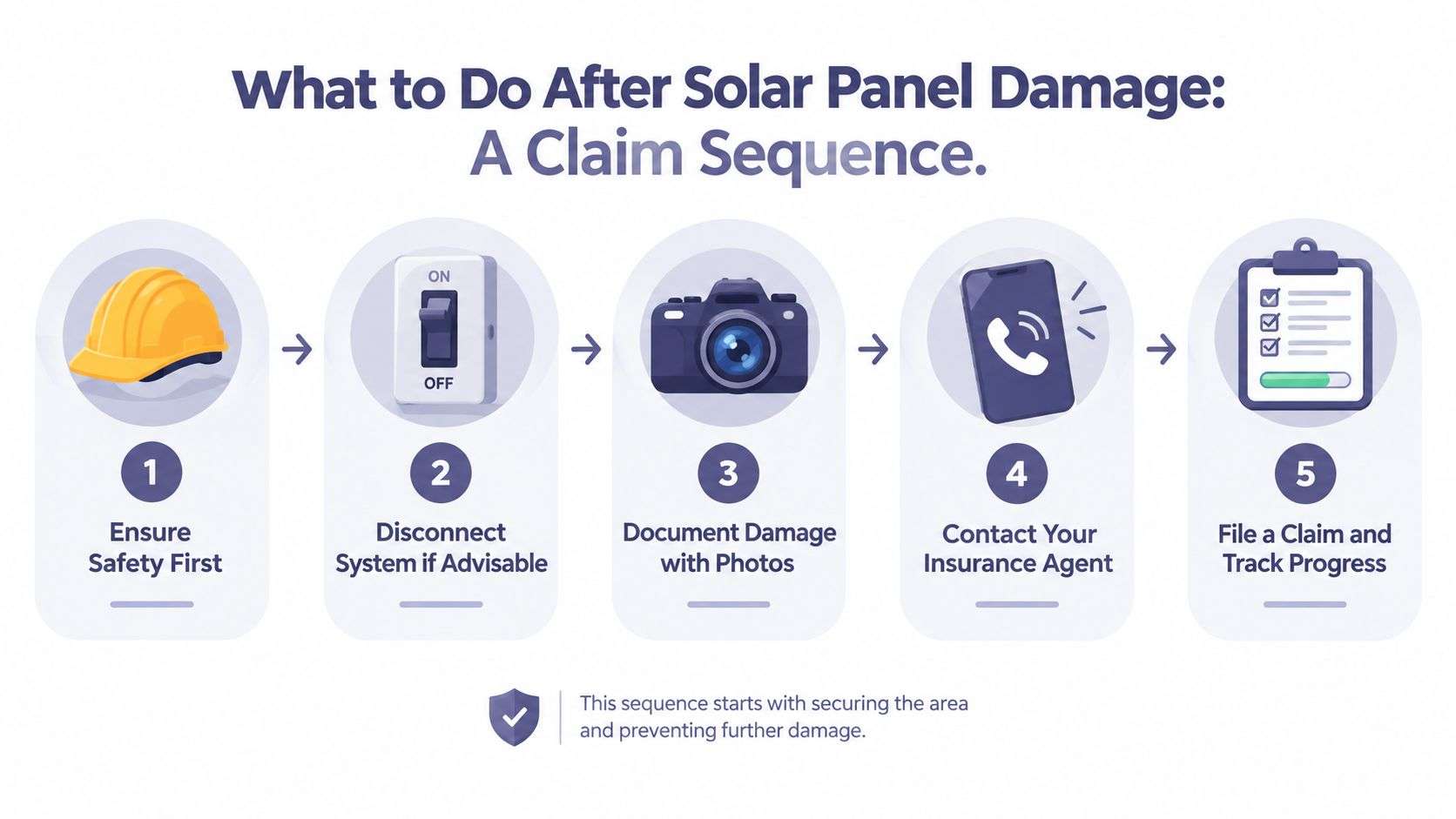
Start with safety. Stay clear of damaged panels, exposed wiring, broken glass, and unstable roof areas. If shutting down the system is appropriate and safe, follow the installer's emergency procedure or contact a qualified professional. Don't climb onto a damaged roof to inspect equipment.
Document before cleanup changes the evidence
Take wide photographs showing the house and array, then close photographs of broken panels, wiring, mounting points, roof damage, interior leaks, and nearby debris. Add timestamps, written notes, weather details, contractor observations, and a record of any temporary measures used to prevent additional damage.
Collect the installation contract, equipment specifications, warranties, permit records, prior photographs, financing or lease documents, and any maintenance records. A complete file helps the adjuster distinguish storm damage from pre-existing wear, defective installation, or gradual deterioration.
Notify and review the claim carefully
Notify your insurer or agent promptly, cooperate with inspections, and keep every email, estimate, photograph, and payment record. Ask whether the claim scope includes panel removal, temporary storage, roof repairs, reinstallation, wiring, inverter work, and matching equipment.
Depreciation, deductibles, exclusions, and policy limits can change the final payment. Keep correspondence organized by date, and don't accept an early settlement until you understand the valuation and whether the roof and solar portions have both been addressed. You can also review this guidance on using your own contractor on an insurance claim before choosing a repair professional.
Key Questions to Ask Your California Agent
Bring your declarations page and solar documents to the conversation. Ask direct questions and request written answers.
Coverage classification
- Is my permanently attached rooftop system included under Coverage A?
- Would my ground-mounted, detached-structure, or carport array fall under Coverage B?
- Does the policy treat the inverter, battery, wiring, racking, and mounting hardware the same way?
- If the panels are leased or subject to a power-purchase agreement, who carries the equipment insurance?
Limits and valuation
- Is the system insured at replacement cost or actual cash value?
- Is the dwelling limit sufficient after the solar installation and related improvements?
- What Coverage B limit applies, and does the array share that limit with other structures?
- Are removal, temporary storage, roof repair, and reinstallation included?
- How are matching panels or unavailable equipment handled?
Perils and deductibles
- Are wind, hail, fire, smoke, lightning, theft, vandalism, and falling objects covered?
- What exclusions apply to flood, earthquake, wear, faulty installation, and electrical damage?
- Is there a separate wind or hail deductible?
- Does a percentage deductible apply?
Victorville-specific review
- Does the roof age affect eligibility or claim handling?
- Are there underwriting requirements related to wind, wildfire exposure, roof condition, or mounting?
- Should I consider equipment-breakdown protection?
- Do I need an endorsement for a detached or high-value system?
Ask the agent to confirm the relevant coverage part, limit, deductible, valuation method, ownership treatment, and removal or reinstallation terms in writing. ISU Insurance Services offers homeowners insurance guidance for California residents and can help Victorville homeowners organize those questions around the actual installation rather than a generic rooftop assumption.
ISU Insurance Services helps California homeowners review home insurance, compare coverage options, and identify gaps involving solar ownership, mounting location, deductibles, and claim restoration terms. Visit ISU Insurance Services to request guidance for your Victorville or California property before a solar loss exposes an avoidable coverage problem.