
You can own a clean-looking Victorville condo and still be exposed. The first time many people find that out is after a leak in the unit above them, a smoke event nearby, or a special assessment from the HOA that lands on their lap with no warning. At that point, the question isn't whether you have insurance, it's whether your policy covers the part of the loss you thought the HOA handled.
That's the problem with generic condo advice. Condo Insurance in Victorville CA has to account for the High Desert, HOA paperwork, interior finish responsibility, and the way California condo underwriting works. If you want coverage that fits the risk, you need to look past the premium and focus on the gaps.
Table of Contents
- Why Victorville Condo Owners Need a Local Insurance Strategy
- Understanding HO-6 Coverage and the Drywall-In Boundary
- Victorville and High Desert Risks That Shape Your Coverage
- What Drives Condo Insurance Pricing in Victorville
- How to Compare Quotes and Choose the Right Carrier
- Your Condo Insurance Checklist for Victorville Owners
- Get a Condo Insurance Quote From ISU Insurance Services
Why Victorville Condo Owners Need a Local Insurance Strategy
A Victorville owner gets a water stain on the ceiling and assumes the HOA will handle the mess because the roof is part of the building. Then the claim gets sorted out, and the hard truth shows up. The master policy may cover the shell and common areas, but the owner often ends up responsible for the interior finish work, personal property, and any special assessment tied to the loss.
That's why local strategy matters. Victorville isn't just “another California condo market.” The High Desert brings its own mix of reconstruction costs, weather stress, and association structures, and those details change what a sensible policy looks like. A cookie-cutter approach leaves owners overconfident on paper and underinsured in real life.
Practical rule: If you haven't read the HOA's insurance summary, you're guessing, not buying coverage.
A local independent agency can help cut through that guessing. ISU Insurance Services works from Victorville, so the conversation can start with the actual property, the HOA setup, and the coverage boundary between the association and the unit owner. That matters more than slick marketing language because condo insurance is really a coordination problem, not a product label.
The state picture backs that up. California's condo-unit-owners market has expanded for years, with written premium rising from $106.3 million in 2001 to $478.4 million in 2017, written exposures growing from 449,676 to 954,907, and average written premium increasing from $236 to $501 over the same period (California Department of Insurance study). That's a statewide sign that condo coverage has become more common and more expensive, and Victorville buyers feel that pressure through the same California loss environment and rebuilding costs.
The right question isn't, “Do I have condo insurance?” It's, “Does my policy line up with my HOA, my unit's finishes, and the risks around my building?” If the answer isn't immediate, the policy needs work.
Understanding HO-6 Coverage and the Drywall-In Boundary
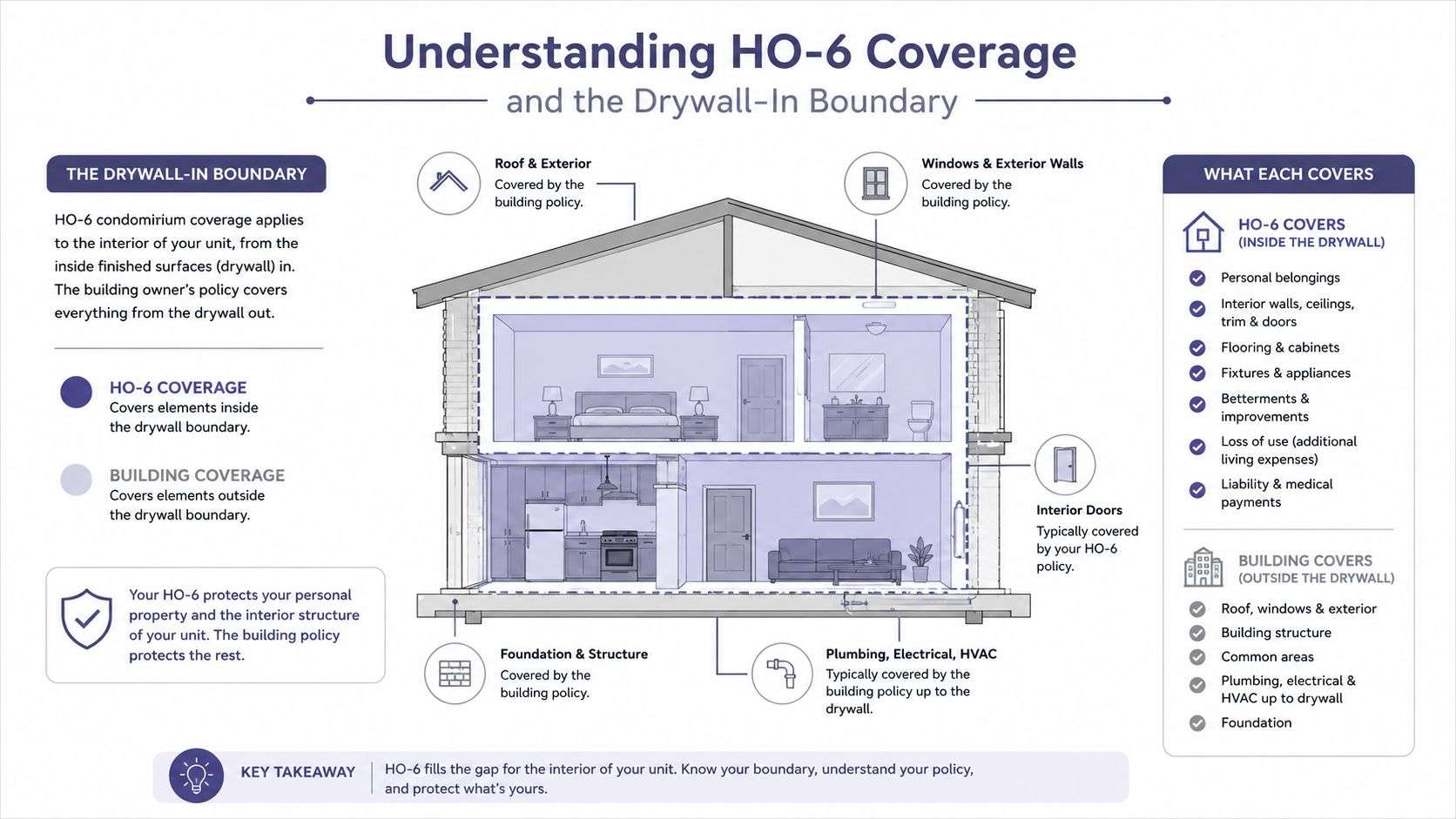
Start with the boundary. In a condo, the HOA master policy usually protects the building shell and common areas, while the owner's HO-6 policy is designed for the unit itself, especially the inside of the walls. In practical terms, the owner is often responsible for everything from the drywall in, including floors, walls, cabinets, and fixtures.
That boundary is the core of the policy. If the HOA insures the roof and exterior, your policy still has to respond when the inside of your unit is damaged. If you upgraded countertops, replaced flooring, or added better fixtures, those improvements sit on your side of the line unless your coverage is built to include them.
The four parts that matter most
Personal property covers belongings like furniture, electronics, clothing, and appliances you own.
Interior structures protect the parts of the unit that aren't part of the building shell, which is where many condo owners get surprised.
Liability matters if someone is injured in your unit or you accidentally damage another unit.
Loss of use helps if you can't live there while repairs are being made.
Those four pieces work together. A cheap policy that ignores one of them is not a bargain. It's a gap with a lower invoice.
Read the HOA policy first, then buy your HO-6 to fill the missing layer, not to duplicate the wrong one.
A useful companion resource is For The Public Adjusters on HOA master, because the core issue isn't just what your policy says. It's how the master policy and the unit-owner policy interact after a claim.
For California condo owners who want to understand earthquake-specific gaps in that structure, this resource helps too, California condo earthquake insurance guidance. Earthquake is a separate conversation from ordinary interior damage, and you should treat it that way.
The short version is simple. Don't buy a condo policy by guessing at the HOA's responsibility. Buy it after you know exactly where the HOA stops and your unit starts.
Victorville and High Desert Risks That Shape Your Coverage
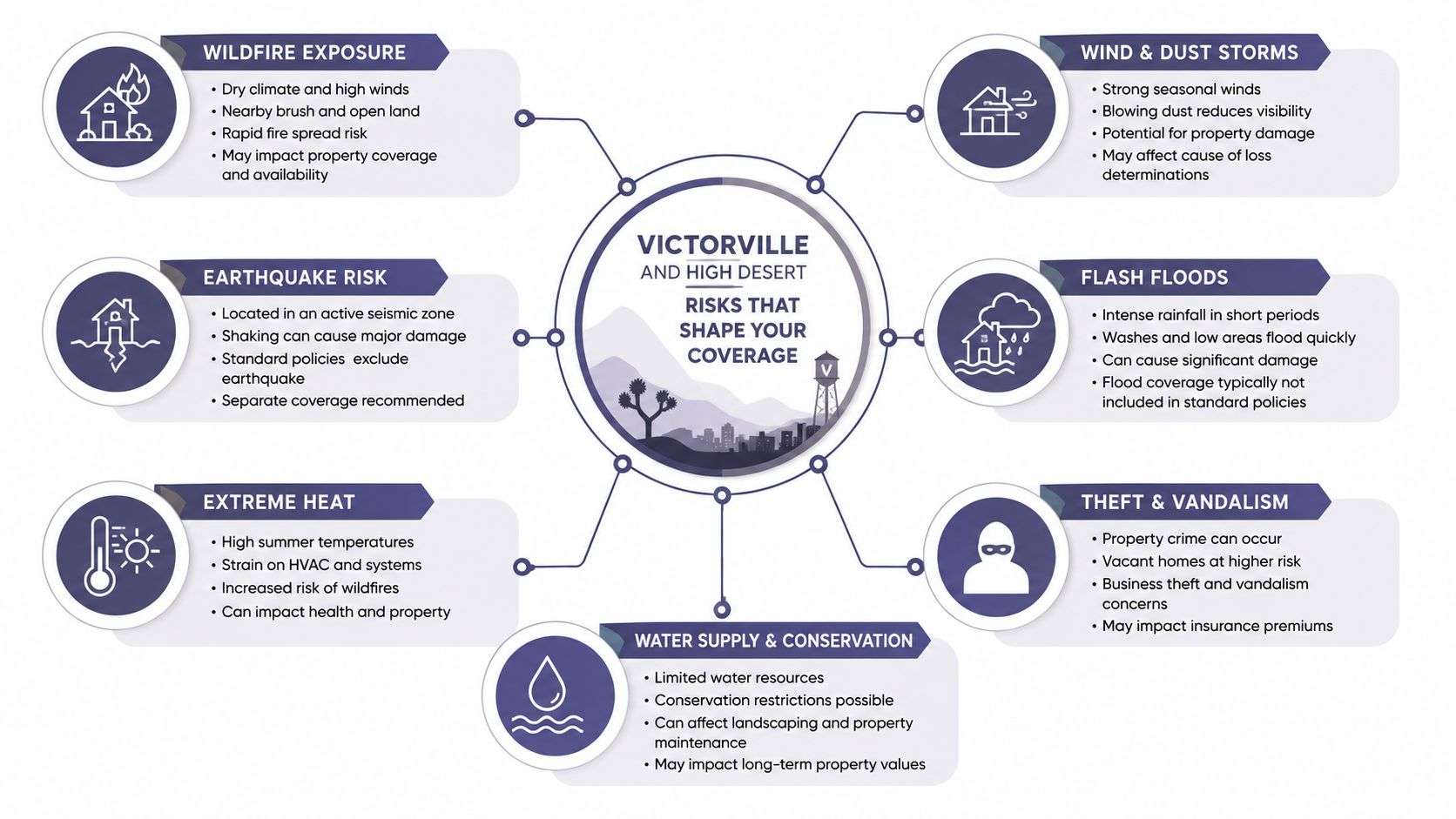
Victorville buyers need to think in terms of exposure, not just price. California condo coverage is sensitive to hazard and loss-cost drivers, and a standard HO-6 policy in lower-risk parts of the state is often estimated around $400 to $700 per year, while higher-wildfire-risk or high-value markets can move to $600 to $1,200+. That range tells you what matters, which is that local risk can move premiums materially.
Victorville adds a few pressure points. Dry conditions, wind-driven debris, and wildfire smoke all matter because damage doesn't have to start inside your unit to affect you. A nearby fire can leave soot, odor, and residue behind, and condo owners still need coverage for their belongings and interior surfaces if the policy responds the right way.
The risks that deserve a real review
Water loss is the big one people underestimate. Burst pipes, roof leaks, and interior plumbing failures can hit a condo hard, and the claim outcome often depends on whether the damage is sudden and whether the interior finishes are insured correctly.
Building age matters because older systems create more questions at underwriting and during claims.
Roof age and plumbing condition matter because carriers increasingly ask for them when evaluating the unit and the property.
Flood exposure should be checked for buildings near washes or low-lying areas, because flood is not something you should casually assume is included.
California condo owners also need to verify what the HOA discloses. Annual budget reporting must include a summary of property, general liability, earthquake, flood, and fidelity insurance policies, plus the insurer name, type of insurance, policy limit, and deductible for each policy (California condo disclosure mechanics). If that information is already on the declaration page, the association can satisfy the requirement by handing out copies of that page with the budget report.
That disclosure is useful because it tells you what's being handled by the association and what isn't. If the HOA's policy leaves a deductible burden or a special assessment risk, your personal policy needs to be read with that in mind.
For Victorville-specific homeowner context that overlaps with condo risk, this High Desert insurance guide is worth reviewing. The local lesson is the same. Dry climate, rebuilding cost pressure, and claim complexity make “good enough” coverage a bad habit.
What Drives Condo Insurance Pricing in Victorville
A Victorville condo owner can get two quotes that look similar on paper and still end up with very different protection. One price may reflect a thin reading of the HOA master policy, a high deductible, or weak coverage for interior finishes. The better quote usually costs more because it addresses the gaps that matter in a High Desert condo, especially loss assessment and interior damage.
Victorville pricing is tied to how much risk the insurer believes it is taking, how costly a repair could be, and how much of the unit's interior exposure you want covered. One California condo pricing page lists Victorville at about $81 per month or $974 per year, while a national benchmark says average U.S. condo insurance is about $531 per year. That puts the Victorville estimate at roughly 83% higher than the national average.
That gap deserves attention. It does not mean every Victorville policy is overpriced. It means local conditions are strong enough that a bargain quote can be a warning sign if the coverage is thin.
| Condo Insurance Cost Comparison | Estimated Annual Premium | Key Pricing Factors |
|---|---|---|
| Victorville, CA | $974 | High Desert rebuilding costs, local risk factors, coverage choices |
| U.S. average | $531 | Broad national benchmark |
| Lower-risk California estimate | $400 to $700 | Lower hazard exposure, simpler underwriting |
| Higher-risk California estimate | $600 to $1,200+ | Wildfire risk, higher-value units, more demanding underwriting |
Pricing also changes when the unit itself is more complex. California underwriting guidance in one insurer document requires dwellings to be insured to 100% of replacement cost, sets a minimum Coverage A and C combined limit of $50,000, a maximum of $750,000, and says electrical, plumbing, and heating systems must be updated within the last 50 years (California underwriting guidelines). Those are the kinds of rules that influence whether a condo is accepted and what it costs.
Bottom line: the cheapest quote often assumes less interior protection, a different deductible structure, or a narrower view of the HOA's responsibility.
Loss assessment is the blind spot that keeps causing trouble. If the HOA hits owners with a special assessment after a master-policy deductible or a common-area loss, the unit owner's HO-6 policy may need the right loss-assessment protection. A useful checklist says owners should check both deductible protection and condominium protection coverages on the certificate, and it notes that separate deductibles can exist for water or earthquake losses (condo unit-owner checklist). Many buyers miss that detail until they are already facing a bill.
If you are trying to see how different coverage choices change the price, use this condo insurance cost calculator and compare the result against the HOA's deductible structure and your actual unit finishes. That gives you a cleaner read on what you are paying for, and what you are leaving exposed.
How to Compare Quotes and Choose the Right Carrier
Don't compare condo quotes by premium alone. That's how people end up with a lower bill and a worse claim. Start with the policy structure, then compare the parts that determine whether the policy pays when the damage is inside your unit.
The first filter is coverage scope. Does the quote clearly protect interior structures, personal property, liability, loss of use, and loss assessment? If it doesn't spell those out, assume the protection is narrower than you want. Then check the deductible, because a lower premium can hide a deductible that hurts when you file.
Questions that separate a real quote from a weak one
Does the policy cover improvements and betterments? Upgraded flooring and cabinetry should not be treated like standard builder-grade finishes if your unit has been improved.
Are there separate deductibles for water or earthquake? Condo policies can have different deductible structures, and that changes your out-of-pocket risk.
How is loss of use calculated? Temporary housing coverage matters more than people think after a major interior loss.
What exclusions apply to interior damage, water, or smoke? You want this in plain language, not buried in fine print.
Working with an independent agency matters because you're not locked into one company's appetite or pricing. ISU Insurance Services, a Victorville-based independent agency, can compare options from multiple carriers and help align the quote to the HOA setup and the unit's actual exposure. That's the point of independence. You get choices instead of one scripted answer.
Ask for the quote, the declarations page, and the endorsement list. If those three items don't tell the same story, the policy needs clarification.
You should also think about carrier strength and claim service. A policy is only useful if the insurer can handle the claim process cleanly and the coverage language is understandable before a loss happens. If the quote process feels rushed, slow down. Condo coverage mistakes usually happen when people buy in a hurry and skip the HOA review.
The cleanest comparison is this, coverage first, price second. If two policies cost different amounts but one clearly fills the drywall-in gap and the other doesn't, the better policy is obvious.
Your Condo Insurance Checklist for Victorville Owners
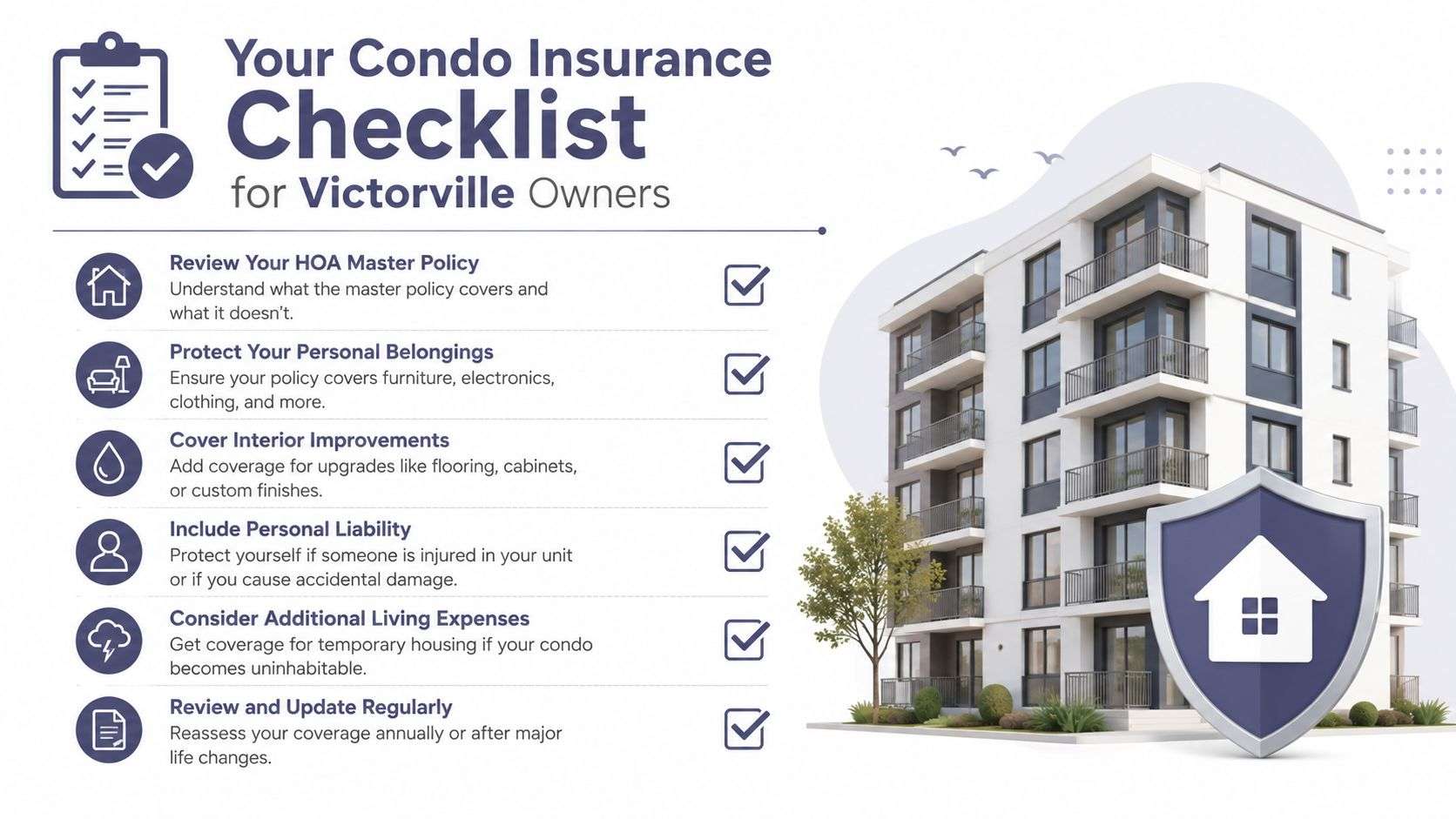
Use this checklist as a working file, not a reading exercise. If you are buying now, or if you have owned the unit for years, the right review catches the gaps that turn into expensive surprises later.
Before you buy
- Read the HOA's insurance summary. You want the insurer name, policy limit, deductible, and policy type, because those facts show what the association covers.
- Ask where the ownership boundary sits. In most cases, the key issue is what happens from the drywall inward, not the building shell.
- List your unit upgrades. Cabinets, floors, fixtures, and other improvements change the amount of interior coverage you need.
- Check how the HOA handles special assessments. A weak master policy can leave owners exposed to a loss assessment bill after a claim, especially in communities where the association runs lean.
While comparing quotes
- Match limits to the unit, not the minimum. Use the carrier rules discussed earlier as your baseline, then make sure the quote fits the unit and the HOA setup instead of stopping at a generic number.
- Check deductible language. HOA deductibles and unit-owner deductibles can create very different claim results.
- Confirm loss assessment protection. If the HOA levies a special assessment, this coverage can be the difference between a manageable bill and a nasty surprise.
- Ask about system age. Electrical, plumbing, and heating updates can matter to underwriting, and older systems can complicate a quote.
- Ask whether the quote reflects investor use if the unit is not owner-occupied. insurance for real estate investors should line up with the actual ownership structure, not a generic condo template.
After you buy
- Review the policy every year. A new appliance, remodel, or HOA change can shift the right coverage level.
- Document personal property. Photos and receipts make claims cleaner when you need to prove what you owned.
- Keep the HOA paperwork. If the association changes coverage or deductibles, your policy may need a quick update.
- Recheck the master policy after any HOA meeting that mentions repairs, claims, or reserve pressure. Those are the moments when hidden gaps usually show up.
If you do nothing else, do this one thing: compare your HO-6 policy against the HOA master policy line by line. That is where the primary risk lives.
Get a Condo Insurance Quote From ISU Insurance Services
Victorville condo owners don't need a generic online answer. They need a local conversation that starts with the HOA documents, the unit finish level, and the actual exposure around the property. ISU Insurance Services gives you that local view, plus the ability to compare multiple options instead of settling for the first quote that lands in your inbox.
That matters whether you're buying your first condo, renewing an old policy, or trying to understand a special assessment risk before the next HOA meeting. A good quote should make the master-policy boundary, the deductible structure, and the interior coverage limits easy to see. If it doesn't, keep asking until it does.
If you want help sorting out your Victorville condo coverage, talk with ISU Insurance Services. They can review your HOA documents, compare condo insurance options, and help you line up the policy with the way your unit is built and insured.